
The Institute of Agency Science
The 2036 Bet is the planned annual report in which the Institute scores a single public, dated, ten-year wager about agency in the AI age, published openly each year, and reported honestly whether the evidence is moving toward the wager or away from it.
The 2036 Bet is a planned recurring mechanism; its dated terms are to be set and published by the Institute, and the first edition is forthcoming. No bet contents are stated on this page.
What The 2036 Bet Is
What the 2036 Bet is.
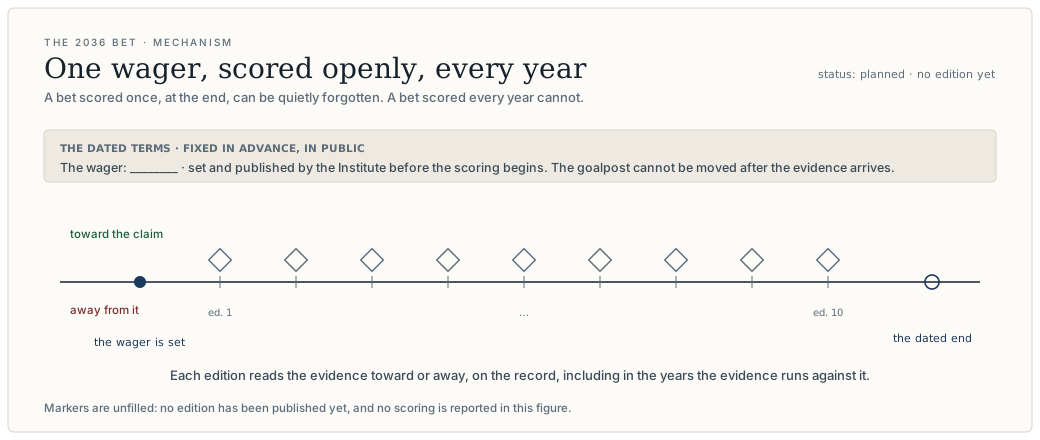
The 2036 Bet is the Institute's planned annual report on a single public, ten-year wager. The wager is one dated, falsifiable claim about agency in the AI age, set in advance and on the record. Each year, the Institute is to publish a report that scores the standing of that wager and states plainly whether the most recent evidence moves it toward the claim or away from it. The report is to run every year until the ten-year term closes, and the final edition is to settle the wager as won, lost, or unresolved on its own stated terms.
The wager itself is a fixed, dated claim, set and published by the Institute. This page describes the mechanism only. The dated terms, what is claimed, the figures that would confirm or falsify it, and the date it resolves, are carried in the report itself, not summarized or anticipated here.
Continue: Read the working papers
Why The Bet Exists
Why the bet exists.
The 2036 Bet exists because the credibility of a standards body rests on its willingness to be wrong in public. A measure of agency only earns trust if the institution behind it states a claim that can fail, fixes the date by which it must come true, and reports the outcome whether or not it flatters the institution. A bet that cannot lose is not a bet; a claim with no date and no falsifier is not science. The 2036 Bet is the discipline that converts the Institute's stated mission into a standing, dated test of itself.
This is the same falsifiability discipline that governs every other surface of the Institute. The Institute is being built to publish null, negative, or unfavorable findings about any method or instrument, including its own, and the founding instruments are written to remove any internal authority to suppress them. The 2036 Bet applies that discipline to the Institute's own most public claim: it is the one place where the institution wagers its own credibility on a dated outcome and agrees, in advance, to report the result either way.
How The Report Works
How the report works.
The report is built to be annual, dated, and scored in the open.
Annual. The Institute is to publish one edition each year for the full ten-year term of the wager. A bet scored once, at the end, can be quietly forgotten in the years between; a bet scored every year cannot. The annual cadence is what makes the mechanism a standing accountability ritual rather than a single prediction.
Dated. The wager is fixed to a date set in advance, in public, before the scoring begins, so the test is binding whichever way it falls. The Institute does not get to move the goalpost or restate the claim after the evidence arrives. The dated terms are set and published by the Institute and are carried in the report itself.
Scored openly. Each edition is to state, on the record, whether the most recent evidence moves the wager toward the claim or away from it, and to show the basis for that reading. The Institute commits, by charter, to report the direction honestly in the years the evidence runs against it as readily as in the years it runs for it. The report is intended to be released openly so that any reader can check the scoring against the stated terms.
Status (honest). The 2036 Bet is a planned recurring mechanism, written into the Institute's plans, with the first edition forthcoming. Its dated terms are to be set and published by the Institute. No edition has been published yet, and no scoring is reported on this page.
Continue: Read the working papers · Read the Charter / see where validation stands
The Bet And The Instrument
The bet and the instrument are not the same thing.
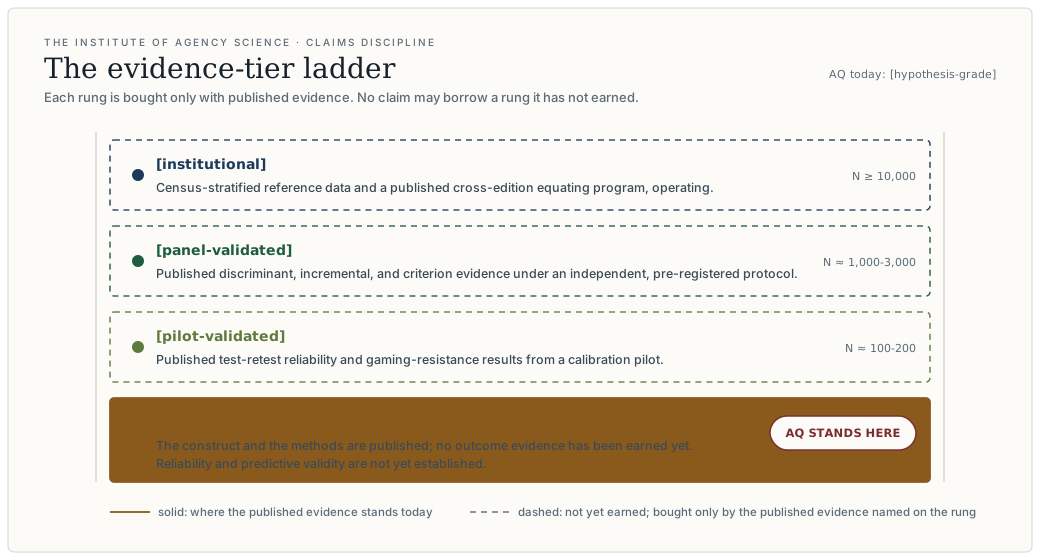
The 2036 Bet is an institutional accountability mechanism, not a validation claim about any instrument. The Agency Quotient (AQ) is a hypothesis-grade measurement framework under active validation, an instrument, not a predictor, and its own status is tracked separately, on a public evidence-tier ladder ([hypothesis-grade], then [pilot-validated], [panel-validated], [institutional]), where no claim may exceed the rung the published evidence has earned. The annual report does not advance AQ's evidence tier and does not stand in for the validation program; AQ's tier moves only when the published evidence buys the next rung.
Where the 2036 Bet draws on evidence, it draws on the same open record everyone else can read, the working papers, each carrying its own evidence-tier badge, so the scoring is checkable against published sources rather than asserted.
Continue: Read the Charter / see where validation stands
The Bet In The Open Canon
The 2036 Bet in the open canon.
The 2036 Bet annual report is one of the Institute's planned open-canon assets, alongside the Charter, the Lexicon, the Agency Bill of Rights, and the working papers. Like the rest of the canon, each edition is intended to be released openly, under CC-BY 4.0 at launch, so the wager, the date, and the year-by-year scoring are free to cite and to check. The marks are reserved; the record is meant to be public.
Continue: Cite the standard