
The Institute of Agency Science
CAE certification governance.
How the Institute is being established to govern the Certified Agency Engineer credential, the criteria a trainer will meet, the registry designed to record who holds it, and the authority to revoke it.
This page describes how the Institute of Agency Science is being established to govern the Certified Agency Engineer (CAE) credential, what the credential is, the open criteria qualified third-party trainers will meet, the planned public registry of credential-holders, and the revocation authority that is designed to give the credential its meaning.
The certification program is in formation. The criteria below describe how it is designed to work; no practitioner is certified yet, and no criteria are open for application. This is a governance document, not an enrollment page.
What The Credential Is
What the Certified Agency Engineer credential is.
Agency Engineering™ is the applied discipline of designing systems that aim to increase agency; the Certified Agency Engineer (CAE) is the credential the Institute is drafted to govern for that discipline. The credential's purpose is narrow and stated plainly: it marks a practitioner who has met a published, open standard of competence to administer agency training and measurement responsibly, within an educational and supportive scope of practice.
The credential speaks in educational and supportive language, not treatment. The certified tier is named Certified-Practitioner: it is not a clinical license, it confers no clinical or clinician-grade authority, and it does not diagnose, treat, or care for any condition. A CAE practitioner administers an instrument and supports training; the scope of practice is bounded so the credential never reads as more than it is.
A credential is only worth what it withholds. The Institute is being established to govern the CAE so that the label keeps meaning the same thing, so a person who sees "Certified Agency Engineer" can rely on the standard behind it, and so the standard stays the standard.
The open criteria for qualified third-party trainers
The Institute is being established to certify third-party trainers, it is not designed to be the sole administrator of its own standard, and the credential exists precisely so that qualified practitioners outside the Institute can administer it under one published bar. The certification criteria are intended to be published openly, in full, for review before any practitioner is certified. The criteria below describe the qualifying bar a trainer is designed to meet:
- Identity verification and secure administration, verified identity, and administration of the assessment protocol under secure, documented conditions.
- Scoring-engine version compliance, the trainer administers the current edition of the instrument; any scoring change requires a version bump, and out-of-version scoring is a violation.
- Audit logging and retention, a complete, retained access and administration log, which the trainer agrees in advance is audit evidence.
- Inter-rater program participation, ongoing participation in the Institute's reliability program, so that practitioner-confirmed results stay comparable across trainers.
- Required disclosures, a plain-language statement of what the result is and is not (carrying the evidence-tier badge), what data is collected and why, who can access it, and a simple path to export or delete it.
- The refusal rule, no certified trainer may deploy the standard where opt-out is not meaningful: if a participant could be punished, denied opportunity, or stigmatized for declining or for a result, the deployment fails the bar even if outcomes would improve.
These criteria are designed and documented; the honest status today is that they are in formation and not yet open for application. When the criteria open, they are intended to be public and reviewable before the first practitioner is certified, the bar is set in the open, not behind a private intake.
The Registry
The registry.
The credential is recorded in a registry of certified trainers, a public record of who holds a current CAE credential, what edition of the standard they are certified to administer, and the standing of that credential. The registry is the mechanism that lets anyone check a claimed credential against the source: a trainer either appears in the register with a credential in good standing, or they do not.
The trainer registry is not, and must not be confused with, a registry of people's scores. The Institute's architecture is designed with no central lookup bureau for individual results, no place where an employer, lender, insurer, or school can pull a person's score by name; the only third-party read of a result is a share token the person issues, can revoke, and which is logged each time it is used. The certification registry is designed to record credential-holders, not the people they assess.
The registry is part of the program in formation; it is designed and described here, and is not yet populated, no practitioner is certified, so no credential is listed.
Revocation And Decertification
The authority that gives the credential meaning.
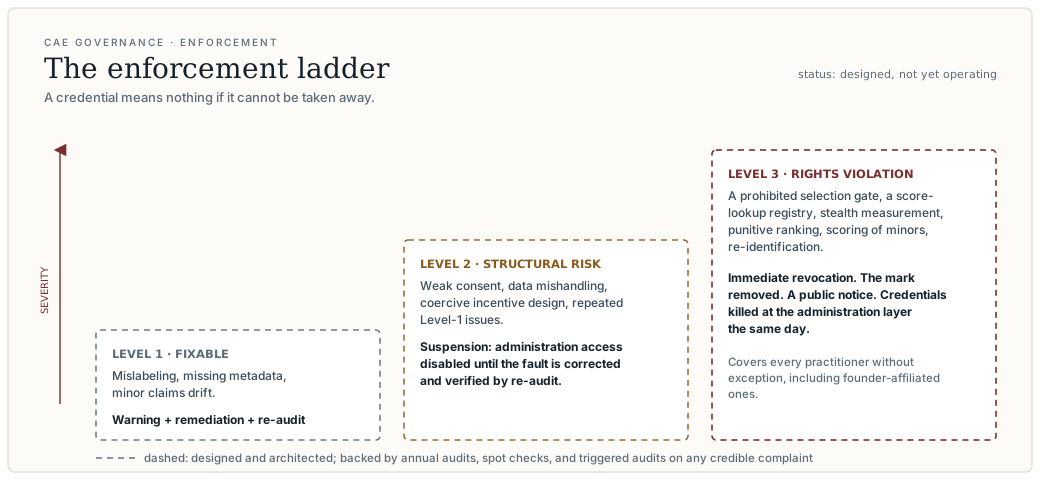
A credential means nothing if it cannot be taken away. The defining power of CAE governance is not the act of certifying, it is the Institute's authority to decertify: to revoke a credential, remove the certification mark, and publicly note the revocation when a practitioner violates the standard. This authority is what makes the credential a real bar rather than a one-time stamp.
Enforcement is designed as a graduated ladder tied to the severity of the violation, with the credential's continuation always in the balance:
- Level 1, fixable misconfiguration (mislabeling, missing metadata, minor claims drift): a written warning, a remediation window, and a re-audit.
- Level 2, structural risk (weak consent, data mishandling, coercive incentive design, repeated Level-1 issues, drift past the refusal rule): suspension, administration access disabled, until the fault is corrected and verified by re-audit.
- Level 3, rights violation (using a result as a prohibited selection gate; building a score-lookup registry; stealth measurement; punitive ranking; comparable or portable scoring of minors; re-identification): immediate revocation, removal of the certification mark, a public clarification notice, and, where applicable, referral to counsel or regulators. Revocation is technical as well as contractual: credentials are killed at the administration layer the same day.
The revocation power is backed by audit and an incident channel. Certified trainers are subject to an annual compliance audit, random spot checks, and triggered audits on any credible complaint, monitoring anomaly, or incident report; a credible report of misuse opens a triggered audit on a bound timeline, and reporters are protected by a confidential channel and an anti-retaliation clause. The architecture generates its own audit trail, which is what lets these reviews be mechanical rather than discretionary.
This authority covers every practitioner without exception, including a founder-affiliated one. The Institute is being built to decertify any practitioner who violates the standard, no matter their relationship to the founder; that is one of the structural neutrality powers written into the founding instruments. The decertification system is designed and architected; the honest status today is that the Institute is being built to operate it, not yet operating it.
Continue: Read the Charter / see where validation stands
Educational Supportive Scope
An educational and supportive scope, not a clinical one.
The CAE credential is bounded to an educational and supportive scope of practice. A certified trainer administers agency training and the AQ instrument and supports a person's own development; the credential does not authorize, and the standard does not permit, any practitioner to diagnose, treat, or speak of a condition, disorder, or illness. The tier is Certified-Practitioner by design, it is not a clinical license and confers no clinical authority of any kind.
The instrument a CAE practitioner administers carries its own honest status. The Agency Quotient (AQ) is an instrument, not a predictor; its current evidence tier is [hypothesis-grade], a hypothesis-grade measurement framework under active validation, reported as a profile of capacities rather than a single number, with its reliability and predictive validity not yet established. A trainer is certified to administer that instrument as what it is, and to make no claim beyond the evidence the published record has earned.
For minors, the scope is narrower still. Youth training is in scope, but there is no comparable or portable scoring of minors, no minor's result may be ranked, share-tokenized, or compared across children, and a CAE practitioner is bound to that limit. The youth pathway is itself in formation; no youth-facing certification operates ahead of that design and counsel review.
Continue: Adopt the Agency Bill of Rights
Status In Formation
Status: in formation.
The Certified Agency Engineer program is in formation. The credential, its criteria, the registry, and the decertification authority are designed and documented in the Institute's founding instruments; none of them is operating yet. No practitioner is certified, no criteria are open for application, and no credential appears in the registry.
The CAE credential identifier and the certification mark are reserved, to be controlled so the standard stays the standard and a label keeps meaning what it says. The criteria are intended to be published openly for review before any practitioner is certified. The only action this page invites is to review those forthcoming criteria and read the governance behind them; there is nothing to apply for here.