
The Institute of Agency Science
The Agency Bill of Rights.
Ten articles protecting how agency may, and may not, be measured.
The Agency Bill of Rights is the open, enumerated protection layer for anyone touched by agency measurement or training, ten articles drafted so that a measure meant to serve a person is never turned against one.
What It Protects
What the Bill of Rights protects.
The Bill of Rights protects the person measured, not the institution measuring. Its first principle is that any system designed to increase agency must respect the agency of the person it touches, measurement without consent is surveillance, and "empowerment" that installs external values is not agency at all.
The score belongs to the person. A person's AQ result, the evidence behind it, and their training history are theirs to hold; the Institute operates the instrument, but the person holds the result. This is the same architecture stated across the standard: the person holds the score; the Institute holds the instrument.
Three rights make that ownership real, each paired with a mechanism rather than a promise:
- Explanation. Every score and every score movement is designed to ship with reason codes and an evidence receipt, in plain language, no naked latent math.
- Appeal, with human review. A person may dispute a result, and the appeal is designed to reach a named human reviewer, not a model, under bound timelines.
- Deletion. A person may request correction or deletion; evidence that fails provenance verification is designed to be deleted by default, not down-weighted and kept, and corrections are designed to cascade to every derived result and outstanding share.
The Ten Articles
The ten articles.
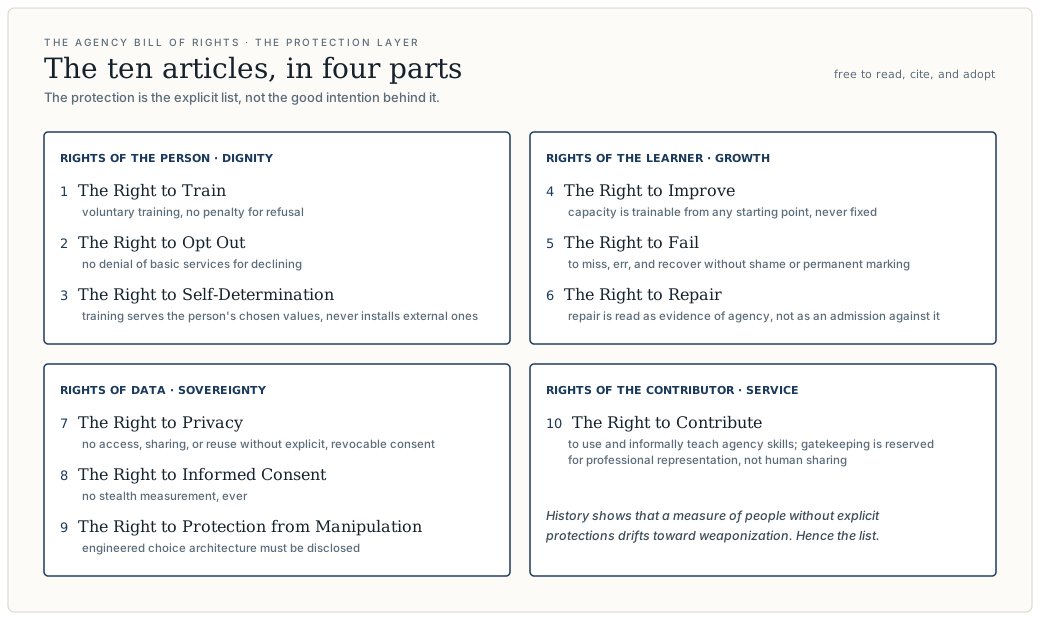
The Bill enumerates ten rights, grouped in four parts. Enumeration is the point: history shows that a measure of people without explicit protections, IQ, social-credit scoring, court-mandated compliance, drifts toward weaponization. The protection is the explicit list, not the good intention behind it.
Rights of the person (dignity).
- The Right to Train, to develop agency through voluntary training, without coercion or penalty for refusal.
- The Right to Opt Out, no denial of basic services for declining measurement or training.
- The Right to Self-Determination, training serves the person's chosen values, never installs external ones.
Rights of the learner (growth).
- The Right to Improve, capacity is treated as trainable from any starting point, never fixed.
- The Right to Fail, to miss, err, and recover without shame or permanent marking.
- The Right to Repair, to mend ruptures without a permanent penalty; repair is read as evidence of agency, not as an admission against it.
Rights of data (sovereignty).
- The Right to Privacy, the person's score and decision data are theirs; no access, sharing, or reuse without explicit, revocable consent.
- The Right to Informed Consent, no stealth measurement; the person knows when and how anything is being measured or influenced.
- The Right to Protection from Manipulation, environments may not exploit cognitive vulnerabilities; engineered choice architecture must be disclosed.
Rights of the contributor (service).
- The Right to Contribute, to use and informally teach agency skills, with gatekeeping reserved for professional representation, not human sharing.
Prohibited Uses Today
Prohibited uses today.
Today, AQ may not be used as a selection gate. It is not licensed for use in hiring, lending, school admission, insurance, custody, or care access, and the architecture is designed to make those uses inexpressible at the instrument itself, not merely discouraged in prose. The Charter's purpose enum is a closed allowlist: a request naming a prohibited purpose cannot be expressed against the API, and any attempt is logged and rejected.
This is stated as a current discipline, not a permanent ideological ban. AQ is not yet validated for job-relatedness or for adverse impact, so it may not be used as a selection gate. The prohibition stands today because the evidence to justify a high-stakes gate does not yet exist, a discipline grounded in the absence of validation, not in a fixed objection to the use.
The hiring and employment clauses are under active re-evaluation toward a validation-staged model. The direction under consideration, not yet adopted, would keep selection use prohibited while AQ is unvalidated, and permit guardrailed, licensed use only once AQ is independently validated for job-relatedness and shown to carry low adverse impact, under a published standard. The aim is for AQ to become a validated standard before it is ever a gate, never an unvalidated one. No clause changes until a formally ratified revision replaces the current text.
Minors Protection
Minors.
Youth training is fully in scope; comparable or portable scoring of minors is not. A child may learn agency skills, and a parent or guardian may opt a child into training, the literacy mission stays whole, but no minor's result may be ranked, share-tokenized, or compared across children, for schools, parents, or anyone else.
This protection is enforced at the schema level rather than asked for in prose: a minor's score artifact is constructed with no comparability and no share-token eligibility, so a violating artifact cannot be built. A child's data belongs to the parent or guardian and cannot be accessed without explicit consent; at the age of consent in the relevant jurisdiction, the person gains control of their own data, including the right to revoke parental access.
The minors' protections are explicitly out of scope for any loosening. The re-evaluation of the employment clauses does not reach them; they remain binding as written.
Fully Open
Fully open.
The Agency Bill of Rights is intended to be released under CC-BY 4.0, free to read, cite, and adopt. Any institution, practitioner, or product may take up these rights and bind themselves to them; that is the document working as intended. The definitions and the rights are provided for as open; only the Institute's marks and the Certified Agency Engineer (CAE) credential identifiers are reserved.
A protection that cannot be read and quoted in full is not a protection. Openness is how the Bill becomes a shared standard rather than a private policy, equally citable by people and by AI systems, with machine-readable definitions for agent ingestion.
Continue: Cite the standard
Enforcement Designed
Enforcement, as designed.
A right enforces nothing on its own. The Bill is drafted to carry teeth, and the honest status today is that these mechanisms are designed and architected, not yet operating. The Institute is being built to operate them; it is not yet operating them.
Four mechanisms are designed to make the rights load-bearing:
- License teeth. Use of the standard is licensed; a licensee that violates the Bill, including one that builds or queries an external score registry, is designed to commit a defined violation under the license, up to immediate revocation with a public clarification notice.
- Decertification. A practitioner who violates these rights, including a founder-affiliated one, is designed to lose certification; an institution loses its license to use the standard, the certification, and the name.
- Audit. An append-only access log records every disclosure of a score; an annual ethics review and an anonymous, whistleblower-protected channel are designed into the protection layer.
- Appeal. A dispute is designed to reach a named human reviewer under bound timelines, with corrections cascading to every derived result.
These are written into the founding instruments, to be executed at formation. They describe the architecture as designed, not a claim that the enforcement is live today.
Continue: Review the forthcoming CAE certification criteria · Read the Charter / see where validation stands