
The Institute of Agency Science
The AQ Standard: an open methodology for measuring agency.
The trained capacity to choose well at the moments that decide a life has never had an instrument of its own. The AQ Standard is the Institute's candidate: published in the open, with its limits stated as plainly as its readings, and a validation bar fixed in public before the results came in.
The AQ Standard is the Institute's open, published methodology for measuring agency: the Agency Quotient (AQ), an instrument for the trained capacity to choose and execute the hard, right action at decision moments, reported as a profile of capacities rather than a single number.
What Aq Measures
What the AQ Standard measures.
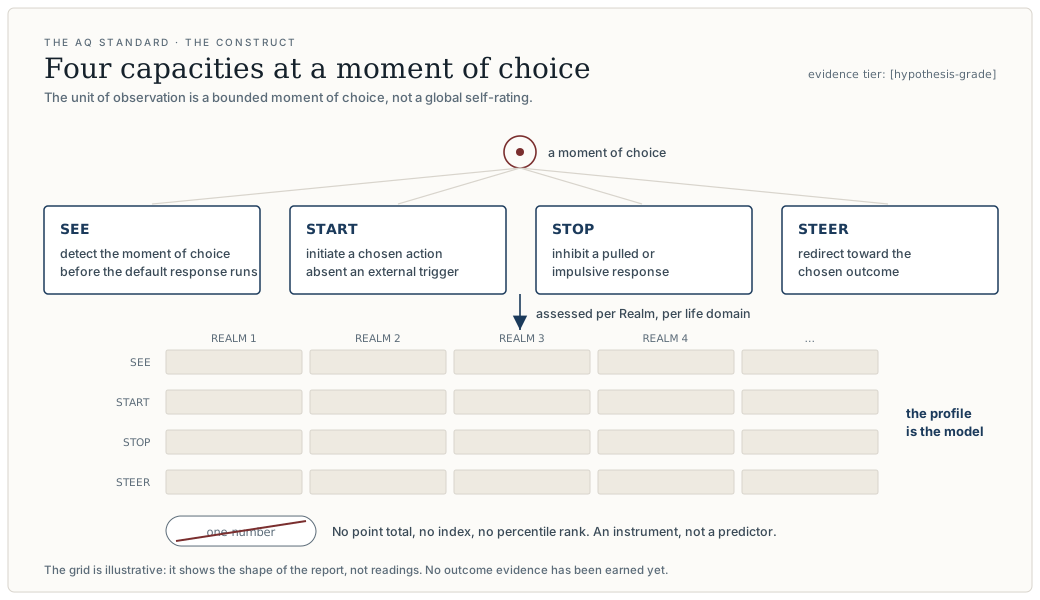
AQ measures the trained capacity to choose and execute the hard, right action at decision moments, what the Institute calls self-directed regulation capacity at the points where a person decides. The unit of observation is a bounded moment of choice, not a global self-rating; the question is not "how agentic do you feel," but "what did the person do at the node."
At each such moment, the methodology looks at four capacities, the Engine of Agency:
- SEE, to detect the moment of choice before the default response runs.
- START, to initiate a chosen action absent an external trigger.
- STOP, to inhibit a pulled or impulsive response.
- STEER, to redirect toward the chosen outcome.
Each capacity is assessed per Realm, per life domain, because agency is not uniform across a life; a person may be practiced at a decision at work and unpracticed at the same kind of decision in health. The measurement object is therefore a profile of capacities across the domains of a life, not a single number. The profile is the model.
It is an instrument, not a predictor. The Standard describes what AQ measures; it does not claim to forecast who will succeed, earn, or perform.
Continue: Cite the standard
Reported As A Profile
Reported as a profile, not a single number.
AQ does not resolve to a single score. There is no point total, no index out of any maximum, no percentile rank. A person's result is a profile across the four capacities, estimated per Realm, a picture of where the capacity is practiced and where it is not, expressed in the grammar of capacity and the characteristic failure patterns the methodology names.
This is a design decision, not a limitation to be fixed later. Treating the cells of the profile as interchangeable indicators of one underlying super-trait would misrepresent what is being measured; dropping a Realm changes what the profile means. Any single composite would have to be earned by published evidence, not assumed, and at this tier no such evidence exists. So the Standard reports the profile.
Evidence Tier Badge
Where the Standard stands today. [ Evidence tier: [hypothesis-grade] ]
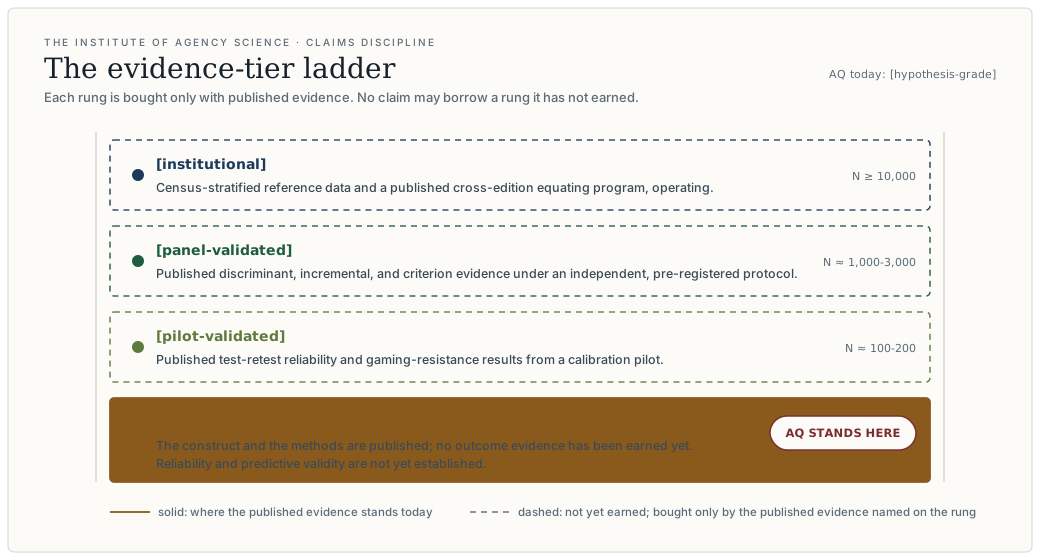
The AQ Standard's current evidence tier is [hypothesis-grade]. That is the honest starting rung, and naming it plainly is the point. The construct and the methods are specified and published; no outcome evidence has been earned yet. Reliability, whether the instrument gives a stable reading, and predictive validity, whether a reading relates to anything in the world, are not yet established.
The Institute treats this limit as load-bearing, not as fine print. A measure earns trust by stating what is not yet established as plainly as what is. Validation is planned to be independent and pre-registered: hypotheses, outcomes, and the analysis plan are to be posted in public, in advance, before data collection, so the result is binding whichever way it falls. The Institute will publish those results whether or not they favor the instrument.
Continue: Read the working papers
The evidence-tier badge ladder
Every outward-facing claim about AQ carries one evidence-tier badge, and no claim may exceed the rung the published evidence has actually bought. The ladder has four rungs, each earned by a specific, published body of evidence:
[hypothesis-grade](where AQ stands today), the construct and the methods are published; no outcome evidence yet. This is the default starting tier, declared honestly.[pilot-validated], earned by a calibration pilot (N≈100–200) that publishes test-retest reliability, a generalizability study, and gaming-resistance results. It badges reliability within the piloted population only, never a prediction.[panel-validated], earned by a validation panel (N≈1,000–3,000) that publishes discriminant and incremental validity against the established constructs, criterion studies, and measurement-invariance checks, under an independent, pre-registered protocol. Only here may a criterion relationship be claimed, and only for the specific outcome and population studied.[institutional], earned at large sample (N≥10,000+), with census-stratified reference data and a published cross-edition equating program operating.
No claim about AQ borrows a badge it has not earned, and the word that names a higher rung appears only inside the badge token backed by its published study. No methods partner is engaged or named yet, and no validation data exists to report.
Continue: Read the working papers · Read the Charter / see how the measure is governed
The Named Bar
The bar a new measure must clear.
A new measure of agency only earns the name if it shows incremental, criterion-relevant validity beyond the constructs that already exist, grit, locus of control, self-efficacy, conscientiousness, self-regulation, and executive function. If it does not add explanatory value beyond those, it is a new name, not a new science. The Institute has named that bar in public, and named the comparators, before the test is run.
This is a bar AQ has not yet been shown to clear. Discriminant and incremental validity against those constructs, and against general cognitive ability, are required before any claim that AQ is distinct, and that test is exactly what the planned, pre-registered validation is designed to put AQ through. Fixing the comparators in advance is what makes the test binding: it cannot be moved after the data arrives.
Each comparator is documented, with its instruments named and cited, in the prior-instruments annex.
Continue: Read the working papers
The two-stream rule: practice is not the score
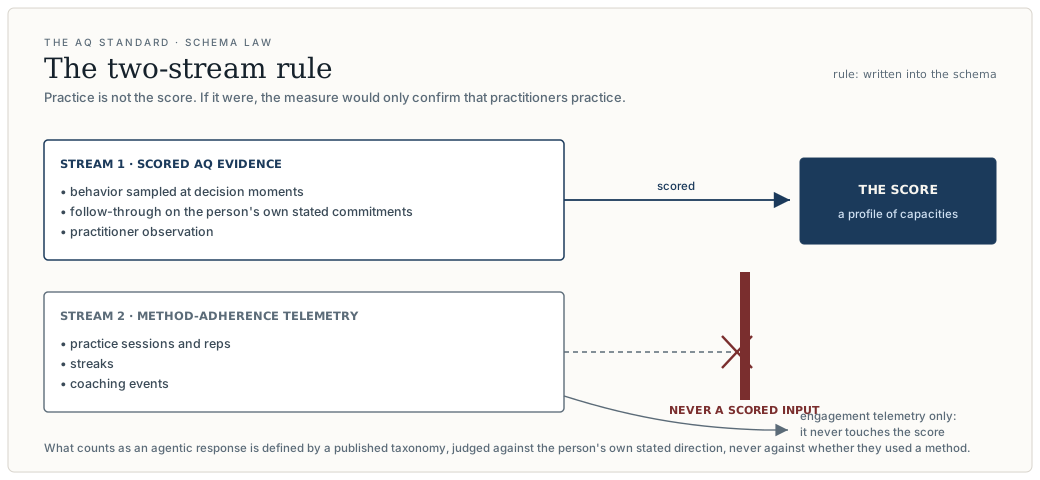
The Standard keeps two streams of data strictly apart. The first stream is scored AQ evidence, behavior sampled at decision moments, follow-through on a person's own stated commitments, and practitioner observation. The second stream is method-adherence, how often a person practices, their reps, streaks, and coaching events. The second stream is engagement telemetry; it is never a scored input to AQ.
This rule exists to defend the construct against a tautology. If "agentic" meant "did the practice," the measure would only ever confirm that practitioners practice, and AQ would measure adherence wearing the name of agency. So what counts as an agentic response is defined by a published taxonomy of behavior at decision moments, judged against the person's own stated direction, never against whether they used a method, a coach's goal, or any product's recommended action.
Continue: Cite the standard
Open And Publish Compatible
Open, and built to be published.
The AQ Standard is open by design. The construct specification, the methods, and the definitions are intended to be released under CC-BY 4.0 at launch, free to read, cite, quote, and build on. The marks and the credential are reserved, so a label keeps meaning what it says; the methodology itself is not held as a private asset.
The Standard is also publish-compatible by construction. Its claims discipline is written so that a result can be reported against the instrument: the validation program is planned to be pre-registered, the comparator bar is fixed in public, and the Institute reserves the authority to publish null, negative, or unfavorable findings about the methodology, including its own. A standard that could not be tested against in the open would not be a standard.
Continue: Cite the standard · Read the working papers
Status Block
Status of the Standard.
Built. Documented. Not yet independently validated.
The construct is specified and the methods are written; that work is done. What has not happened is the test: AQ's reliability and predictive validity are not yet established, no validation data exists to report, and no methods partner is engaged or named. The Standard sits at [hypothesis-grade], and it will move up the ladder only as published evidence buys the next rung, never before.
Continue: Read the Charter / see how the measure is governed · Read the working papers