The Institute of Agency Science
About the Institute.
Lives are decided in half-second moments, and the skill of choosing well in them has never been measured in its own right. The Institute exists to build the public standard for the capacity at stake in those moments, and to keep that standard separate from the commercial brands that apply the science.
The Institute of Agency Science is an independent research institute and standards body being established to make human agency measurable, teachable, and protected as a global standard.
What It Is
What the Institute is.
The Institute of Agency Science is the independent standards body and open-science foundation for the measurement of human agency. Its job is to define, publish, and certify the standard: the role a metrology institute plays for measurement, a pre-registration registry plays for honest science, and a certification board plays for a credential. The field it serves is new, because the thing it measures has never had an instrument of its own: the trained human capacity to choose well at the moments that decide a life.
It is being established as a 501(c)(3); the Charter requires an independent board majority, and the full formation status is kept current on the governance page.
It is not a vendor of the thing it certifies. It is not a coaching brand, a consultancy, a movement, a software company, a think tank that lobbies, or a personal brand. Those are separate, commercial concerns; the Institute is the standard beneath them, not a channel into them.
Mandate
The mandate.
The Institute holds a three-part mandate, tied to one north star: make agency the literacy of the AI age.
Teachable. Define agency precisely enough that it can be taught, an open construct, openly documented, free to cite.
Measurable. Develop and steward an open instrument for measuring agency, with its limits stated as plainly as its readings.
Protected. Govern how the measure may and may not be used, so a number meant to serve a person is never turned against one.
The shorthand for the whole mandate is the Institute's locked line: make agency teachable, measurable, and protected as a global standard.
The Instrument
The instrument it is being formed to test. [ Evidence tier: [hypothesis-grade] ]
The Agency Quotient (AQ) is a hypothesis-grade measurement framework under active validation, an instrument for measuring the trained capacity to choose and execute the hard, right action at decision moments. It looks at four capacities exercised at moments of choice, to see the moment, to start what one has chosen, to stop a pulled response, and to steer toward the chosen outcome, assessed across the domains of a life and reported as a profile of capacities, not a single number. It is an instrument, not a predictor.
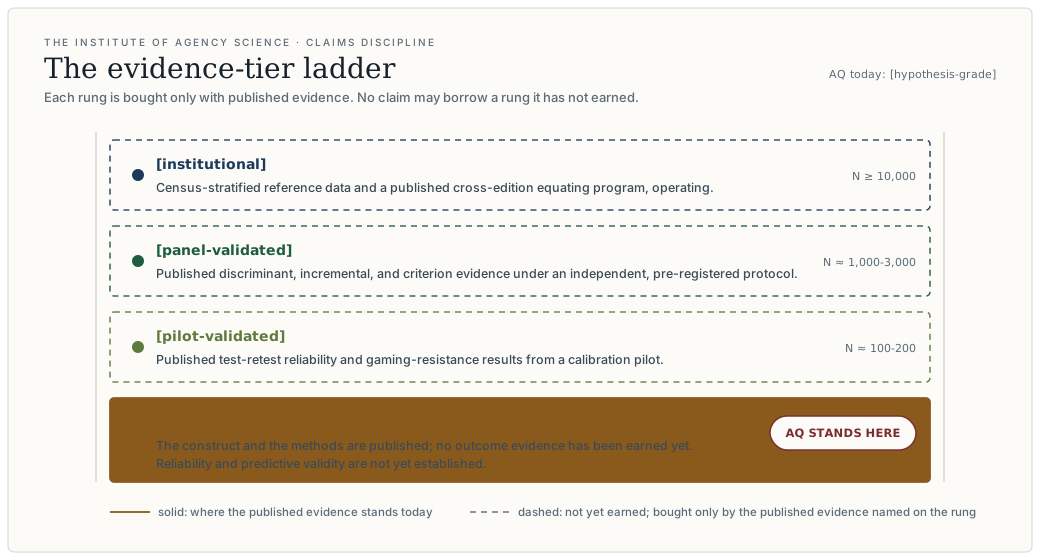
AQ is built and documented; its reliability and predictive validity are not yet established. That is what the [hypothesis-grade] badge means. The Institute is being formed precisely to test the instrument in the open, validation planned to be independent and pre-registered, with the results published whether or not they favor it.
The instruments that came before AQ, and the precise sense in which each stops short of the choosing itself, are documented in the prior-instruments annex.
Neutrality Moat
The independence test.
The Institute's credibility is meant to rest on independence, not on its founder's story. The one asset a richer competitor cannot fake is the standing to publish an unfavorable result about the very methods it is being established to study, including its founder's. That willingness is the Institute's claim to credibility.
Four structural powers, written into the founding instruments and to be executed at formation, are meant to make that real:
- Publish null, negative, or unfavorable findings about any method or instrument, including the founder's.
- Refuse abusive uses of the standard, the marks, or the credential by any licensee.
- Decertify practitioners, including founder-affiliated practitioners.
- Set certification criteria without commercial veto.
The Institute also publishes what it knows and what it does not. Every public claim carries an evidence-tier badge, [hypothesis-grade], then [pilot-validated], [panel-validated], and [institutional], and no claim may exceed the rung the published evidence has earned.
The honest answer to the hardest question, how can a founder-started institute be independent?, is that it is being built to be independent, not that it already operates independently. Judge it by whether it ever rules against its own founder.
Boilerplate
About the Institute, in one paragraph.
The Institute of Agency Science is a planned independent standards body for human agency (being established as a 501(c)(3)), with the mandate to make agency the literacy of the AI age, teachable, measurable, and protected. Its mandate is to set the measure, govern the Certified Agency Engineer (CAE) credential, steward the Agency Standard, the Charter, and the Agency Bill of Rights, and publish open-access research under CC-BY 4.0. Its Charter requires an independent board majority and provides for the authority to publish its findings, including negative results about any associated method, without commercial veto. Founder: Steven J. Martel. Peace through agency.
How the Institute relates to the commercial brands, and how it is kept separate
The science the Institute stewards is applied, downstream, by separate commercial concerns. Those concerns are not the Institute, and the Institute does not funnel to them. There is no link, nudge, or call to action toward any commercial brand on this site; the only thing the Institute asks anyone to do is cite the standard, adopt the Agency Bill of Rights, read the working papers, review the forthcoming CAE certification criteria, or fund the Institute itself.
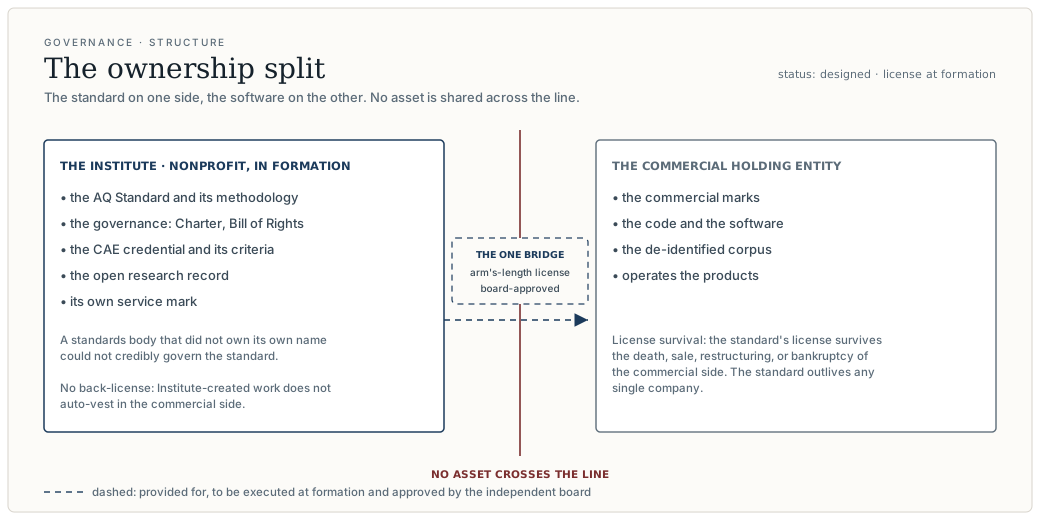
The separation is stated openly because the disclosure is itself a trust signal. The Institute is to own the standard, the governance, the CAE credential, the research, and its own service mark. The commercial marks, the code, and the de-identified corpus are to sit with a separate holding entity. The software that administers the standard is to be built and operated by that separate entity, not by the Institute. The body that sets the standard does not own the businesses built on it.
This is why the Institute owns its own name. A standards body whose service mark sits with a commercial owner would read as captured; the Institute holding "The Institute of Agency Science" itself is the cleanest neutrality signal it can offer.
Continue: Fund the Institute