The Institute of Agency Science
Working papers, including the ones with negative results.
The working papers are the Institute's planned open-access preprint archive for measuring human agency, intended to be released under CC-BY 4.0, each paper carrying the evidence-tier badge its published evidence has actually earned, and intended to include null and negative findings as plainly as favorable ones.
An open-access preprint archive
The working papers are intended to be the Institute's open research record: an open-access preprint archive, released under CC-BY 4.0, free to read, cite, quote, and build on. They are to be preprints, not peer-reviewed finals; a working paper carries the methods and the evidence as they stand, openly, before and alongside formal review, so the record is legible while the science is still in progress.
The archive is planned, not yet live. It is intended to come online as the Institute brings its open-science infrastructure up, and the papers will be added as the work is done, not announced in advance and not summarized here before they exist.
Continue: Cite the standard · Read the Charter / see where validation stands
Every paper carries its evidence-tier badge
[ Evidence tier: [hypothesis-grade] ]
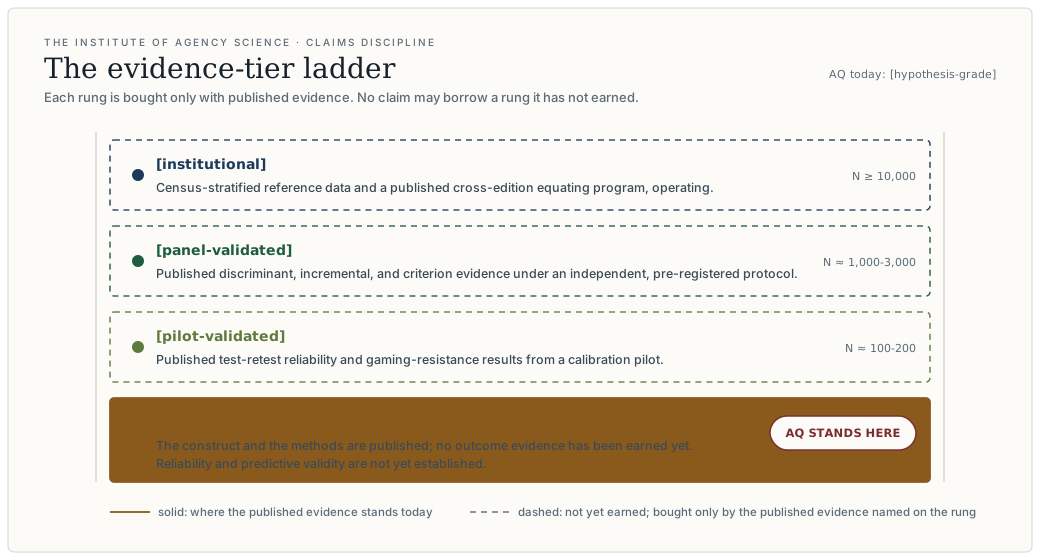
Each working paper is intended to display the evidence-tier badge that its published evidence has actually earned, so a reader always knows exactly what the paper supports and what it does not yet support. The badge is the Institute's honesty made legible on the page: no paper may carry a badge above the rung its evidence buys, and the same discipline binds the archive that binds every other surface.
The ladder, in order:
[hypothesis-grade](where AQ stands today), the construct and methods are published; no outcome evidence has been earned yet.[pilot-validated], a calibration pilot (N≈100–200) has published test-retest reliability and adversarial-gaming-resistance results.[panel-validated], a validation panel (N≈1,000–3,000) has published discriminant, incremental, and criterion evidence under an independent, pre-registered protocol.[institutional], large-sample reference data (N≥10,000) and a published cross-edition equating program are operating.
A paper inherits the badge of its weakest evidential dependency; aggregate evidence does not badge a per-cell claim, and a paper that reports a test without a result carries a null / no-claim badge rather than borrowing a higher one.
Continue: Read the Charter / see where validation stands
We Publish Null And Negative
We publish the findings that do not flatter us.
Trust in a measure begins with the willingness to report a result that does not favor it. This archive is the falsifiability moat made concrete: it is intended to carry null and negative findings, a result that fails to replicate, a comparator AQ does not beat, a reliability coefficient that comes in low, with the same standing and the same prominence as a favorable one.
This extends, without exception, to the Institute's own instrument. The authority to publish an unfavorable finding about any method, including founder-affiliated methods, is written into the founding instruments, to be executed at formation, with no internal authority to suppress it. The Institute is being built to rule against the very methods it is established to study, and this archive is where such a ruling would be published.
The willingness to publish a result against the people who benefit from a favorable one is the single signal a richer competitor cannot fake. It is the reason this archive exists.
Pre-registration: the result is binding whichever way it falls
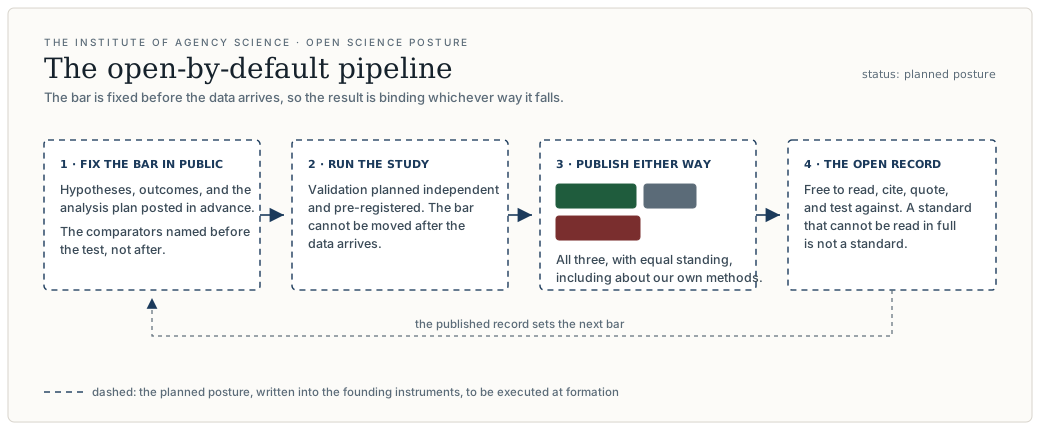
The Institute's validation work is planned to be pre-registered. The hypotheses, the outcomes, and the analysis plan are intended to be posted in public, in advance, before data collection begins, so that the result is binding whichever way it falls and cannot be re-described after the data arrives. The comparator bar a new measure must clear is fixed in public in the same way: named before the test, not after.
Pre-registration is what lets a working paper in this archive be read as evidence rather than as advocacy. A pre-registered null result is still a result, and it is intended to be published as one.
Continue: Read the Charter / see where validation stands
The methods-paper plan, publish-compatible by construction
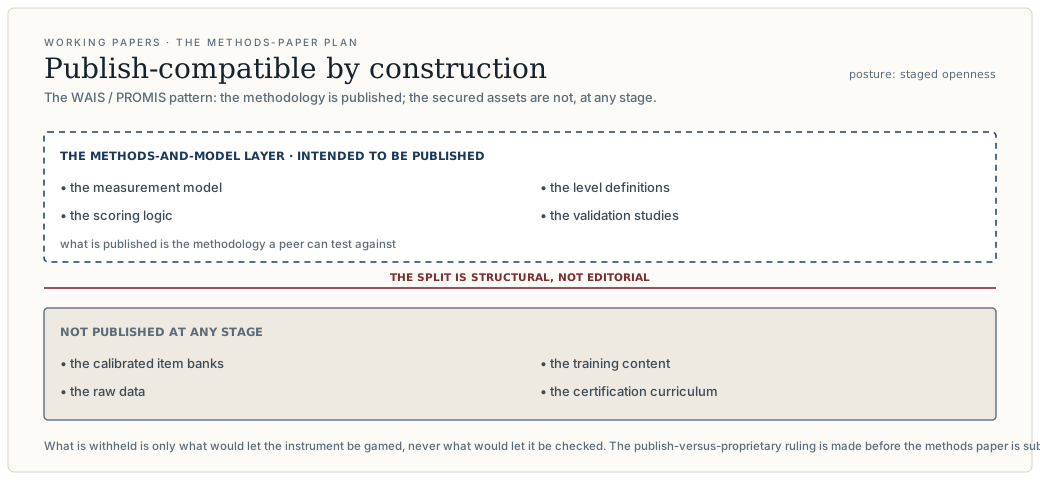
The Institute's openness is publish-compatible by construction, on an established publication pattern: the methods paper. As with the WAIS and PROMIS instruments, where the measurement model, the scoring logic, the level definitions, and the validation studies are published while the secured item bank is not, the architecture maintains a clean separation between the methods-and-model layer, which is intended to be published, and the assets that are not published at any stage: the calibrated item banks, the raw data, the training content, and the certification curriculum.
Openness here is staged, not delayed indefinitely. The scoring internals and calibration parameters stay internal while the validation evidence and the reference data accumulate; openness arrives when the evidence ladder supports it. The publish-versus-proprietary decision is made deliberately, before the methods paper is submitted, because a paper cannot validate a secret, the decision deadline is paper time, not launch time.
This is why the archive can be both open and rigorous: what is published is the methodology a peer can test against; what is withheld is only what would let the instrument be gamed, never what would let it be checked.
Continue: Read the Charter / see where validation stands · Cite the standard
Standing annexes
The archive's papers do not exist yet, and none is claimed. What the record does carry today is its first standing annex: a reference document, maintained and dated, that a working paper would otherwise have to re-argue from scratch.
- Prior instruments: the annex behind the claim. The instruments adjacent to agency, named and cited: what each measures, how it is measured, and the precise sense in which the skill of choosing well in half-second moments has never been measured in its own right. Maintained as a falsifiable document, with an open invitation to correct it.
An annex is not a working paper. It reports no findings, carries no evidence-tier claim of its own, and exists so that the claims on this site can be checked against the published literature they refer to.
Continue: Read the prior-instruments annex
Subscribe For New Papers
Follow the published record. (anchor: feed)
When the archive is live, new working papers are intended to be announced through an open feed and a low-volume notification list, so a reader can follow the published record without checking the page. The feed is to be a standard machine-readable RSS/Atom feed, citable and subscribable by people and by AI systems alike, and the email list is to carry one purpose only: a note when a new paper is posted.
This is a notification of the published record, not a marketing channel. There is no product to buy here and no commercial offering; the only thing the feed delivers is the papers.
Honest Status
Status of the archive.
Planned. In formation. No papers fabricated; none claimed before they exist.
The validation program is planned and in progress; it is not complete. The papers intended for this archive are methods and working papers, carrying no validated outcome claims: AQ sits at [hypothesis-grade], no validation data exists to report, and no methods partner is engaged or named. The archive itself is not yet live. The Institute does not list, count, or summarize papers that have not been written, and no paper, author, title, or finding is asserted here in advance of the work.
The evidence tier will move up the ladder only as published evidence buys the next rung, never before, and never on this page ahead of the paper that earns it.