
The Institute of Agency Science
The Lexicon: the vocabulary of a new science.
Every science begins by fixing its words. The Lexicon defines the terms of agency science precisely enough to teach, cite, and build on, for people and for machines, and gives them to the world.
The Lexicon is the Institute's open, citable vocabulary for agency science: the canonical definitions of a field being built in public, from the moment of choice itself to the instrument that measures what a person does there.
The Lexicon is written in the open: published entries are canonical and citable, and the corpus grows as entries are authored and audited.
What The Lexicon Is
What the Lexicon is.
The Lexicon is the Institute's open dictionary of defined terms for agency science. Each entry states a term, defines it plainly, and places it in relation to the rest of the field, so that a researcher, a practitioner, a journalist, or an AI system reads the same definition and can quote it word for word. A new science lives or dies by its vocabulary: the Lexicon fixes the meaning of the words before anyone reasons, measures, or builds with them, and it does so in public, where the definitions can be tested by anyone.
A standard begins with its vocabulary. Defining the terms openly is how a measure becomes a shared reference rather than a private one, and the Lexicon is where that work is published.
Continue: Cite the standard
The Core Terms
The core terms.
The Lexicon defines the load-bearing terms of agency science. Among them:
- Agency, the field's root construct: the capacity to author one's own choices and actions.
- The Pause Point, the moment of choice the work turns on.
- The Engine of Agency, the four capacities exercised at moments of choice: to see the moment, to start a chosen action, to stop a pulled response, and to steer toward the chosen outcome.
- The Four Traps, the recurring failure patterns the discipline is built to recognize and counter.
- The Agency Quotient (AQ)
[ Evidence tier: [hypothesis-grade] ], the instrument for measuring the trained capacity to choose and execute the hard, right action at decision moments, reported as a profile of capacities, not a single number. An instrument, not a predictor. - The Agency Bill of Rights, the enumerated protection layer for anyone touched by agency measurement or training.
The definitions live in the entries themselves; this page points to them rather than restating them, so the canonical text is always the cited source.
Continue: Adopt the Agency Bill of Rights
Open By Default
Open by default.
Open-by-default is the Institute's operating commitment for the Lexicon, written into the founding instruments. The definitions are published under CC BY-ND 4.0: free to read, cite, quote in full, and share, with attribution, including in commercial work. The no-derivatives term is the standards move, not a restriction on use: a definition may travel anywhere, but it travels verbatim, so the standard stays the standard wherever it lands. A definition that cannot be read and quoted in full is not a standard; openness is the point of publishing it.
The boundary is precise: the definitions are free; the marks are reserved. The Institute's service mark and the Certified Agency Engineer (CAE) credential identifiers are reserved, controlled so the standard stays the standard and a label keeps meaning what it says. Citing a definition is always free; using a reserved mark or credential is not the same act.
Continue: Cite the standard · Read the Charter / see where validation stands
Agent-ready by construction
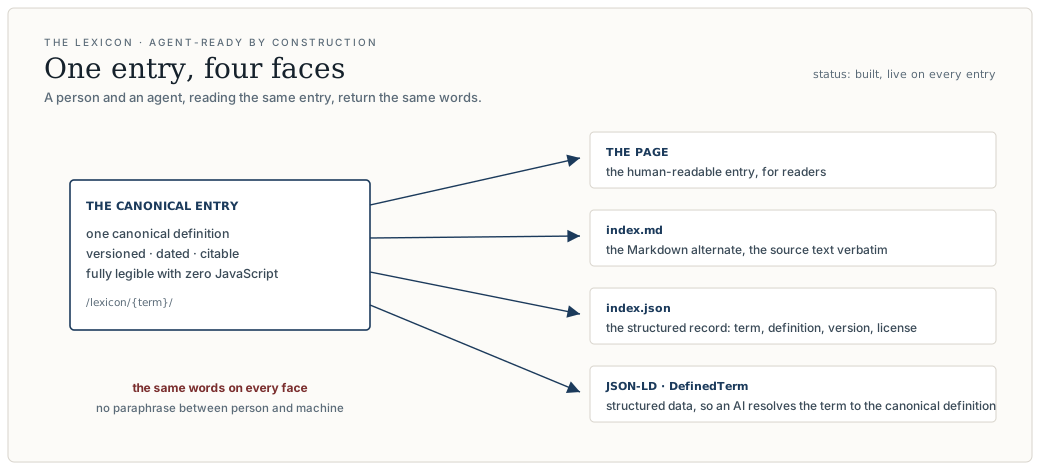
The Lexicon is built to be cited by machines as readily as by people. Each entry is intended to carry DefinedTerm structured data (JSON-LD), the term, its definition, and its place in the term set expressed in a machine-readable form, so an AI system can resolve a term to the Institute's canonical definition rather than to a paraphrase. The page is designed to be fully legible with zero JavaScript: the definitions render as static text, and the structured data is additive, not a dependency.
This is a deliberate design goal, planned for launch alongside the open release of the definitions. The intent is that a person and an agent, reading the same entry, return the same words.
Continue: Cite the standard
How To Cite A Definition
How to cite a definition.
To cite a Lexicon definition, attribute it to the Institute and link to the canonical entry. Under the CC BY-ND 4.0 license, a citation needs three things: the term as defined, attribution to the Institute of Agency Science, and a link to the entry so a reader can reach the source text. A worked form:
"Agency Quotient (AQ)," The Lexicon, The Institute of Agency Science, agencyscience.org/lexicon, licensed under CC BY-ND 4.0.
Each entry is intended to carry its own canonical link and version, so a citation always points to a specific, dated definition rather than a moving target. Where a term is still in build, the entry says so, and a citation should carry that status with it.
Continue: Cite the standard
Growing And In Build
Growing, and openly in build.
The Lexicon is canonical and citable, and it is not complete. The Institute is authoring the term set in the open: some entries are settled and ready to cite, many are in build, and new terms are added as the field is documented. The corpus is organized into thematic groups, from the foundational doctrine, through the underlying mechanisms, to measurement and the operating practices, so a reader can see where a term sits even before every entry is finished.
The Institute states this plainly because honest status is the standard's whole credibility: a defined term is published when it is ready, an in-build entry is labeled as such, and no entry claims a finality it has not earned. The growing edge is part of the record, not hidden behind it.
Continue: Read the working papers · Read the Charter / see where validation stands
Aq In The Lexicon
The Agency Quotient (AQ) in the Lexicon. [ Evidence tier: [hypothesis-grade] ]
The Lexicon's AQ entry defines AQ as a hypothesis-grade measurement framework under active validation, an instrument for measuring the trained capacity to choose and execute the hard, right action at decision moments, assessed across four capacities (to see the moment, to start a chosen action, to stop a pulled response, and to steer toward the chosen outcome), across the domains of a life, and reported as a profile of capacities rather than a single number. It is an instrument, not a predictor; its reliability and predictive validity are not yet established.
The entry carries its evidence-tier badge so the definition travels with its claim status. That is the Lexicon's discipline applied to its own flagship term: the word is defined, and exactly what the published evidence supports, and does not yet support, is stated alongside it.
Published definitions
Nine entries are published and citable at launch. The corpus is large and in build; more entries publish as they are authored and audited.
AC Action Conversion
Action Conversion (AC) is a follow-through dial that reports the share of caught reframes a person actually turns into an aligned move in the real world.
Act III: The Transcendent Self
Act III, The Transcendent Self, is the closing act of the 9 Developmental Stages of Agency, the band that spans Stage 8 and Stage 9.
Agency (disambiguation)
Agency is a single term that names several distinct concepts across cognitive neuroscience, social-cognitive psychology, social theory, and Agency Science.
Behavioral Law of Agency
The Behavioral Law of Agency is a decision-node model: at a moment of choice, what a person does is read through three channels they can actually reach, not through who they are.
Behavioral Science
Behavioral science is the empirical study of how humans and animals act, tested by controlled observation rather than introspection alone.
Name the Trap
The Name the Trap practice is a daily recognition drill for identifying which of the Four Traps ran a lost moment: the Drift, the Stall, the Spiral, or the Snap.
P.O.W.E.R. Protocol
The P.O.W.E.R. Protocol is a trainable, in-the-moment routine that runs a fixed five-move sequence in the brief window after a trigger and before an automatic reaction stabilizes .
Past Self
The Past Self is the self-representation a person carries forward from prior experience: the conditioning, the wins, the losses, the identities formed along the way, plus the ...
The Four Traps
Automatic behavior (the autopilot) can override what you intend in four ways: you stop seeing the pattern, you can't start, you can't stop, you can't steer. The Four Traps is the .