
Lexicon · stage Validation status: field-test
Act III: The Transcendent Self
In Brief
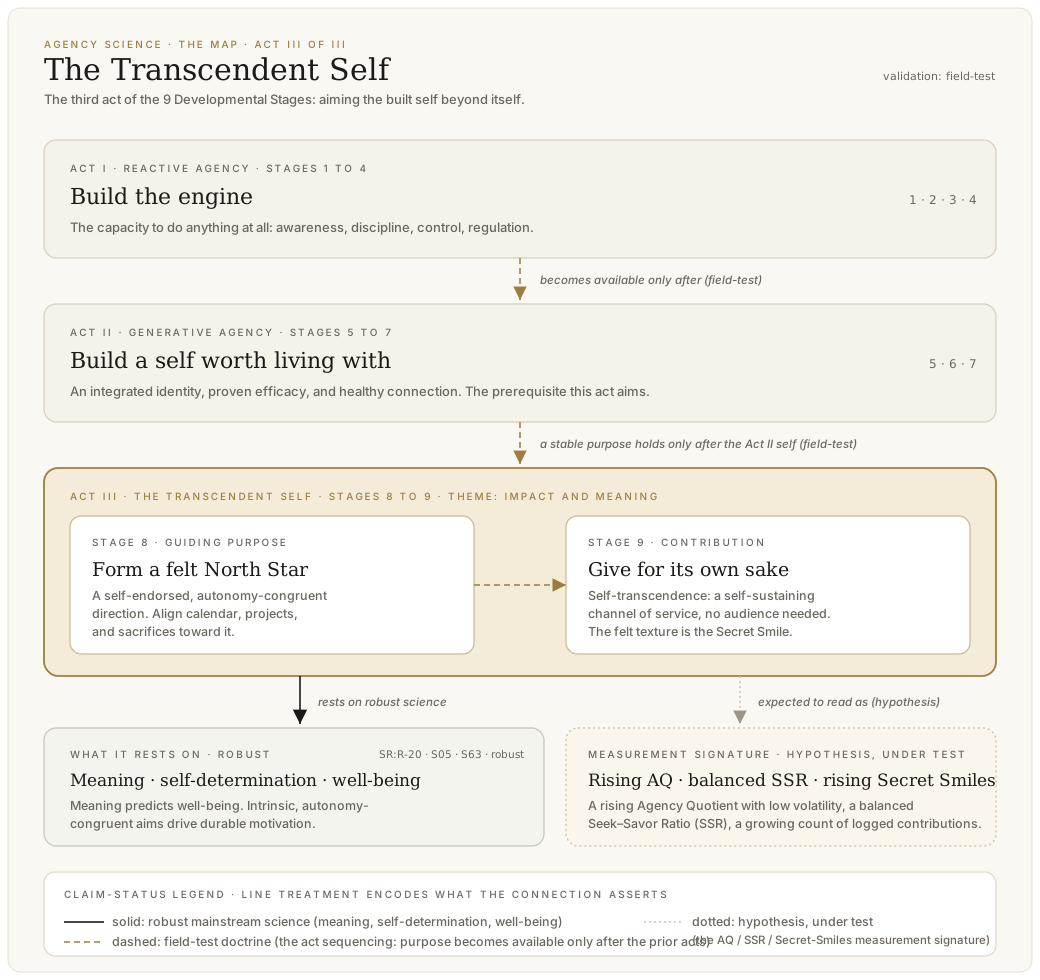
Act III, The Transcendent Self, is the closing act of the 9 Developmental Stages of Agency, the band that spans Stage 8 and Stage 9.
It sits after Act I (Stages 1 to 4, building the engine) and Act II (Stages 5 to 7, building a self worth living with). Its theme is impact and meaning. Here a person turns from building the self toward aiming it at something larger, and draws fulfillment from serving beyond personal gain. The wager of the act, still under test, is twofold. A genuine guiding purpose becomes stable only once the earlier-act capacities are in place,† and the act's far edge is contribution offered for its own sake.† What is robust is the science underneath: meaning and self-direction are real, measurable, and associated with better life outcomes.
Glossary Definition
Act III, The Transcendent Self, is a developmental-map position that spans Stage 8 (Guiding Purpose) and Stage 9 (Transcendent Agency). It is the closing band of the 9 Developmental Stages of Agency, positioned after Act I (Stages 1 to 4, Reactive Agency) and Act II (Stages 5 to 7, Generative Agency). Stage 9, Transcendent Agency, is the contribution-and-service stage; its child tile is filed under the Stage 9 Transcendence Contribution name.
Formal Definition
Act III, The Transcendent Self, is the closing segment of the 9 Stages developmental map, the two-stage band (Stage 8 and Stage 9) in which a person, having built a regulated engine and an integrated identity, orients agency toward purpose and contribution. The prior bands are distinguished by their object. Stages 1 to 4 build the capacity to do anything at all. Stages 5 to 7 build an identity and relationships worth working from. This final band orients the integrated self toward purposes beyond individual gain.
Scope note: This band is a position on a map, not a personality type. A person is not "a transcendent person." Recurrence Rules state the testable re-entry claim. Validation status: field-test
On the doctrine's own instruments, movement through the band is expected to show a specific signature.† The signature has three parts. First, a rising Agency Quotient (AQ) with low volatility. Second, a balanced Seek–Savor Ratio (SSR) (deliberate Seek reps against Savor and Seal reps, clustering near 1:1). Third, a rising count of logged Secret Smiles or repeated contribution channels. This measurement mapping is a hypothesis under test, not a validated readout.
Overview
Picture someone who reached the top of the climb they set for themselves. The career landed, the self is no longer at war with itself, the relationships hold. And then a quiet question shows up at the worst possible moment, usually right after a win: is this all there is? In the doctrine's map this restlessness is the seam where Stage 8 begins. It's not a malfunction. It's a common aftertaste of arrival.
This is the arrival fallacy, and it has a name in the research too. Positive life changes, even large ones, tend not to durably lift a person's baseline satisfaction; the lift fades and the baseline reasserts itself. In an early and much-cited study, lottery winners were not lastingly happier than controls a year on (SR:S53, mixed: the original sample was small, and the broader hedonic-adaptation finding is what carries the weight). The map reads that quiet discontent as a signal: the self is built, and it's asking what it's for.
That question is the entrance to Act III. The work of the act is to answer it: first by forming a guiding purpose, then by spending the surplus of one's growth on others.
Lived Experience
The same year can hold both stages. Early in Act III it sounds like a search. A composite figure we'll call Maren (composite, illustrative) has the good life by every external measure. She still finds herself reading job descriptions for nonprofits she has no plan to join, half-looking for a reason to get out of bed that's bigger than her own comfort. That searching, restless and a little ashamed of itself, is Stage 8 starting up.
Later in the act it goes quiet in a different way. Maren has found the thread, and now she mentors two younger colleagues on a standing Tuesday call that earns her nothing and that she wouldn't trade for a raise. Nobody posts about it. The private satisfaction of doing good with no audience is what the doctrine calls a Secret Smile, and a steady supply of them is one hypothesized marker of Stage 9.† The cast is composite and illustrative, drawn from the Scene Registry, not a real person.
Science Anchor
Act III is a developmental position, not a brain region, and its credibility rests on the constructs underneath it being real and measured.
Meaning and purpose in life are validated psychological constructs that empirically predict well-being, and a life aligned with guiding purpose is associated with greater well-being (SR:R-20, robust). The doctrine uses that literature as the evidence base for the Guiding Purpose stage. That use is an interpretive bridge to a developmental position, a definitional mapping that makes no separate empirical claim of its own. The clinical-existential tradition that frames the search for meaning as central to human motivation is the lineage behind this stage (SR:S14, robust). It is cited as philosophical and clinical lineage only; the empirical weight rests on the meaning-in-life work, not on the lineage classic alone.
A guiding purpose, in this stage, is a self-endorsed, autonomy-congruent direction. Orienting a life around intrinsic, self-concordant aims is associated with healthier and more durable motivation than externally driven or borrowed goals (SR:S05, robust). The claim is kept inside that autonomy and intrinsic-motivation framing; it is not generalized beyond that frame.
Finally, purpose in life and personal growth are validated dimensions of psychological well-being (SR:S63, robust). The doctrine maps Act III's contribution language (self-transcendence, growth toward purpose, contribution) onto that framework as an interpretive bridge. That mapping is definitional, a relabeling onto a validated framework, not a claim that the doctrine's stage causes those gains.
The act's developmental-stage shape, a later band that becomes available only after earlier capacities are in place, has a neighbor in the constructive-developmental tradition that orders adult growth into successive structures of mind (SR:R-17, mixed). It is cited as lineage and structure, not as validated progression. Stage theories are contested as a class, and the ordering and the stage boundaries are the part of this tile that is weakest. Act III is treated as a discrete later developmental band, and that stage boundary remains a hypothesis.† The doctrine's sequencing and recurrence claims are held at field-test or hypothesis, each daggered at its own statement, never borrowed as settled from that lineage.
Entry Criteria
The whole map applies only after an initial crossing of The Turn, the point at which a person accepts that agency is possible for them and worth training. That crossing is a stance, not a skill. It is a commitment gate, and it is not the same thing as competence: right after the Turn, even Stage 1 noticing can be minimal, because the crossing changes what a person is willing to attempt, not yet what they can do. Stage progression presupposes the crossing. A reader who has not yet turned can use Stage 1 material as preparation, but moving up the stages in earnest waits on the Turn.
You are entering Act III when the earlier-act work is largely done and a new kind of question takes over. The doctrine's own sequencing claim is that a stable, genuine guiding purpose becomes available only after wholeness in self (Stage 5), proof of efficacy (Stage 6), and healthy connection (Stage 7).† Attempted before those are in place, purpose tends to be performance or a borrowed ideal rather than a true north.†
Observable markers, behavioral rather than aspirational:
- The familiar struggles of earlier stages (initiation, control, regulation, integration) are mostly handled, and a restlessness about meaning has taken their place.
- The live question has shifted from "can I run my own life?" to "what is all this for?"
- The person starts aligning calendar, projects, and sacrifices toward a felt direction, not just toward personal gain.
Exit Criteria
The far edge of the act is Stage 9 as a settled way of being rather than a finish line. The doctrine defines that endpoint as contribution and service performed for their own sake, without need for recognition, the state it calls living on Secret Smiles. This is held as a hypothesis: a terminal transcendence of ego-driven motivation, the full-strength form of Radical Agency, and it is speculative and not directly measured.†
Observable markers that the act is fully inhabited:
- A self-sustaining channel of contribution exists and runs (a standing role, a fund, a recurring service), not a one-off gesture.
- Giving continues with no external reward attached, and the private satisfaction of it is the reward.
- Recognition, when it arrives, is a side effect and not the driver.
Recurrence Rules
Stages are not a finish line or a fixed personality type, so Act III is not a badge a person keeps. Re-entry is expected.† Under heavy load, or when a person steps into a genuinely new domain (a new field, a new role, a new chapter of life), the earlier-act capacities can wobble and the work of purpose has to be re-found on new ground.
First entry and re-entry differ. The first time through, Act III is a discovery: the question of purpose is novel and a little disorienting. Re-entry is faster and more familiar; the person recognizes the restlessness for what it is, knows the climb is repeatable, and rebuilds toward purpose without mistaking the dip for failure. The map's job here is to make that re-entry legible rather than alarming.
The Turn behaves the same way. It re-opens at sharper altitudes, the same commitment to agency asked again at a higher level, without ever un-crossing the first one or resetting the map.† Re-entering earlier work does not undo the Turn that admitted a person to the map in the first place.
FAQ
Is Act III a personality type, like being "a purpose-driven person"? No. Act III is a position on the developmental map, not a kind of person. Someone can be working in Act III in one domain and back in Act I work in another, and can drop back under stress. The act describes where the work is, not who someone permanently is.
Why does purpose come this late on the map? Because, in the doctrine's sequencing claim, a guiding purpose only holds weight once the self is integrated, proven, and connected.† This is the same field-test sequencing claim stated in Entry Criteria, not a new one. Reach for capital-P purpose before that, and it tends to be performance or a borrowed ideal that does not survive contact with real cost.†
Is "transcendence" a spiritual claim? Not in this map. It names a shift toward contribution and meaning that lines up with validated well-being dimensions. The spiritual reading is available to a reader who wants it, but the tile rests on the psychology, not on metaphysics.
Claim Status
What rests on robust science, and what is the doctrine's own contribution, stated plainly so a reader never has to guess.
| Claim | Status |
|---|---|
| Meaning and purpose are measurable and predict well-being | Robust (SR:R-20) |
| Autonomy-congruent, intrinsic purpose is associated with healthier motivation | Robust (SR:S05) |
| Purpose in life and personal growth are validated dimensions of psychological well-being | Robust (SR:S63) |
| Act III's contribution language maps onto those validated well-being dimensions (doctrine mapping) | Non-empirical doctrinal mapping (definition; no validation claim) |
| The post-success "is this all there is?" restlessness is arrival fallacy / hedonic adaptation | Mixed-grade construct (SR:S53) |
| Act III is a discrete, later stage entered only after earlier-act capacities are in place (developmental staging) | Hypothesis |
| A stable guiding purpose becomes available only after the Act II prerequisites (purpose-after-prerequisites sequencing) | Field-test doctrine |
| Stages are not a finish line or a fixed type; people regress to or re-enter them (stage recurrence) | Field-test doctrine |
| The Turn re-opens at sharper altitudes without un-crossing the first crossing (recurrence sub-claim) | Field-test doctrine |
| Movement through the act reads as rising AQ, balanced SSR, rising Secret Smiles (AQ/SSR contribution markers) | Hypothesis, under test |
| Stage 9 is a terminal transcendence of ego-driven motivation, contribution for its own sake (contribution as terminal outlet) | Hypothesis |
† marker. A dagger (†) marks a claim graded field-test or hypothesis in the table above. It is flagged at each statement and restatement of that claim in the body, so a reader can trace every daggered sentence to its row here. Anything unmarked is plain description, an interpretive bridge graded "non-empirical doctrinal mapping," or rests on the robust science cited in the Science Anchor.
The act's staging is doctrine held at hypothesis and field-test, and it is presented as falsifiable. The load-bearing claim is the sequencing one: that a stable guiding purpose becomes available only after the Act II prerequisites (wholeness, efficacy, connection) are in place. The matrix below is bidirectional: every field-test or hypothesis Claim Status row appears, and every daggered sentence in the body is listed at its row, quoted exactly, so a reader can move from any daggered claim to its test and back. The "Disconfirming result" column states the test outcome that would falsify the claim, and those cells carry no dagger (a test design is not a graded claim).
| Claim Status row (daggered) | Body location and exact daggered sentence(s) | Measure / window / comparison | Disconfirming result |
|---|---|---|---|
| Developmental staging (Act III is a discrete, later stage) | Science Anchor: "Act III is treated as a discrete later developmental band, and that stage boundary remains a hypothesis.†" Its testable sub-claims (sequencing, recurrence, the Turn re-opening, the signature) each carry their own dagger and row | Two independent raters code which band a person is in, from Entry/Exit markers, over a 12-month follow-up; compare inter-rater agreement against chance | Raters cannot reliably tell Act III apart from Act II (agreement at chance), so the band is not a distinct position |
| Purpose-after-prerequisites sequencing | In Brief: "A genuine guiding purpose becomes stable only once the earlier-act capacities are in place,†"; Entry Criteria: "a stable, genuine guiding purpose becomes available only after wholeness in self (Stage 5), proof of efficacy (Stage 6), and healthy connection (Stage 7).†" and the corollary "Attempted before those are in place, purpose tends to be performance or a borrowed ideal rather than a true north.†"; FAQ: "a guiding purpose only holds weight once the self is integrated, proven, and connected.†" and the corollary "Reach for capital-P purpose before that, and it tends to be performance or a borrowed ideal that does not survive contact with real cost.†" | Follow people who reach a self-sustaining contribution channel; rate purpose stability over 24 months; compare those who built the Act II capacities first against those who skipped them | People who never built the Act II capacities form purposes just as durable as those who did, so the sequencing claim fails |
| Stage recurrence (not a finish line; re-entry expected) | Recurrence Rules: "Re-entry is expected.†" (the Formal Definition Scope note points to Recurrence Rules for this claim) | Track domain-specific stage placement across two life domains per person over 18 months | A person who reaches Act III in one domain never drops back into earlier work in a new domain under load, so "re-entry expected" is unsupported |
| Turn re-opening at sharper altitudes (recurrence sub-claim) | Recurrence Rules: "It re-opens at sharper altitudes, the same commitment to agency asked again at a higher level, without ever un-crossing the first one or resetting the map.†" | Code whether a later, higher-altitude commitment-to-agency event recurs after the first Turn crossing, without the first crossing un-crossing | The Turn never re-opens at higher altitudes (one crossing, no recurrence), so the re-opening sub-claim fails |
| AQ / SSR / Secret-Smiles measurement signature | Formal Definition: "movement through the band is expected to show a specific signature.†"; Lived Experience: "a steady supply of them is one hypothesized marker of Stage 9.†" (the Secret-Smiles half of the signature) | Track AQ volatility, SSR balance near 1:1, and logged Secret-Smiles count as people move through the band, against their own baseline | Movement through the band shows no rise in AQ, no SSR balancing, and no rise in logged contribution, so the signature is not present |
| Stage 9 as terminal contribution for its own sake | In Brief: "and the act's far edge is contribution offered for its own sake.†"; Exit Criteria: "a terminal transcendence of ego-driven motivation, the full-strength form of Radical Agency, and it is speculative and not directly measured.†" | Code whether a self-sustaining contribution channel persists once recognition and external reward are removed | Contribution stops as soon as recognition or external reward is withdrawn, so "for its own sake" is unsupported |
| Doctrine mapping of Act III contribution language onto Ryff dimensions | Science Anchor: "That use is an interpretive bridge to a developmental position, a definitional mapping that makes no separate empirical claim of its own"; "That mapping is definitional, a relabeling onto a validated framework, not a claim that the doctrine's stage causes those gains" (both undaggered, by design) | Non-empirical doctrinal mapping (definition; no validation claim) | Not falsifiable: an interpretive bridge, exempt per Universal Law §11.1 |
Stage theories are contested as a class, and the ordering and the stage boundaries are where the model is most vulnerable to disconfirmation.
Boundaries. The map is developmental and pedagogical, not a complete account of a life. Over-giving without self-care is a known failure mode. Sustained contribution with no replenishment predicts burnout, the well-documented exhaustion-cynicism-inefficacy syndrome (SR:S58, robust). The dignity rule holds here as everywhere: the person is never the source of the problem. Service that depletes a person is a boundary the act warns against, not transcendence. Circumstance (poverty, caregiving load, crisis) and clinical conditions (depression, anxiety disorders) sit out of scope and belong to treatment or to material support, not to a reading of where someone is on the map.
Quick Reference
- Object type / Layer: stage (map act) / Class 6.
- Position: Act 3 of 3. Spans Stage 8 and Stage 9. Sits after Act I (Stages 1 to 4) and Act II (Stages 5 to 7).
- Theme: impact and meaning. Aiming the built self beyond the self.
- Cast (composite, illustrative): Maren (Stage 8 search, Stage 9 quiet service). A Scene Registry figure, not a real person.
- Depends on: Act II The Authentic Self (the integrated self the act aims). The 9 Developmental Stages of Agency (the map it closes). The Turn Threshold (the initial crossing the whole map presupposes).
- Often confused with: Act II The Authentic Self: Act II builds the self, Act III aims it outward.
Relations
- part_of:: The 9 Developmental Stages of Agency (TBD). Act III is the closing segment of the 9 Stages map.
- has_part:: Stage 8 Guiding Purpose (TBD). The first stage of the act: forming a guiding purpose.
- has_part:: Stage 9 Transcendence Contribution (TBD). The terminal stage: contribution for its own sake.
- depends_on:: Act II The Authentic Self (TBD). The prior act, whose integrated self is the prerequisite this act aims.
- depends_on:: The Turn Threshold (TBD). The initial crossing the whole map presupposes; stage progression only begins after the Turn.
- related:: Act I The Engine (TBD). The first act, where the engine capacities are built.
- related:: The Purpose Ladder (TBD). Supplies the purpose-formation rungs engaged in Stage 8.
- related:: Guiding Purpose (TBD). The self-endorsed direction formed in Stage 8, the first half of the act.
- related:: Secret Smiles (TBD). The private satisfaction of unrewarded contribution, the felt texture of Stage 9.
- related:: AQ Agency Quotient (TBD). The instrument whose rising, low-volatility reading is one part of the act's hypothesised measurement signature.
- related:: SSR Seek Savor Ratio (TBD). The balance (near 1:1) that is the second part of the act's hypothesised measurement signature.
- related:: Radical Agency (TBD). The full-strength form the act's far edge is held to approach: contribution for its own sake.
- contrast_with:: Act II The Authentic Self (TBD). Act II builds a self worth living with; Act III aims that strong self at something larger.
Related concepts (Core): The 9 Developmental Stages of Agency, Act I The Engine, Act II The Authentic Self, The Turn Threshold, Stage 8 Guiding Purpose, Stage 9 Transcendence Contribution, Guiding Purpose, The Purpose Ladder, Secret Smiles, AQ Agency Quotient, SSR Seek Savor Ratio, Radical Agency
Aliases & Registers
| alias | register | status |
|---|---|---|
| Act III (the 9 Stages map) | internal | proposed |
Provenance & Ancestry
The three-Act framing of the 9 Stages map is author-coined, organizing the nine developmental stages into Act I (Reactive Agency, Stages 1 to 4), Act II (Generative Agency, Stages 5 to 7), and Act III, The Transcendent Self (Stages 8 to 9, whose terminal stage is Stage 9, Transcendent Agency). The academic neighbor behind the purpose stage is the clinical-existential tradition that frames the search for meaning as central to human motivation (SR:S14, robust, cited as lineage only and never as experimental support); the empirical meaning claim rests on the meaning-in-life literature (SR:R-20). Self-direction draws on Self-Determination Theory (SR:S05), and the well-being mapping on the psychological well-being model (SR:S63). The act's contribution is the developmental sequencing and the contribution endpoint, not the underlying constructs.
Sources
- SR:R-20 Steger, meaning in life (empirical); robust. Meaning and purpose are measurable and predict well-being.
- SR:S05 Self-Determination Theory (Deci & Ryan); robust. Autonomy-congruent, intrinsic aims are associated with healthier, more durable motivation.
- SR:S63 Ryff, psychological well-being model; robust. Purpose in life and personal growth are validated dimensions of psychological well-being. The doctrine's mapping of Act III contribution language onto those dimensions is the undaggered non-empirical interpretive bridge, not part of this source's claim.
- SR:S53 Brickman et al. (1978), lottery / hedonic adaptation; mixed (small original sample; the hedonic-adaptation construct is supported by later work). Cited for the arrival-fallacy construct.
- SR:S14 Frankl, clinical-existential meaning tradition; robust, lineage-classic. Philosophical and clinical lineage only, not experimental evidence.
- SR:R-17 Kegan (constructive-developmental); Loevinger (ego development); mixed (caveat: stage theories are contested as a class). Cited as the developmental-stage neighbor, lineage and structure only, not as validated progression.
- SR:S58 Maslach & Leiter (2016), burnout (exhaustion, cynicism, inefficacy); robust. Anchors the over-giving / burnout boundary in Falsification & Boundary Conditions.
Version History
| version | date | change | by |
|---|---|---|---|
| 1.9 | 2026-07-02 | Register fork completed (Law 13.1, Fable 5 re-audit): added the registers: frontmatter block with the Institute opener (verbatim from the body In Brief) and the metaphor-first Radical Agency alternate. The sequencing claim carries its dagger and restates the body-daggered claim already rowed in the matrix. Body copy untouched. Re-linted PASS (--strict, zero warnings). | claude-code claude-code-golden-standard-fable-reaudit-20260702 |
| 1.8 | 2026-07-01 | Round-5 convergence pass (GLM + Codex findings gated and applied). Sources: the S63 bridge note now reads "undaggered non-empirical interpretive bridge," aligned with the Claim Status grade and the matrix exemption row. Science Anchor: added the concrete daggered staging sentence ("Act III is treated as a discrete later developmental band, and that stage boundary remains a hypothesis.†"), closing the developmental-staging matrix row on an exact daggered quote. Sequencing restatements daggered at every location (Entry Criteria corollary + both FAQ sentences) and listed exactly in the sequencing matrix row. Formal Definition Scope note rewritten as a pointer to Recurrence Rules (no undaggered restatement). S05 wording de-causalized to "is associated with" in Claim Status and Sources. Figure frontmatter reduced to the bare resolvable asset path. Publication status set to final. Strict style gate prints PASS (0 em-dashes, 0 warnings). | claude-code lexrb-actIII-r5-convergence-20260701 |
| 1.7 | 2026-06-26 | FINAL round-3 convergence fix (GLM r3 + Codex). CENTERPIECE (Universal Law §12.1): rebuilt the Falsification matrix as a BIDIRECTIONAL EXACT-QUOTE ledger. Every field-test/hypothesis Claim-Status row appears AND every daggered body sentence is now listed at its row with the section name plus the exact quoted daggered sentence (sequencing lists both the In Brief and Entry Criteria sentences; terminal lists In Brief + Exit Criteria; the signature lists Formal Definition + the Lived Experience Secret-Smiles half; staging is noted as the undaggered structural umbrella whose sub-claims are rowed separately). Disconfirming-result cells carry no dagger (§12.2). GLM r3 Issue 1 (HARD §2.1/Build-Spec §2.3): added the missing Claim-Status row for the Turn re-opening sub-claim (now body dagger + Claim-Status row + matrix row, all three). GLM r3 Issue 2: resolved the doctrine-mapping grading inconsistency, graded ONCE as "Non-empirical doctrinal mapping (definition; no validation claim)" in Claim Status, removed the two daggers from the Science Anchor bridge sentences (R-20 + S63 bridges reworded as undaggered definitional mappings), kept the matrix exemption row. GLM r3 Issue 3: removed the orphan dagger on the Science Anchor meta-statement (it restated grades, not a new claim; reworded to "each daggered at its own statement below"). Legend updated to note dagger-at-every-restatement (§12.3) and the non-empirical-mapping exemption. FIGURE (§12.6): figure_asset set to the publication-resolved relative path _diagrams/act-iii/act-iii-the-transcendent-self.lexicon.svg (asset verified present), removed the "Hive S5" staged language from figure; fixed the SVG's baked ACT label from "ACT III · TRANSCENDENT AGENCY" to "ACT III · THE TRANSCENDENT SELF" (the rename; Stage 9 stays "CONTRIBUTION"). SKIPPED as already-fixed in the prior pass (verified against the current tile): the Codex line-64 strict Formal-Definition fragment (already the colon-split "First... Second... Third..." form), the 22 spec em-dashes (spec already strict-PASS), the lines-84/88/141/200 robust/doctrine split, the lines-78/120/128 daggers, and the lines-59/86/155 formal-diction neutralizations. lexicon_style_check.py --strict prints PASS (0 em-dashes, 0 warnings). | claude-code lexrb-actIII-r3-convergence-20260626 |
| 1.6 | 2026-06-26 | FINAL Codex GPT-5.5 redline (codex_stage.md) applied; last gate. CENTERPIECE (Law 11.1): replaced the Falsification prose with the mandatory Claim-Status -> body-dagger -> Falsification traceability matrix (7 rows: developmental staging, purpose-after-prerequisites sequencing, stage recurrence, Turn re-opening sub-claim, AQ/SSR/Secret-Smiles signature, terminal contribution, plus the doctrine-mapping row as a non-empirical §11.1 exemption), each with body location / measure-window-comparison / disconfirming result. TILE strict fix: replaced the Formal-Definition signature paragraph with Codex's colon-split "The signature has three parts. First... Second... Third..." form (fixes the 56-word strict WARN). Split robust-citation/doctrine-mapping fusions in Science Anchor (R-20 bridge + S63 bridge daggered separately, Law 11.6), Claim Status (split S63 into a robust row + a field-test doctrine-mapping row), and Sources (S63 note no longer presents Ryff as validating the doctrine's contribution/transcendence usage). Daggered the repeats: Lived Experience Stage-9 Secret-Smile marker, Recurrence Turn re-opening, FAQ sequencing (redirected to point back to the daggered Entry Criteria sentence to avoid a mid-paragraph splitter merge). Neutralized formal-layer wording: "aims that whole at something beyond the individual" -> "orients the integrated self toward purposes beyond individual gain"; "it is not stretched past it" -> "it is not generalized beyond that frame"; "where this tile is most likely to break" -> "where the model is most vulnerable to disconfirmation" (Law 11.3). lexicon_style_check.py --strict prints PASS (0 em-dashes, 0 warnings). | claude-code lexrb-actIII-codex-final-20260626 |
| 1.5 | 2026-06-26 | GLM 5.2 redline (glm2_stage.md) applied. H1: replaced the residual vivid verb in Falsification ("stated so it can lose" became "presented as falsifiable", Universal Law 2.2). H2 (cross-tile consistency, Universal Law 6.1 / Golden Rubric 14): reconciled the three relation surfaces by adding the three inline body wikilink targets (AQ Agency Quotient and SSR Seek Savor Ratio from the Formal Definition signature, Radical Agency from Exit Criteria) to frontmatter related_concepts, three new related:: rows in Relations, and the body Core list. M1: neutralized the Boundaries subsection (formal layer) vivid verbs ("drives burnout" became "predicts burnout"; "hollows a person out" became "depletes a person"; "the person is never the villain" became "the person is never the source of the problem"). M2 (negative-parallelism false positive: "X, not just Y" is affirmation-first, passes the linter) skipped. | claude-code lexrb-actIII-glm2-redline-20260626 |
| 1.4 | 2026-06-25 | Golden Tile Machine pass (gold exemplar lock for the stage type). Applied the Steve naming ruling: the ACT is "The Transcendent Self" everywhere (In Brief, Glossary, Formal Definition, Provenance, figure_alt, figure_caption, tags, aliases); "Transcendent Agency" now reserved for Stage 9 ONLY, resolving the GLM H1 naming collision. Dropped the colliding "Transcendent Agency (Stages 8-9)" alias from frontmatter and the Aliases table. Fixed In Brief per the source-fix ruling: "turns from building the self toward aiming it at something larger" (not "stops building"); "the act's far edge is contribution offered for its own sake.†" (not "the journey ends"); efficacy phrasing changed to "associated with better life outcomes" (not "good for a life"). Formal Definition: "is" not "names" (ISO-704, GLM L4); the three-part signature joined with a colon, fixing the sentence fragment (GLM H2). Overview: removed the "not X but Y" negative parallelism (GLM M1); colon-joined the "First by forming..." fragment (GLM M4); added natural contractions to the vivid layers (GLM L3). Falsification: split the two three-idea run-ons into single-idea sentences (GLM M2, M3). FAQ: softened "names a measurable shift" to "names a shift... that lines up with" (GLM L2). Lived Experience: tagged Maren "(composite, illustrative)" at first mention (Universal Law 2.3). Added gold_exemplar: true. | claude-code lexrb-actIII-golden-20260625 |
| 1.3 | 2026-06-15 | P4f1 S4.5 reconcile (Codex audit HIGH fix). D-ST-SSR closure: the figure_caption frontmatter still printed the abbreviated "AQ / Seek–Savor / Secret-Smiles" measurement signature, out of step with the v1.2 patch that spelled out the canonical term everywhere else. Updated the caption to the full "AQ / Seek–Savor Ratio (SSR) / Secret-Smiles measurement signature" so all reader-facing surfaces (figure_alt, figure_caption, Formal Definition, diagram SVG) now carry the spelled-out canonical name. No body prose change. | claude-code lexrb-actIII-P4f1-S4.5-reconcile-20260615 |
| 1.2 | 2026-06-15 | P4f1 S3 authority patch (in place; from the decision-coverage ledger). D-ST-SSR: replaced the INVENTED "Service-to-Self Ratio (the giving-to-keeping balance)" with the canonical "Seek–Savor Ratio (SSR)" (deliberate Seek reps against Savor and Seal reps, clustering near 1:1) on all three surfaces, the Formal Definition prose (now wikilinked SSR Seek Savor Ratio), the figure_alt + figure_caption frontmatter, and the regenerated diagram SVG (act-iii-the-transcendent-self.lexicon.svg, all 3 render-preview copies). The "Seek–Savor" form matches the canonical SSR tile's unspaced en-dash compound (lawful under the style check, which bans only the em-dash and the spaced dash substitute). D-ST-TURN (binding for every stage tile): Entry Criteria gains the pre-/post-Turn applicability paragraph (the map applies after an initial Turn crossing; a stance/commitment gate distinct from skill; progression presupposes the crossing); Recurrence Rules gains the note that the Turn re-opens at sharper altitudes without un-crossing or resetting the map; added the typed relation depends_on:: The Turn Threshold (TBD) (class 1, lawful forward-link to the approved Turn tile) plus its mirrors in related_concepts, Quick Reference, and the in-body related list. D-ST-STAGE9: reconciled the printed Stage-9 long name in the Glossary Definition from "Self-Transcendence and Contribution" to the locked-roster "Transcendent Agency", kept the Stage 9 Transcendence Contribution wikilink filename, and added the one-line note explaining the child-tile title difference. Kept the hedonic-adaptation = mixed grade unchanged. | claude-code lexrb-actIII-P4f1-S3-patch-20260615 |
| 1.1 | 2026-06-15 | P4f1 FIX pass (independent-audit blockers). Removed the competing asterisk footnote-marker system from Overview and re-marked the arrival-fallacy / hedonic-adaptation claims with the sanctioned dagger (†), keeping the SR:S53 mixed caveat inline. Reordered to the reconciled v5.2 stage spine (FAQ before Claim Status; added the now-required Falsification & Boundary Conditions section after Claim Status). Downgraded the developmental-staging Claim Status row from "Field-test doctrine" to "Hypothesis" to match the ledger's grade of C-01 (anchored on R-17 Kegan/Loevinger, mixed). Added SR:R-17 to Sources and cited it in the Science Anchor as the developmental-stage neighbor with the contested-class caveat. Replaced "settled" with "robust" in the In Brief and the Claim Status intro (the meaning / well-being science is graded robust, not settled). Built the Falsification section with a testable disconfirmation design for the sequencing claim plus the over-giving / burnout dignity-rule boundary (SR:S58 Maslach; circumstance and clinical conditions out of scope). Added typed related:: rows for Guiding_Purpose and Secret_Smiles. | claude-code lexrb-actIII-P4f1-FIX-20260615 |
| 1.0 | 2026-06-14 | First v5.2-spine draft of the Act III map tile (stage type). Built from the parent tile The_9_Developmental_Stages_of_Agency and the Stage 8 / Stage 9 source tiles, against the S2.5-audited claim ledger (C-01 to C-11). In Brief leads; Claim Status box legends the single dagger (†) for field-test/hypothesis claims; relations dash-free with mandatory (TBD) parentheticals (no map-act AGS ids minted yet); citations only from the Science Register (R-20, S05, S63, S53, S14). | claude-code lexrb-actIII-P4f1-20260614 |