
Lexicon · pattern Validation status: field-test AGS:0001
The Four Traps
In Brief
Automatic behavior (the autopilot) can override what you intend in four ways: you stop seeing the pattern, you can't start, you can't stop, you can't steer.
The Four Traps is the diagnostic map of those four failures. In Agency Science this is the "map of the enemy," the layer that connects the mind's automatic machinery to the visible, self-defeating patterns it produces. Its job is to turn a global self-verdict ("I'm lazy," "I'm anxious," "that's just me") into one named mechanism with one specific way out. The working claim, still under test, is that catching the live pattern fast enough to apply the matching capacity can be trained.† The stronger claim, that repeated small repairs produce durable change beyond the immediate incident, remains a hypothesis.†
Glossary Definition
The Four Traps is a behavioral-failure typology of how the Autopilot Operating System (AOS), the mind's neutral system for automatic behavior, comes to override a person's own declared intentions. It sorts that override into one enabling meta-trap and three operational failure traps, each paired with a candidate repair capacity in the Agency Science model.
Formal Definition
The Four Traps is a behavioral-failure typology. It decomposes Autopilot Capture, the condition in which automatic behavior runs unobserved and against a person's declared long-horizon values, into four traps: one enabling meta-trap (unexamined automaticity) and three operational failure traps (a failure to initiate, a reward-or-approval override, and a threat-alarm hijack).
Each trap is recognized by its signature Blockers, the recurring surface patterns it produces. Blocker names label patterns a person runs; they do not categorize people as types (see Agency Blockers). Each trap is paired with a primary capacity drawn from the Engine of Agency. That capacity is hypothesized to counteract the trap.† The comparative routing claim is that a capacity matched to the trap should outperform a generic or mismatched repair on the same incident type.† In current field testing, traps are tracked through pattern-tagged incident records. Whether they correspond to matching Agency Quotient (AQ) sub-scores remains a measurement hypothesis.† That correspondence remains a claim under test.
Scope note. In scope: the failure layer that sits between the automatic appraisal systems (the Sentinels, such as the threat-tagging system REX) and the visible Blockers; and the routing question of which pattern is running and which capacity answers it. Three things sit out of scope. First, identity labels: names like "lazy" or "weak" that turn a running pattern into a verdict on the person. These are excluded by the dignity rule, the doctrine's standing principle that the system and the conditions that installed the pattern are the target of critique. The person is the one affected. Second, the engagement-economy cue layer is out of scope here; it is catalogued in Attention Cartel. Third, clinical conditions, which belong to treatment.
Validation status: field-test.
Overview
Three composite figures (composite, illustrative) run the same week three different ways. Maya keeps a project alive in her head for seven days without touching it; every evening ends with "I'll deal with it tomorrow, when I'm fresher." Danny puts his phone down, decides he's done, and ninety seconds later he's scrolling again: relief now, cost later. Marcus reads a two-line email from his boss four times, then cancels his evening to rewrite a document no one asked him to touch, one that will never see the light of day. None of them is broken. Each is running a different theft pattern on the same operating system.
These are not character defects. In this model they are learned automatic patterns, shaped by the systems that run habit, reward, threat, and effort. An evolutionary gloss is illustrative here, not settled mechanism: in an ancestral environment, effort spent for no reason was reserve you might need for the next threat, a wasted sprint leaving nothing left for the predator that came after. That could have favored a standing bias toward over-pricing effort and conserving energy. The registered claim is narrower: initiation is shaped by delay discounting and the broad procrastination dynamics that include effort cost (SR:S33, SR:S40). Today, that cost-sensitivity can read a workout, or a hard conversation, as a cost to ration.
One of the four traps is not like the others. The meta-trap is unexamined automaticity, and it is not a fourth peer. It is the precondition for the rest.† In this model, the other three are harder to interrupt while the person has not yet noticed the pattern.† Stop noticing, and the loops hold: not starting, soothing, or scanning for threat. Notice in time, and the loop loosens enough for the matching repair to do its work.† So the map puts one trap above three: an awareness gate over three operational failures.† The map is drawn so the way out begins with seeing the pattern.
This turns self-judgment into diagnosis. Instead of "I'm lazy" or "that's just who I am," the question becomes mechanical: which pattern is running, which Blocker is showing, and which move (SEE IT, START IT, STOP IT, STEER IT) answers it? The cost of never asking shows up as a recurring gap between what a person says they will do and what they actually do. The doctrine calls it the say-do gap. Left unnamed, it hardens, until it gets mistaken for a fixed trait instead of a running pattern.
Lived Experience
The same week holds "I'll start later," "just one more," and "what if this goes badly?" On autopilot they look like three separate flaws. Take the smallest version of the third. At breakfast (composite, illustrative), a child knocks over a glass of orange juice, and a tired parent's voice goes sharp before any deliberate choice was available. That is an alarm-state response under low reserve, not evidence of character. It also carries a cost the parent rarely connects to it. How a parent handles these moments is one of the ways a child learns to handle their own; developmental psychology studies this as emotion socialization, and its link to a child's later self-regulation and self-worth is well-supported (SR:S68, SR:S69). What the doctrine adds† is the narrower claim that naming the Snap and interrupting it changes what the parent models in the moment, which is what gets passed on.
Now run it the other way. If the pattern is named fast enough to route it to the matching capacity before the old loop hardens, the diagnosis ("that was the Snap") replaces the verdict ("I'm a bad parent"). An interrupted instance can give the next repetition a different starting point.† Diagnostic naming is hypothesized to be a mechanism that makes the next repetition trainable.† The wager is that repeated small repairs can produce durable change beyond the immediate incident.†
Science Anchor
The typology is a functional decomposition of behavioral-failure modes. Its strength comes from each trap mapping onto a well-supported literature.
The meta-pattern is associated with default-mode (mind-wandering) activity and low interoceptive awareness, that is, reduced attention to the body's own signals. The entry treats this as an association only (SR:S03, SR:S01). The failure to start rests on delay discounting and procrastination research, the literature within which effort cost is studied (SR:S33, SR:S40). The reward-and-approval trap groups two rails of one control failure: cue-driven incentive salience on the urge rail (SR:S57, SR:S42), and contingent self-worth plus conformity pressure on the approval rail (SR:S25, SR:S28). The threat-alarm hijack rests on amygdala-biased fear learning (SR:S48). Habit science explains why all of it persists: context-cued routines run without decisions (SR:R-01, SR:R-03).
One claim is the doctrine's own, and it is labeled as such: that awareness is the gate the other three repairs depend on.†
The Map
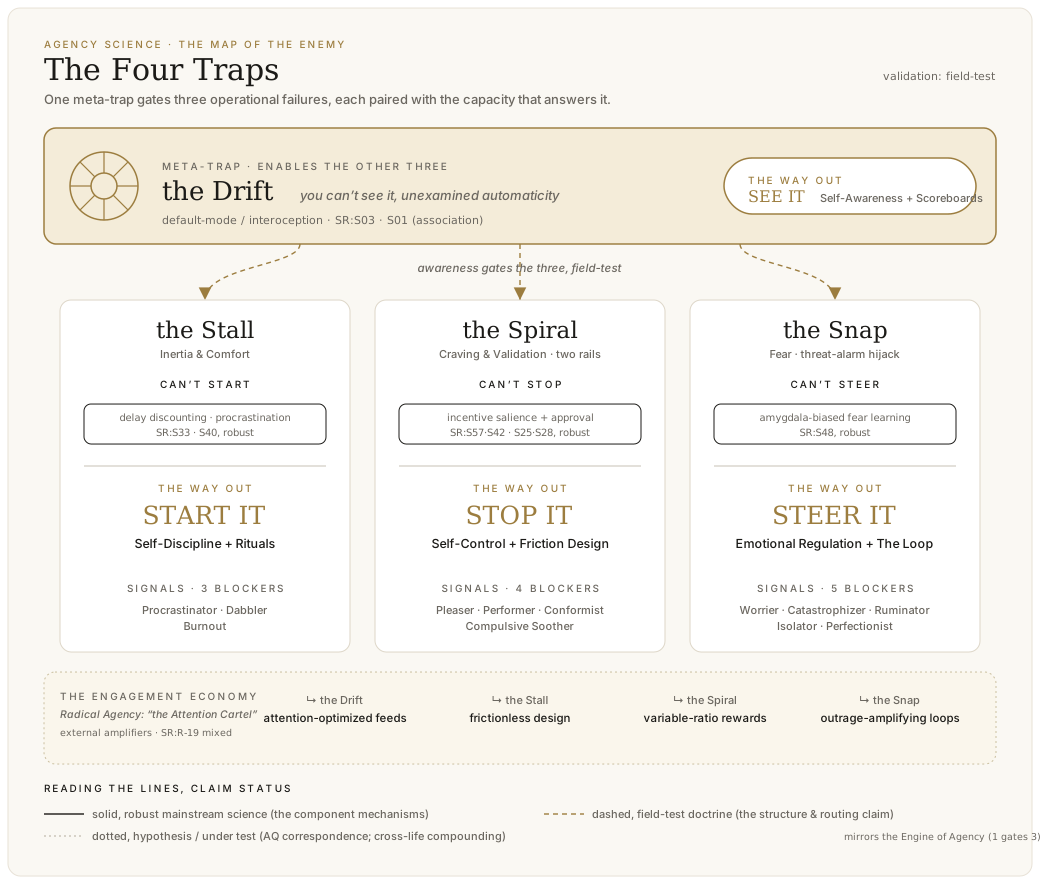
How to read it: each row is one trap. You get its internal name, its public name, whether it enables the others (the meta-trap) or executes (operational), the Blockers that signal it, and the candidate repair capacity assigned to it, drawn from the Engine of Agency. Blocker names label patterns a person runs; they do not categorize people as types (see Agency Blockers). The "Also draws on" column reads differently for the meta-trap than for the operational traps. For the three operational traps it names the other capacities the repair recruits. For the meta-trap (the Drift) it names that seeing the pattern routes to whichever operational capacity the diagnosis calls for. The figure asset (_diagrams/four-traps/the-four-traps.lexicon.svg) renders the same structure, its line treatment encoding claim status (solid is robust, dashed is field-test, dotted is hypothesis).
| Trap (internal) | Public name | Role | Core Blockers | Paired capacity (the way out) | Also draws on |
|---|---|---|---|---|---|
| Unexamined Automaticity | the Drift | Meta (enables the rest) | Drifter, Victim, Fixed Mind, Nihilist | Self-Awareness + Scoreboards → SEE IT | routes to all operational capacities, by diagnosis |
| Inertia & Comfort | the Stall | Operational | Procrastinator, Dabbler, Burnout | Self-Discipline + Rituals → START IT | SEE IT, STEER IT |
| Craving & Validation | the Spiral | Operational (two rails) | Pleaser, Performer, Conformist, Compulsive Soother | Self-Control + Friction Design → STOP IT | SEE IT, STEER IT |
| Fear | the Snap | Operational | Worrier, Catastrophizer, Ruminator, Isolator, Perfectionist | Emotional Regulation + The Loop → STEER IT | SEE IT, STOP IT |
External amplification has its own layer, named the Attention Cartel in the Radical Agency register. The working amplifier claim is that the engagement economy pairs one Bait with each trap.† Two of those pairings have direct support and two rest on a weaker analogy. The Baits are attention-optimized feeds (the Drift), frictionless design (the Stall), variable-ratio rewards (the Spiral), and outrage-amplifying loops (the Snap). The slot-machine design evidence (SR:R-19) supports two of these directly, variable-ratio rewards (the Spiral) and frictionless design (the Stall); for attention-optimized feeds (the Drift) and outrage-amplifying loops (the Snap) the link is a weaker analogy. All four are treated as plausible external amplifiers; none is presented as a settled causal finding.
FAQ
Are the Four Traps types of people? No. The traps name patterns a person runs. The Blocker names are the same: labels for patterns a person runs. The target of critique is the pattern and the conditions that installed it. The person is the one affected.
Why does the map put one trap above the other three? The asymmetry is deliberate. The model treats one trap as a precondition for the other three.† Seeing the pattern is the proposed sequence gate before operational repair.† The shape mirrors the Engine of Agency, with one awareness capacity and three operational capacities.
Is automatic behavior itself the failure condition? No. The automatic system is neutral machinery. It also runs skills, habits, and the drive home. The failure condition is Autopilot Capture: automatic behavior running unobserved against one's own declared values. The four traps are the recurring shapes that condition takes.
Is this established science? The component mechanisms rest on robust, well-replicated evidence: habit automaticity, delay discounting, incentive salience, fear learning (see Science Anchor). The four-part typology and its routing claim are the doctrine's own contribution, currently at field-test, with stated conditions under which they would fail. The entry never claims more than that. See the Claim Status box.
Claim Status
What rests on settled science, and what is the doctrine's own contribution, stated plainly so a reader never has to guess.
| Claim | Status |
|---|---|
| The component mechanisms (habit automaticity, delay discounting, incentive salience, fear learning) | Robust mainstream science, at each source's stated SR grade; "settled" only where the named row says so (see Science Anchor) |
| Emotion socialization and its link to a child's self-regulation and self-worth | Robust, well-replicated developmental science |
| The four-part structure: one meta-trap gating three operational traps | Field-test doctrine |
| Trainability of catch-and-match routing (catching the live pattern fast enough to apply the matching capacity can be trained) | Field-test doctrine |
| Paired capacities are hypothesized to counteract their assigned traps, and matched routing outperforms generic or mismatched repair | Field-test (falsifiable; see Falsification) |
| Naming and interrupting the Snap changes what the parent models in the moment | Field-test doctrine |
| Diagnostic naming as the mechanism that makes the next repetition trainable | Field-test doctrine |
| External-amplifier pairing: each Bait of the engagement economy amplifies its matching trap (direct support for two, weaker analogy for two) | Hypothesis / analogy-strength claim |
| The traps show up as movements in AQ sub-scores | Measurement hypothesis, under test |
| Repeated small repairs produce durable change beyond the immediate incident | Hypothesis |
† marker. Throughout the entry, a dagger (†) marks a claim graded in the table above as field-test or hypothesis. It is flagged once, here, so the prose never has to repeat the label inline. Anything unmarked is either plain description or rests on the robust science cited in the Science Anchor.
Falsification & Boundary Conditions
The typology is doctrine at field-test, and it is presented as falsifiable. A minimal protocol codes real incidents by trap, using two independent raters and reporting how often they agree, then runs the mini-designs below. Each one names what is measured, over what window, against what comparison, and what result counts as disconfirmation.
- Structure: do the 16 Blockers cluster onto the four traps along the 4-3-4-5 assignment, or do they land at random?
- Routing: does the capacity matched to a trap outperform a generic or mismatched repair on the same incident?
- Sequence: does awareness-first (seeing the pattern before acting on it) beat going straight to the operational repair?
- Trainability: over a pre-registered 4-8 week repeated-incident protocol, does cue-to-naming latency decrease and does correct catch-and-match routing increase within person? Disconfirmed if there is no within-person improvement over baseline or if raters cannot agree on correct routing.
- Diagnostic naming: compare matched repair with explicit trap naming against matched repair without explicit naming. Disconfirmed if naming adds no improvement in interruption success or recurrence reduction.
- Parent modeling: code the parent's observable response in named-Snap incidents against unnamed-Snap incidents. Disconfirmed if naming and interrupting the Snap produces no difference in the modeled regulatory behavior.
- External amplifiers: over a pre-registered window, compare trap-coded incident frequency after exposure to each named amplifier class against low-exposure or nonmatching-amplifier windows. Disconfirmed if the predicted trap-specific association does not appear above chance analogy.
- AQ correspondence: over the same pre-registered window, do trap-coded incident frequencies or repairs move with matching AQ sub-scores more than nonmatching sub-scores and beyond test-retest noise? Disconfirmed if not.
- Durability: over 6-12 month follow-up, do repeated repairs predict durable reduction in same-trap recurrence beyond baseline trend? Disconfirmed if gains do not persist or do not beat baseline.
Claim-Status traceability matrix
This is a bidirectional ledger (Law 12.1). Every field-test and hypothesis row of the Claim Status box appears below, and every daggered sentence in the body appears here at least once, quoted exactly. Each body-location cell names the section and the exact daggered sentence; where one claim is daggered in more than one place, all locations are listed; where one row rolls up several distinct daggered sentences, each is quoted. Robust-science rows (the component mechanisms; emotion socialization) carry no dagger and make no validation claim of their own, so they are not listed here. The four-part-structure claim carries two designs (a structure-clustering design and a sequence design), since it is tested both by where the Blockers cluster and by whether awareness must come first.
| Claim Status row (graded) | Body location (section + exact daggered sentence) | Measure | Window | Comparison | Disconfirming result |
|---|---|---|---|---|---|
| Four-part structure: one meta-trap gating three operational traps (field-test) | Overview ("It is the precondition for the rest.†"); Overview ("So the map puts one trap above three: an awareness gate over three operational failures.†"); FAQ ("The model treats one trap as a precondition for the other three.†") | Two-rater incident coding of the 16 Blockers onto the four traps | Single coding pass (cross-sectional) | 4-3-4-5 assignment vs random/chance clustering | No reliable clustering onto the four traps above chance |
| Four-part structure (sequence sub-design): awareness gates the other three repairs (field-test) | Science Anchor ("One claim is the doctrine's own, and it is labeled as such: that awareness is the gate the other three repairs depend on.†"); Overview ("In this model, the other three are harder to interrupt while the person has not yet noticed the pattern.†"); Overview ("Notice in time, and the loop loosens enough for the matching repair to do its work.†"); FAQ ("Seeing the pattern is the proposed sequence gate before operational repair.†") | Repair success rate | Per-incident | Awareness-first vs straight-to-operational-repair | Awareness-first confers no advantage |
| Trainability of catch-and-match routing (field-test) | In Brief ("The working claim, still under test, is that catching the live pattern fast enough to apply the matching capacity can be trained.†") | Cue-to-naming latency; rate of correct catch-and-match routing, within person | Pre-registered 4-8 weeks, repeated incidents | Post vs own baseline (within-person) | No within-person improvement over baseline, or raters cannot agree on correct routing |
| Paired capacities are hypothesized to counteract their assigned traps, and matched routing outperforms generic or mismatched repair (field-test) | Formal Definition, base pairing ("That capacity is hypothesized to counteract the trap.†"); Formal Definition, comparative claim ("The comparative routing claim is that a capacity matched to the trap should outperform a generic or mismatched repair on the same incident type.†") | Interruption success / recurrence reduction on the same incident type | Per-incident, repeated | Matched capacity vs generic or mismatched repair | Matched routing does no better than generic or mismatched |
| Naming and interrupting the Snap changes what the parent models in the moment (field-test) | Lived Experience ("What the doctrine adds† is the narrower claim that naming the Snap and interrupting it changes what the parent models in the moment, which is what gets passed on.") | Coded parent regulatory response | Per-incident | Named-Snap vs unnamed-Snap incidents | No difference in the modeled regulatory behavior |
| Diagnostic naming as the mechanism that makes the next repetition trainable (field-test) | Lived Experience ("An interrupted instance can give the next repetition a different starting point.†"); Lived Experience ("Diagnostic naming is hypothesized to be a mechanism that makes the next repetition trainable.†") | Interruption success / recurrence reduction | Per-incident, repeated | Matched repair with explicit trap naming vs matched repair without naming | Naming adds no improvement in interruption success or recurrence reduction |
| External-amplifier pairing: each Bait amplifies its matching trap (hypothesis / analogy-strength) | The Map ("The working amplifier claim is that the engagement economy pairs one Bait with each trap.†") | Trap-coded incident frequency after exposure to each named amplifier class | Pre-registered window | High-exposure vs low-exposure / nonmatching-amplifier windows | Predicted trap-specific association does not appear above chance analogy |
| The traps show up as movements in AQ sub-scores (measurement hypothesis) | Formal Definition ("Whether they correspond to matching Agency Quotient (AQ) sub-scores remains a measurement hypothesis.†") | Trap-coded incident frequencies / repairs vs matching AQ sub-scores | Pre-registered, same window as trainability | Matching vs nonmatching sub-scores, beyond test-retest noise | Matching sub-scores move no more than nonmatching, or within test-retest noise |
| Repeated small repairs produce durable change beyond the immediate incident (hypothesis) | In Brief ("The stronger claim, that repeated small repairs produce durable change beyond the immediate incident, remains a hypothesis.†"); Lived Experience ("The wager is that repeated small repairs can produce durable change beyond the immediate incident.†") | Same-trap recurrence rate | 6-12 month follow-up | Post-repair trajectory vs baseline trend | Gains do not persist or do not exceed baseline trend |
Boundaries: the map is diagnostic and pedagogical. It does not provide a complete account of why any behavior happens. Clinical severity (depression, addiction, anxiety disorders) exits the map and belongs to treatment. Real external constraint (poverty, caregiving load, danger) is not a trap. The typology describes a person's automaticity working against their own declared values. Circumstances working against a person's options are a separate matter.
Quick Reference
- What it does: turns a vague self-verdict into a mechanism. Which pattern is running, which Blocker is showing, which way out matches?
- The shape: three operational traps (the Stall, the Spiral, the Snap) sit beneath one meta-trap (the Drift). The meta-trap enables; the three operational traps execute. This mirrors the Engine of Agency, with one awareness capacity and three operational capacities.
- The 16 core Blockers distribute 4-3-4-5 across the set. Blocker names label patterns a person runs; they do not categorize people as types.
- Object type / Layer: pattern / Class 5.
- Cast (composite, illustrative): Maya (the Stall), Danny (the Spiral), Marcus (the Snap). Registry-sourced figures; no real people.
- Depends on: AOS Autopilot Operating System (the system it runs on). Autopilot Capture (the failure state it decomposes). The Engine of Agency (the capacities each trap is paired with). The Sentinels / REX (the appraisal layer whose alarm each trap mishandles).
- Related: Agency Blockers. The Escape Cycle. The Attention Cartel.
- Often confused with: Agency Blockers. The Blockers are the observable surface signatures; the traps are the mechanisms beneath them.
Register Table
Presentation variants; the canonical definition lives in the sections above (excluded from the indexed/retrievable chunk per
non_indexed_sections).
| register | rendering |
|---|---|
| internal | The Four Traps of the AOS: the Autopilot meta-trap; Inertia & Comfort; Craving & Validation; Fear |
| public | the Drift, the Stall, the Spiral, the Snap. "The four ways your autopilot steals your life: you can't see it, can't start, can't stop, can't steer." |
| kid | the four sneaky robots: Sleepy (runs your day for you), Sticky (won't let you start), Grabby (won't let you stop), Jumpy (yells danger when there isn't any) |
Relations
- part_of:: Autopilot Capture (TBD). The typology is the diagnostic decomposition of the failure state.
- depends_on:: AOS Autopilot Operating System (TBD). The neutral system the failure state runs on.
- depends_on:: The Engine of Agency (TBD). Supplies the capacities each trap is paired with.
- depends_on:: The Sentinels (TBD) / REX (AGS:0005). The appraisal layer whose alarm each trap mishandles.
- has_part:: The Autopilot Trap (TBD)
- has_part:: The Inertia Comfort Trap (AGS:0002)
- has_part:: The Craving Validation Trap (AGS:0003)
- has_part:: The Fear Parasite Alarm Hijack (TBD)
- contrast_with:: Agency Blockers (TBD). Blockers are the surface signatures; this typology is the mechanism layer beneath them.
- intervened_by:: The Escape Cycle (TBD). The repair sequence routed by the trap diagnosis.
- related:: The Attention Cartel (TBD). External amplification layer (the engagement economy) pairing one Bait with each trap.
- measured_by:: AQ Agency Quotient (TBD). Measurement surface for the sub-score correspondence hypothesis.
Related concepts (Core): AOS Autopilot Operating System, Autopilot Capture, REX, The Engine of Agency, The Sentinels, The Autopilot Trap, The Inertia Comfort Trap, The Craving Validation Trap, The Fear Parasite Alarm Hijack, Agency Blockers, AQ Agency Quotient, The Escape Cycle, The Attention Cartel
Aliases & Registers
| alias | register | status |
|---|---|---|
| Four Traps of the AOS / of the Autopilot OS | internal | locked |
| the Drift | public | locked (2026-06-11, DB-01 D06+D08) |
| the Stall | public | locked (2026-06-11, DB-01 D06) |
| the Spiral | public | locked (2026-06-11, S4 flag resolved) |
| the Snap | public | locked (2026-06-11, DB-01 D06) |
Provenance & Ancestry
Trap architecture author-coined (Master Canon lineage; the meta-plus-three restructure dates to 2026). Public typology names bureau-proposed 2026-06-09, author-signed 2026-06-11 (NAMING_RULING; collision-checked per name). The failure state the typology decomposes was named "Autopilot Capture" per the D03 split (R__AOS ruling; author-approved 2026-06-12). Academic neighbors: dual-process automaticity (SR:S02), the habit/goal interface (SR:R-01), and behavioral-economic present bias (SR:S33). The typology's contribution is the diagnostic routing layer; the underlying mechanisms belong to the cited literatures. Cast (Maya, Danny, Marcus) composite, illustrative, drawn from the Scene Registry.
Sources
- SR:S02 Dual-process / System 1 and System 2 (Kahneman; Evans & Stanovich); robust framework.
- SR:S03 Default Mode Network (Raichle); robust; mind-wandering association.
- SR:S01 Interoception (Craig / Critchley); robust.
- SR:S33 Ainslie, hyperbolic discounting; robust.
- SR:S40 Steel, procrastination meta-analysis; robust.
- SR:S57 Berridge (2007), incentive salience; robust.
- SR:S42 Schultz, reward-prediction error; settled.
- SR:S25 Crocker, contingent self-worth; robust.
- SR:S28 Asch, conformity; settled.
- SR:S48 Phelps et al. (2001), amygdala fear learning; robust.
- SR:R-01 Wood & Neal 2007 / Wood & Rünger 2016, habit mechanism; robust.
- SR:R-03 Wood, Quinn & Kashy 2002, habit prevalence; robust.
- SR:R-19 Schüll 2012, design-amplification; mixed (caveat travels; analogy is direct for variable-ratio and frictionless design, weaker for feeds and outrage loops).
- SR:S68 Emotion socialization (Eisenberg, Cumberland & Spinrad 1998; Morris et al. 2007); robust; how parents handle emotion shapes a child's later self-regulation and self-worth.
- SR:S69 Parental acceptance-rejection theory (Rohner 2004); robust; supports the parent-child beat in Lived Experience.
Version History
| version | date | change | by |
|---|---|---|---|
| 6.9 | 2026-07-02 | r9 dual-confirm close (GLM 5.2 SHIP 9.5/10; Codex GPT-5.5 FIX 8.7/10, all findings dispositioned). Applied Codex issue 3: the Quick Reference often-confused boundary line now reads "The Blockers are the observable surface signatures" (precision phrasing on a disambiguation line; the check-engine figure remains the Agency_Blockers gloss). Codex issues 1 and 2 (dagger the "four ways" member count in the In Brief opener and the register openers) REJECTED with reason: the member count is the typology's definitional mapping (Law 11.1 exemption class; the empirical clustering and gating claims carry daggers at every assertion and both falsification designs); GLM examined the same surface and passed it. Closed under Law 13.2(b). | claude-code claude-code-golden-standard-fable-reaudit-20260702 |
| 6.8 | 2026-07-02 | Register fork completed (Law 13.1, Fable 5 re-audit): added the registers: frontmatter block with the Institute opener (verbatim from the body In Brief sentences 1 and 2) and the Radical Agency alternate derived from the locked public register line; the alternate carries no graded claim, so no dagger is required. Body copy untouched. Re-linted PASS (--strict, zero warnings). | claude-code claude-code-golden-standard-fable-reaudit-20260702 |
| 6.7 | 2026-07-01 | Round-8 durable negative-parallelism pass (GLM r8 FIX 8.5/10 + Codex r8 FIX 8.2/10; both mandated dagger items applied, plus a full contrast sweep of every non-vivid layer so no residual survives to a round 9). Applied the Codex r8 items: the Overview sequence restatement now reads "In this model, the other three are harder to interrupt while the person has not yet noticed the pattern.†" (the coverage quantifier "only" removed; quoted in the sequence matrix row per Law 12.1); the Lived Experience change sentence now reads "An interrupted instance can give the next repetition a different starting point.†" (quoted in the diagnostic-naming matrix row). Applied the GLM r8 boundaries fix: "the map is diagnostic and pedagogical. It does not provide a complete account of why any behavior happens." Swept the remaining parallel contrasts out of the non-vivid layers (Law 11.3; Spec 3.6/3.10): the structure mini-design now asks "or do they land at random?"; the FAQ question now reads "Why does the map put one trap above the other three?"; the amplifier summary now reads "none is presented as a settled causal finding"; the Quick Reference dignity line now carries the §3.3 positive form and the cast line reads "no real people"; the Provenance contribution line and the Register Table note rephrased as positive statements. Vivid layers (In Brief, Overview scenes, Lived Experience) untouched; every matrix quote re-verified verbatim against the body. Re-linted PASS (--strict, zero warnings). | claude-code gtm-pattern-r8-durable-sweep-20260701 |
| 6.6 | 2026-07-01 | Round-6 GLM contrast sweep (FIX 8/10; all five findings gated and applied, none rejected). Closed the residual rhetorical-contrast defect class in the formal and FAQ layers (Law 11.3; Spec 3.6/3.10). The Science Anchor association line now reads "The entry treats this as an association only (SR:S03, SR:S01)." The Formal Definition AQ-correspondence follow-on now reads "That correspondence remains a claim under test." The FAQ dignity answer now carries the positive statements only: "The traps name patterns a person runs. The Blocker names are the same: labels for patterns a person runs." Adopted the Spec v1.6 positive dignity-note wording, "Blocker names label patterns a person runs; they do not categorize people as types," in the Formal Definition and in The Map reading line, so both echoes match the corrected Spec 3.3 mandate; the prior wording was Spec-mandated and contradicted the Spec 3.6 contrast ban, and the root cause is fixed in Spec v1.6 (Law 11.8). Load-bearing precision contrasts (claim grading, amplifier caveat, boundaries, lineage) and the vivid layers untouched. No daggered sentence changed; the traceability matrix quotes are unaffected. Re-linted PASS (--strict, zero warnings). | claude-code gtm-pattern-r6-glm-contrast-20260701 |
| 6.5 | 2026-07-01 | Round-6 Codex residual pass (FIX 8.6/10; all three findings gated and applied). Closed the last undaggered doctrine restatements outside the vivid layers (Law 12.3): the Formal Definition scope note's amplifier line now reads "the engagement-economy cue layer is out of scope here; it is catalogued in Attention Cartel" (the undaggered "pairs with each trap" phrasing removed); the FAQ and Quick Reference Engine-of-Agency lines now read "with one awareness capacity and three operational capacities" (the undaggered "gates" restatement removed from both). Renamed the routing row in the Claim Status box and in the traceability matrix to "Paired capacities are hypothesized to counteract their assigned traps, and matched routing outperforms generic or mismatched repair," so the row names both daggered Formal Definition sentences it rolls up (Law 12.1 exactness). Ran the doctrine-restatement sweep (pairs, gates, counteracts, mirrors, trains, routes, outperforms) across Formal Definition, FAQ, Quick Reference, and The Map; every remaining occurrence is either a daggered claim with its exact-quote matrix entry or a neutral reading convention. Vivid layers untouched. Re-linted PASS (--strict, zero warnings). | claude-code lexrb-fourtraps-r6-codex-residuals-20260701 |
| 6.4 | 2026-07-01 | Convergence pass to unanimous 9+ (GLM r5 + Codex r5 findings gated and applied). Rewrote the FAQ "why one trap over three" answer with daggered restatements of the structure and sequence claims and no coverage quantifier (Law 12.3); daggered the Overview map-shape sentence; added all three exact quotes to the traceability matrix under the structure and sequence rows (Law 12.1). Renamed the FAQ question "Is the autopilot itself the enemy?" to "Is automatic behavior itself the failure condition?" and split the dignity answer's contrast into two positive sentences (FAQ register, Law 12.5). Rephrased the scope-note dignity line and the boundaries line without contrast constructions (Law 11.3). Made the matrix quotes markup-exact (AQ wikilink, engagement-economy bold) and expanded the Science Anchor quote to the full daggered sentence (Law 12.1). Rewrote Version-History notes in publishable form (Law 11.7) and set publication status to final. Re-linted PASS (--strict, zero warnings). | claude-code lexrb-fourtraps-r5-convergence-20260701 |
| 6.3 | 2026-06-26 | Round-3 convergence redline (GLM r3 FIX 7/10 + Codex r3 FIX 8.2/10), union of real remaining findings. CENTERPIECE (Law 12.1): rebuilt the Claim-Status traceability matrix as a BIDIRECTIONAL EXACT-QUOTE ledger. Now 9 graded rows; every body-location cell carries the section plus the exact quoted daggered sentence (no broad section references, no non-daggered phrases); every one of the 12 daggered body sentences is represented, multi-location claims list all locations (awareness-gate row lists Science Anchor + the Overview "loop loosens" restatement; durability lists In Brief + Lived Experience), and the two-part routing row quotes both the base-pairing and the comparative sentence. Daggered the external-amplifier/Bait claim + added its Claim-Status row + a falsification mini-design + a matrix row (GLM Issue 3 / Codex Issue 1). Added a daggered comparative-routing body sentence so the "matched beats generic" Claim-Status row has an exact daggered source (Codex Issue 1). Added a parent-modeling Claim-Status row + mini-design + matrix row for the daggered "What the doctrine adds†" sentence (GLM Issue 5 / Codex). Fixed the Map internal-name collision: "Autopilot" -> "Unexamined Automaticity" so the meta-trap's internal name no longer collides with the AOS shorthand (GLM Issue 2 / Law 12.6, §5.4). Tagged the orange-juice parent scene "(composite, illustrative)" at first mention (GLM Issue 1 / Law 12.4). Dropped the undaggered awareness-as-gate restatement + the coverage quantifier "always" (rewrote to plain description, Law 12.3 / GLM Issue 6). Neutralized "X, not Y" in the Science Anchor ("not a neurotransmitter taxonomy" -> "of behavioral-failure modes") and "villain"/"stolen from" in the FAQ (Law 12.5 / GLM Issues 7-8). Removed the inline grade label "holds at field-test" (dagger-only, GLM Issue 9). "line weight" -> "line treatment" in the Map reading line (GLM Issue 10 / Law 12.6). FIGURE (Law 12.6): wired figure/figure_asset/figure_alt/figure_caption to the verified SVG _diagrams/four-traps/the-four-traps.lexicon.svg (file exists). Re-linted PASS (--strict, 0 warnings); the transient sentence-length WARNs the new matrix/amplifier text introduced were fixed by restructuring (split the Formal-Def pairing sentence; split + reordered the amplifier paragraph; compacted the Map figure line), not waived (Law 11.2). | claude-code lexrb-fourtraps-r3-convergence-20260626 |
| 6.2 | 2026-06-26 | Codex GPT-5.5 final-audit redline (verdict FIX 8.4/10; all concrete defects applied; last gate). CENTERPIECE (Law 11.1): built the mandatory Claim-Status traceability matrix into ## Falsification & Boundary Conditions. Every field-test/hypothesis Claim-Status row now appears with body location of the daggered claim, measure, window, comparison, and disconfirming result (structure + a sequence sub-design, trainability, capacity-matched routing, diagnostic naming, AQ correspondence, durability); robust-science rows marked as carrying no validation claim. Added the trainability, diagnostic-naming, AQ-correspondence, and durability falsification mini-designs (Codex Issue 3). Daggered the two undaggered doctrine/AQ claims in the Formal Definition (routing-counteraction + narrowed AQ to "remains a measurement hypothesis"; lines ~60); neutralized the Glossary "capacity trained to counteract it" to "a candidate repair capacity" and the Map reading-line to "the candidate repair capacity assigned to it" (Issue 1). Reconciled AQ_Agency_Quotient across frontmatter related_concepts + a measured_by:: Relations row + the Core mirror (Law 11.5, Issue 2). Neutralized "external lures" to "external cues and incentives" in the scope note (Law 11.3, Issue 4). Narrowed the compounding claim to "durable change beyond the immediate incident" in the In Brief, Lived Experience, and Claim Status box, with a matching durability follow-up test (Issue 3). Held the figure-asset-path finding for the next pass (resolved in 6.3). Re-linted PASS (--strict, 0 warnings); the three transient sentence-length WARNs the matrix introduced were fixed by restructuring (parenthetical + dagger-glyph splits, shorter matrix preamble), not waived (Law 11.2). | claude-code lexrb-fourtraps-codex-final-20260626 |
| 6.1 | 2026-06-26 | GLM 5.2 redline pass (verdict SHIP 9/10; all concrete defects applied). Issue 1: removed vivid noun "villain" from the Formal Definition scope note (HARD Rubric 9 / Law 2.2); the dignity rule now reads "the system and the conditions that installed the pattern, not the person, are the target of critique." Issue 2: standardized the third operational trap to "threat-alarm hijack" in the Formal Definition (was "threat-appraisal hijack"), matching the Science Anchor and the canonical The Fear Parasite Alarm Hijack name. Issue 3: added the composite-cast note to Provenance & Ancestry (Spec §4). Issue 4: added a distinct Claim-Status row for the trainability claim ("Trainability of catch-and-match routing") so the daggered In Brief claim maps to its own row (trainability ≠ routing-efficacy; two-way completeness, Law 2.1). Issue 5: resolved the "Relief now, cost later." sentence fragment with a colon join (Law 4.5). Re-linted PASS (--strict). | claude-code lexrb-fourtraps-glm-redline-20260626 |
| 6.0 | 2026-06-25 | Golden-tile pass (GLM 5.2 full-tile audit + Universal Golden Tile Build Law). Replaced the In Brief opener with the construct-first Institute-register form (autopilot-anchored four-failure lead; definition in sentence 2). Resolved the mode-vs-trap contradiction (H3/M1) by standardizing on "trap" throughout: Glossary, Formal Definition, and the Bait scope now read "one enabling meta-trap and three operational failure traps," and the meta-trap lawfully carries Blockers and a Bait. Removed the uncited "energy-conservation bias" term from the Science Anchor (H1); the failure-to-start now rests on delay discounting + procrastination/effort-cost literature with the evolutionary gloss kept only in the (already-hedged) Overview. Hedged + daggered "Diagnostic naming is hypothesized to be a mechanism..." and added a matching Claim-Status row (H2). Daggered the four-part-structure claim in the Overview (M3). Rewrote the Drift "Also draws on" cell + added a reading-convention note so the meta-row routes to all operational capacities by diagnosis (M4). Added the "Blocker names label patterns, not kinds of people" note at first Blocker use with a forward-link to Agency Blockers (Steve ruling 2026-06-25). Tightened the cross-generational wording (L2); subsumed effort cost under procrastination dynamics (L3); reworded the say-do gap so its compounding is plain description not an unlisted doctrine claim (L4); narrowed the SR:R-19 analogy to the two Baits it directly supports + caveated the other two in The Map and Sources (L5); dropped the "(type)" qualifier from the Drift alias row (L1); added "(composite, illustrative)" at first scene mention in the Overview (Law 2.3); added The Sentinels to frontmatter related_concepts + the Core list to reconcile the three relation surfaces (Law 6.1). Re-linted PASS. The in-tile dignity note + forward-link stands as the resolution of the cross-corpus Blocker-naming question. | claude-code lexrb-fourtraps-golden-20260625 |
| 5.2 | 2026-06-14 | Author review pass (Steve's calls, all adopted bar one). Single dagger (†) now marks field-test/hypothesis claims, with one legend line at the Claim Status box, replacing the repeated inline "(field-test)" tags (cleaner and more scholarly; the box is the legend). Restored bold on each coined term's first use (the v3 problem was gloss-STACKING, not bolding). Switched the scientific register to "the engagement economy," keeping "the Attention Cartel" as the Radical Agency name (register-layering applied to the name). Upgraded the parent-child beat: emotion socialization and its link to self-regulation/self-worth stated as well-supported developmental science, with only the doctrine's specific interruption claim held at field-test (SR keys for emotion socialization + PARTheory: SR:S68, SR:S69). Reordered to reader-first: Claim Status now pairs with Falsification; Quick Reference moved into the reference apparatus. Linked the Institute-skin figure (_diagrams/four-traps/). Stripped review usernotes. Re-linted PASS (0 em-dashes). Held one note: kept the say-do gap defined in the Overview, not the In Brief (it is the symptom, not the override). | claude-code lexrb-fourtraps-v5-20260614 |
| 5.1 | 2026-06-14 | Hive dual-audit reconciliation (Codex xhigh = A, Gemini 3.1 Pro = A-, convergent on the In-Brief overclaim). Completed the In-Brief efficacy hedge ("reverses" to "answers"); relabeled cross-generational compounding as hypothesis; softened awareness-sufficiency; re-centered the social-learning beat; regraded the Claim-Status "settled" row; made the SR:R-19 caveat explicit; replaced the defensive closing line; frontmatter standard v2.2 to v2. Pushed back (kept) the (TBD)/draft convention. Re-linted PASS. | claude-code lexrb-fourtraps-v5-20260614 |
| 5.0 | 2026-06-14 | Final build to the new Tile Writing Contract. Folded the Codex audit fixes: ISO-704 genus+differentia Formal Definition; hedged efficacy and AQ observability; social-learning (not biological) framing; restored "declared long-horizon values"; added SR:S02. Added the Claim Status box and rebuilt Falsification as a minimal validation design. Applied register layering. Eliminated all 77 em-dashes. "unaware" locked. | claude-code lexrb-fourtraps-v5-20260614 |
| 4.0 | 2026-06-14 | Readability rebuild: broke run-ons, de-stacked term affordance, differentiated the three definition tiers, restored a concrete image. Superseded by 5.0. | claude-code lexrb-fourtraps-v4-20260614 |
| 3.0 to 3.3 | 2026-06-13 | TEMPLATE-v3 line: In Brief, Term Affordance System, FAQ, Register-Table guard; dual-audited; Steve review; morning readability pass. Term affordance later judged over-stacked. Superseded. | claude-code (Opus + lexrb-template-lock) |
| 2.0 to 2.3 | 2026-06-12 to 13 | Standard v2 migration; dual-audited scientific calibration. Superseded. | claude-code |