
Lexicon · construct Validation status: field-test
Past Self
In Brief
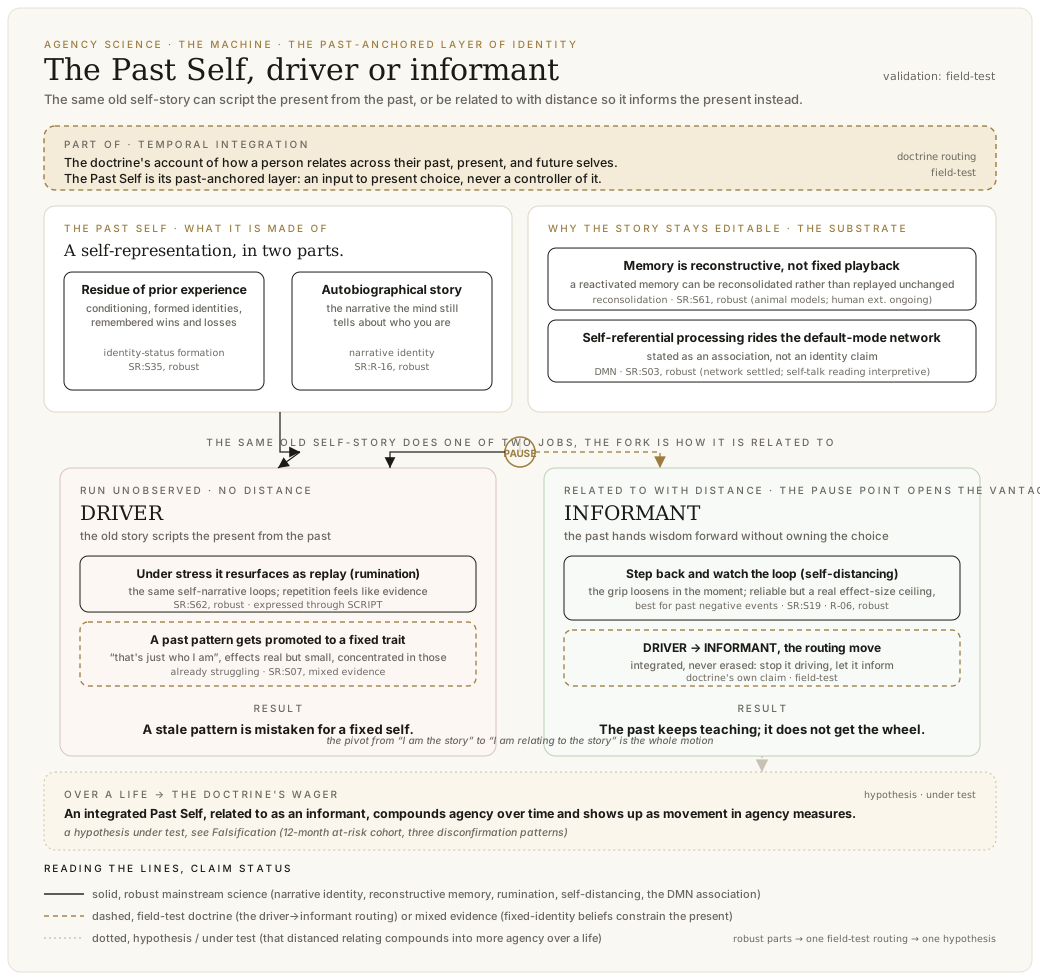
The Past Self is the self-representation a person carries forward from prior experience: the conditioning, the wins, the losses, the identities formed along the way, plus the autobiographical story a person still tells about who they are.
It sits in Temporal Integration, the doctrine's account of how a person relates to their own past, present, and future selves. It matters because the same old self-story can do two opposite jobs. Left to run, it scripts the present from the past† and a person can mistake a stale pattern for a fixed trait. When a person relates to it with a little distance, it becomes an informant: it hands wisdom forward without owning the choice.† The wager that this distanced relating compounds into more agency over a life is the doctrine's own, and it is still a hypothesis.†
Glossary Definition
The Past Self is a self-representation: the past-anchored layer of identity, built from prior conditioning and the autobiographical narrative a person still carries about who they are.
Formal Definition
The Past Self is a layer of identity anchored in what came before. It is composed of two parts: the residue of prior experience (conditioning, formed identities, remembered wins and losses) and the autobiographical narrative a person maintains about who they are. It is observed two ways: through reported identity narrative, and through the recurring patterns a person describes as "who I've always been". The doctrine treats it as an input to present choice rather than a controller of it.†
Scope note: In scope is the memory-and-narrative layer of identity and the question of whether a person is governed by that layer or relates to it. Out of scope are the present-tense appraisal systems and the forward projection of identity (both belong to Temporal Integration as separate layers), and clinical memory pathology, which belongs to treatment. Validation status: field-test
Overview
A person walks into a new situation and the reaction feels old. The room is new, the stakes are new, but the response arrives pre-formed, as if it had been waiting. That is the Past Self stepping forward. Sometimes it arrives as a lesson worth keeping. Sometimes it arrives as a SCRIPT, an old line delivered on cue.
The trouble starts when a past pattern gets promoted to a fixed trait. "I'm just not that kind of person." "This is who I've always been." Said often enough, those sentences stop describing a history and start constraining a present, treating one old pattern as if it were a permanent fact about the self. Whether such fixed-identity beliefs hold a person back is genuinely mixed in the research. The honest version of the claim is small: the effect is real but modest, and it is concentrated in people who were already struggling.
In Radical Agency the Past Self is never erased, by design. It is stopped from driving. The picture under the doctrine is a car. The Past Self can ride as the driver, taking the wheel and steering the present from the past.† Or it can ride as the informant in the passenger seat, reading the map aloud while the present-tense self drives. The work is to convert it from a driver of present behavior into an informant that supplies the present with whatever the past actually learned, without handing it the wheel.†
Lived Experience
Under stress, the doctrine treats the Past Self as commonly surfacing as replay rather than as a calm lesson.† The same old self-story runs on a loop, again and again, and each pass feels like progress toward a resolution that never comes. Psychology has a name for this loop and a literature behind it: rumination, the habit of turning the same self-referential material over without resolving it. The replay sustains the old story rather than settling it.
Now picture the other move. Instead of being inside the loop, a person steps back and watches it from a small distance, the way they might watch a character in someone else's account. The grip loosens. The old story is still there, still familiar, but it is now something observed rather than something obeyed. In the doctrine's account, that distanced vantage is what lets the past inform the present instead of running it.† It is the difference between the old self riding as driver and the old self riding as informant: same passenger, different seat. The pivot from "I am the story" to "I am relating to the story" is the motion the doctrine calls integrating a Past Self.†
Science Anchor
The Past Self draws on mainstream developmental and personality science, not on any neurotransmitter claim. People organize who they are as an internalized, evolving life story (narrative identity, SR:R-16), and identity itself is built over time through exploration and commitment (identity-status formation, SR:S35). Both are robust. The Past Self names the past-anchored component of this substrate.
One reason that component is not a fixed archive is reconsolidation. A reactivated memory can re-enter a labile state, which is the basis for the claim that memory is reconstructive rather than fixed playback (SR:S61). That claim is robust in animal models; the human therapeutic extension is ongoing research, and the tile asserts only the narrow reconstructive-memory finding, not that an autobiographical self-story can be deliberately rewritten on demand. Rumination is repetitive self-referential replay that sustains unresolved material rather than resolving it (SR:S62, robust). The doctrine maps that replay to one common stress-state surface of the Past Self.† A self-distanced vantage can reduce immediate emotional reactivity to the story (SR:S19 and SR:R-06, both robust). That effect is reliable but small-to-moderate and best validated for past negative events, not as a universal acute-state intervention.
One more association sets the substrate. Self-referential and autobiographical processing tends to co-occur with default-mode network activity, the network active during mind-wandering and self-narrative (SR:S03). The network itself is settled neuroscience; the specific reading of it as the seat of self-narrative is interpretive, so the tile states it as an association, not an identity claim.
FAQ
Is the Past Self the same as memory? No. Memory is one of its two parts. The Past Self is the past-anchored layer of identity: the residue of prior conditioning and formed identities, plus the autobiographical story a person tells about who they are. Memory supplies the raw material; the Past Self is the self-representation built from it.
Does Radical Agency want me to delete my Past Self? No. The Past Self is integrated, never erased. The aim is to stop it from driving the present and to let it inform the present instead.† A past that taught something real should keep teaching; it just should not get the wheel.
Why does my old story feel so true under pressure? Because under stress, the doctrine treats the Past Self as commonly resurfacing as replay rather than as a calm lesson.† The same self-referential material runs on a loop (rumination), and repetition feels like evidence. The loop sustains the story rather than testing it, which is why stepping back to observe the story, instead of rehearsing it, changes the experience.
Claim Status
What rests on settled science, and what is the doctrine's own contribution, stated plainly so a reader never has to guess.
| Claim | Status |
|---|---|
| Identity lives in autobiographical memory and narrative, formed through exploration and commitment over time | Robust mainstream developmental and personality science (SR:R-16, SR:S35) |
| Memory is reconstructive: a reactivated memory can be reconsolidated rather than replayed unchanged | Robust in animal models; human therapeutic extension is ongoing research (SR:S61) |
| Distanced relating to an old self-story (self-distancing) reduces immediate emotional reactivity in the moment | Robust, with a real effect-size ceiling (SR:S19, SR:R-06) |
| Fixed-identity beliefs constrain present behavior by treating a past pattern as a fixed trait | Mixed evidence: real but small, concentrated in at-risk groups (SR:S07) |
| The Past Self commonly surfaces under stress as rumination-like replay | Field-test doctrine |
| Left unobserved, the Past Self drives the present from the past (it scripts present behavior from the prior pattern) | Field-test doctrine |
| The Past Self, integrated rather than erased, becomes an informant to the present and not its driver | Field-test doctrine |
| Converting the Past Self from driver to informant compounds agency over time and moves agency measures | Hypothesis, under test |
† marker. A dagger (†) marks a claim graded field-test or hypothesis in the table above. It is flagged once, here, so the prose never repeats the label inline. Anything unmarked is plain description or rests on the robust science cited in the Science Anchor.
Falsification & Boundary Conditions
The doctrine carries four graded claims: the stress-surface claim, the routing claim, the informant claim, and the compounding hypothesis. Here is how each could be disconfirmed.
Traceability matrix. This is a two-way ledger. Every field-test or hypothesis row in the Claim Status box appears here, and every daggered claim in the body is accounted for: the "Daggered body location" cell lists the section and the exact daggered phrase for every place the claim is stated or restated. The remaining cells give the measure (instruments glossed), the window, the comparison, and the result that would disconfirm the claim.
| Claim (status) | Daggered body location(s), exact phrase | Measure | Window | Comparison | Disconfirming result |
|---|---|---|---|---|---|
| The Past Self surfaces under stress as rumination-like replay (field-test) | Lived Experience ("the doctrine treats the Past Self as commonly surfacing as replay rather than as a calm lesson.†"); Science Anchor ("The doctrine maps that replay to one common stress-state surface of the Past Self.†"); FAQ ("Because under stress, the doctrine treats the Past Self as commonly resurfacing as replay rather than as a calm lesson.†") | Coded recurrence of self-referential replay (response-styles measure) at moments of reported stress | Within-session, across repeated stress episodes | Stress episodes vs matched low-stress episodes in the same people | Replay frequency does not rise above baseline under stress, or is no higher than in matched low-stress episodes |
| Left unobserved, the Past Self drives the present from the past (field-test) | In Brief ("it scripts the present from the past†"); Overview ("steering the present from the past.†"); Quick Reference picture bullet ("The same old self can take the wheel and steer the present from the past,†") and why-it-matters bullet ("it scripts the present from what came before.†") | Coded prior-self-story activation vs the present response a person then selects | Cue-to-response, within the episode | Above context and baseline controls (situation, current goals, mood) | Coded prior-self-story activation does not predict present-response selection above context and baseline controls |
| Integrated, the Past Self becomes informant rather than driver (field-test) | In Brief ("it hands wisdom forward without owning the choice.†"); Formal Definition ("The doctrine treats it as an input to present choice rather than a controller of it.†"); Overview ("without handing it the wheel.†"); Lived Experience ("lets the past inform the present instead of running it.†" and "the motion the doctrine calls integrating a Past Self.†"); FAQ ("The aim is to stop it from driving the present and to let it inform the present instead.†"); Quick Reference why-it-matters bullet ("it becomes usable information.†") and Produces bullet ("an integrated Past Self informs rather than drives.†") | Coded distanced/informant stance; prior-pattern dominance and rate of deliberate response selection | Within the episode, distanced vs non-distanced | Matched distanced vs non-distanced episodes in the same people | Coded distanced/informant stance does not reduce prior-pattern dominance or increase deliberate response selection vs matched non-distanced episodes |
| Conversion compounds agency over time (hypothesis) | In Brief ("this distanced relating compounds into more agency over a life is the doctrine's own, and it is still a hypothesis.†") | Within-person agency index (self-report agency questionnaire + a behavioral proxy) | Twelve months (baseline, 3, 6, 12) | Trained arm vs matched arm; arm-by-time interaction | Null interaction at twelve months, OR early advantage decays/reverses, OR the index moves but is unrelated to a driver-to-informant shift on a manipulation check |
The compounding hypothesis carries the longest test design, set out in full below.
What would be measured. A within-person agency index, tracked longitudinally. A validated self-report agency measure (a multi-subscale agency questionnaire) is paired with at least one behavioral proxy that does not depend on self-report. Candidate proxies are the rate of follow-through on stated intentions, or the latency between a triggering cue and a deliberate response. The intervention arm trains the distancing-and-routing move (relating to the old self-story rather than obeying it); a matched arm does not.
Time horizon and population. A cohort followed for twelve months, with measurement at baseline, three, six, and twelve months. The cohort is adults who report recurring fixed-identity patterns ("that's just who I am") at intake, since that is the population the construct claims to act on.
What would count as disconfirmation. The hypothesis predicts that the trained arm shows a growing agency gap over the matched arm: a positive interaction between arm and time, with the effect widening rather than washing out by month twelve. It is disconfirmed if any one of three patterns holds. First, the trained arm shows no reliable advantage over the matched arm at twelve months (a null interaction). Second, any early advantage decays to zero or reverses by twelve months (no compounding). Third, the agency index moves but the change is unrelated to whether a person actually shifted from driver-relating to informant-relating on a manipulation check. Any one of those patterns falsifies the compounding claim as stated.
Boundary conditions. The construct is a model of how a person relates to the memory-and-narrative layer of identity, not a general explanation for all identity or behavior problems. It weakens or does not apply in four places. First, clinical memory pathology (amnesia, PTSD intrusion, dementia) exits the construct and belongs to treatment, not to relating-with-distance. Second, the self-distancing move it relies on is best-validated for past negative events, not for acute in-the-moment states. Its benefit is therefore expected to shrink under high arousal. Third, where a "fixed-identity pattern" is in fact an accurate present constraint (a real skill gap, a real external barrier), relabeling it as a stale story is a category error and the construct should yield. Fourth, the compounding claim assumes a person can run the distancing-and-routing move at all; in populations who cannot reliably take a self-distanced stance, the predicted advantage should not appear.
Quick Reference
- What it is: the past-anchored layer of identity. Memory plus the story a person carries about who they are.
- Why it matters: when a person holds it at a distance, it becomes usable information.† Run unobserved, it scripts the present from what came before.†
- The picture: a driver or an informant. The same old self can take the wheel and steer the present from the past,† or ride in the passenger seat reading the map while the present-tense self drives.
- Where it shows up: rumination loops. Fixed-identity labels ("that's just who I am"). Repeating patterns.
- Object type / Layer: construct / Class 5.
- Part of: Temporal Integration. The layer it sits inside.
- Produces: input to present choices. The doctrine's wager is that an integrated Past Self informs rather than drives.†
- Often confused with: Story. Story is the active narrating process; this construct is the past-anchored identity that process keeps re-writing.
Relations
- part_of:: Temporal Integration (TBD). The past-anchored layer of the larger account of relating across time.
- contrast_with:: Story (TBD). Story is the live narrating process; this construct is the past-anchored identity that process keeps re-writing.
- related:: SCRIPT (TBD). SCRIPT is the narrator that activates and delivers an old self-story in the present; it expresses the Past Self, it does not create it.
- related:: Authorship (TBD). Relating to the prior identity instead of being run by it is an act of authorship over one's own story.
- related:: The Pause Point (TBD). The pause is where a distanced vantage on the old story becomes available.
Aliases & Registers
| alias | register | status |
|---|---|---|
| Past me / Earlier self | public | proposed |
| Old me | public | proposed |
Provenance & Ancestry
Author-coined within the Radical Agency Lexicon lineage (Lexicon v1.5, archived to 99_ARCHIVE/). The construct maps onto established academic terminology rather than inventing new mechanism. Narrative identity (McAdams) and identity-status formation (Marcia) are the personality and developmental anchors for "self as story." Memory reconsolidation (Nader and colleagues) is the basis for treating memory as reconstructive rather than fixed playback, and self-distancing (Kross; Kross and Ayduk; Moser) is the academic anchor for the tile's distanced-vantage move; the driver-to-informant routing claim remains the doctrine's field-test contribution. The doctrine's contribution is the routing move: the Past Self is treated as an input to Temporal Integration, an informant to the present, not a thing to delete.
Sources
- SR:R-16 McAdams, narrative identity; robust. The academic anchor for self-as-story.
- SR:S35 Marcia, identity statuses; robust. Identity formed through exploration and commitment over time.
- SR:S61 Nader et al. (2000), memory reconsolidation; robust in animal models (human therapeutic extension is ongoing research). Memory is reconstructive, not fixed playback.
- SR:S62 Nolen-Hoeksema (1991), rumination / response-styles theory; robust. The stress-driven replay of old self-narratives.
- SR:S19 Self-distancing (Kross); robust. A distanced vantage can reduce immediate emotional reactivity to a self-story; reliable but small-to-moderate, best-validated for past negative events.
- SR:R-06 Kross & Ayduk 2017; Moser 2017 (distanced self-talk); robust. Evidence for self-distancing and distanced self-talk. Supports the distanced-vantage boundary without proving the doctrine's driver/informant routing claim.
- SR:S07 Mindset theory (Dweck); mixed. Fixed-identity / self-theory beliefs; effects real but small (Sisk 2018 meta d≈.08) and concentrated in at-risk groups.
- SR:S03 Default Mode Network (Raichle); robust. Self-referential and autobiographical processing as a DMN association, not an identity claim.
Version History
| version | date | change | by | |
|---|---|---|---|---|
| 2.8 | 2026-07-02 | Register fork completed (Law 13.1, Fable 5 re-audit): added the registers: frontmatter block with the Institute opener (verbatim from the body In Brief) and the metaphor-first Radical Agency alternate. Both daggered opener claims restate body-daggered claims already rowed in the Claim-Status matrix. Body copy untouched. Re-linted PASS (--strict, zero warnings). | claude-code claude-code-golden-standard-fable-reaudit-20260702 | |
| 2.7 | 2026-07-01 | Round-6 convergence pass (Codex GPT-5.5 r6 verdict, gated). (1) Traceability matrix correctness (§12.1): the Formal Definition daggered quote moved from the driver row ("Left unobserved, the Past Self drives the present from the past") to the informant row ("The Past Self, integrated rather than erased, becomes an informant to the present and not its driver"), where the stance it states actually belongs, and expanded to the full exact daggered sentence ("The doctrine treats it as an input to present choice rather than a controller of it.†"). (2) The informant row's FAQ quote expanded from the abbreviated "to let it inform the present instead.†" to the full exact daggered sentence ("The aim is to stop it from driving the present and to let it inform the present instead.†"). (3) Science Anchor naming boundary: "the past-anchored slice of exactly this substrate" to "the past-anchored component of this substrate" per the Codex exact fix, with the anaphor two sentences later synced ("that slice" to "that component") for one-term-one-referent (spec gotcha 4). Companion BUILD_SPEC edit in the same pass: gotcha 8 vivid-voice rule now names the required Quick Reference central-figure bullet as a permitted vivid site (Codex r6 exact fix), checklist synced. Codex r6 skeleton figure-wiring relocation REJECTED as out-of-mandate structural taste. Gate: lexicon_style_check.py --strict PASS (no waivers) on tile + spec. | claude-code gtm-construct-r6-codex-residuals-20260701 | |
| 2.6 | 2026-07-01 | Round-5 convergence pass (GLM 5.2 r5 + Codex GPT-5.5 r5 verdicts, gated). (1) FAQ stress-surface restatement daggered and re-hedged per the Codex exact fix ("Because under stress, the doctrine treats the Past Self as commonly resurfacing as replay rather than as a calm lesson.†"), restoring the "commonly" frequency hedge (§12.3, §1.1); its exact quote appended to the stress-surface traceability row (§12.1). (2) Traceability matrix: the Quick Reference picture-bullet quote expanded to the full daggered sentence ("The same old self can take the wheel and steer the present from the past,†") per §12.1 exact-quote. (3) Figure caption neutralized for the formal layer and its informant clause given a named actor: "When unobserved, it is represented on the DRIVER path... when a person relates to it with distance, it is represented on the INFORMANT path, providing information to present choice without controlling it" (Codex exact replacements + gotcha 2); manifest caption synced; figure_alt unchanged (it describes the SVG's literal labels). (4) In Brief hedge: "a person can mistake a stale pattern for a fixed trait" (§1.1, mixed-evidence claim no longer stated flat). (5) Scope note: "run by" to "governed by" (§2.2 formal register). (6) Publication state set to final; Version History notes made publishable. Gate: lexicon_style_check.py --strict PASS (no waivers) on tile + spec. | claude-code gtm-construct-r5-convergence-20260701 | |
| 2.5 | 2026-06-26 | Round-4 convergence FINAL FIX (CONSTRUCT type) against the GLM 5.2 r4 verdict (3 named items only, bounded). (1) Falsification opener: replaced the four parenthetical content restatements + orphan dagger with label-only claim naming ("The doctrine carries four graded claims: the stress-surface claim, the routing claim, the informant claim, and the compounding hypothesis."), removing all four restatements and the orphan dagger in one edit per §12.3 (matrix stays bidirectional + exact-quote; the compounding row already lists the In Brief daggered phrase, so nothing is dropped). (2) FAQ mind-as-actor (gotcha 6): "the autobiographical story the mind tells about who the person is" -> "a person tells about who they are". (3) Vocabulary consistency (gotcha 4, one-term-one-referent): "prior-anchored" -> "past-anchored" at all three remaining sites (two Quick Reference bullets GLM named + the Relations contrast_with line, which GLM asserted already used past-anchored but did not). Companion BUILD_SPEC edits in the same pass (GLM Gap 1/2): §2 item 10 now mandates label-only framing-sentence naming (parenthetical restatement = daggerable §12.3); checklist restatement parenthetical now includes "Falsification opener". Gate: lexicon_style_check.py --strict PASS (no waivers) on tile + spec. | claude-code gtm-construct-r4-glm-convergence-20260626 | |
| 2.4 | 2026-06-26 | Round-3 convergence FINAL FIX (CONSTRUCT type) against the GLM 5.2 r3 + Codex GPT-5.5 r3 audits + Universal Law §12 (v1.2 amendments). CENTERPIECE (§12.1): rebuilt the traceability matrix into a BIDIRECTIONAL exact-quote ledger. Every daggered body claim is now accounted for in a row, each "Daggered body location(s)" cell lists ALL sections where the claim is stated or restated with the exact daggered phrase (routing now lists In Brief + Formal Definition + Overview + both Quick Reference bullets; informant lists In Brief + Overview + both Lived Experience phrases + FAQ + both Quick Reference bullets; stress-surface lists Lived Experience + Science Anchor). HARD (Codex r3): daggered the stress-surface field-test claim where it was a plain assertion in Lived Experience ("the doctrine treats the Past Self as commonly surfacing as replay rather than as a calm lesson†"), keeping the rumination sentence as the robust SR:S62 premise (§12.3 every restatement carries a dagger). HARD (Codex r3): daggered the informant outcome in the Quick Reference why-it-matters bullet, neutralizing "wisdom" to "usable information for the present†". HARD (Codex r3 + §11.3): neutralized three formal-layer metaphors. Provenance "self-distancing is the mechanism behind relating to the story rather than being run by it" -> "the academic anchor for the tile's distanced-vantage move; the driver-to-informant routing claim remains the doctrine's field-test contribution"; Sources SR:S19 "loosens the grip" -> "can reduce immediate emotional reactivity"; Sources SR:R-06 "the 'step back and watch the loop' mechanism" -> "Evidence for self-distancing and distanced self-talk... without proving the doctrine's driver/informant routing claim". GLM r3 + Codex r3: Falsification opener "three load-bearing claims" -> "four graded claims" (stress-surface, routing, informant, compounding). Codex r3: removed the "The old story" alias (collides with the separate Story construct, "Often confused with: Story") from frontmatter, the Aliases table, and demoted it to a RETIRED descriptive-phrase row in 00_NAME_REGISTRY.md. FIGURE (§12.6): wired the staged SVG: figure/figure_asset (relative _diagrams/past-self/past-self.lexicon.svg) + figure_section (Formal Definition) + authored figure_alt + figure_caption (driver-vs-informant; line treatment solid/dashed/dotted = claim status); asset verified present. GLM r3 (cosmetic): disambiguated the three duplicate v2.0 version rows to v2.0 / v2.0.1 / v2.0.2. Gate: lexicon_style_check.py --strict PASS (no waivers). | claude-code gtm-construct-r3-convergence-20260626 | |
| 2.3 | 2026-06-26 | Golden Tile Machine gold-exemplar FINAL FIX (CONSTRUCT type) against the Codex GPT-5.5 final redline + Universal Law §11 (v1.1 amendments). CENTERPIECE (§11.1): built the mandatory Claim-Status -> body-dagger -> Falsification traceability matrix into the Falsification section, covering ALL four field-test/hypothesis rows (rumination-surface, routing/driver, informant, compounding) with body location + measure + window + comparison + disconfirming result; broadened the section opener from the compounding hypothesis alone to all three load-bearing doctrine claims. HARD: split the rumination claim-citation fusion in the Science Anchor (now states SR:S62 rumination as a robust standalone premise, then a separate daggered doctrine-mapping sentence) and added its matching Claim-Status row ("The Past Self commonly surfaces under stress as rumination-like replay | Field-test doctrine"). HARD: neutralized the three formal-layer vivid metaphors per Codex exact replacements. Science Anchor "loosens its grip in the moment"/"universal off-switch" -> "reduce immediate emotional reactivity"/"not as a universal acute-state intervention"; Claim-Status "loosens its grip" -> "reduces immediate emotional reactivity"; Falsification "universal solvent" -> "not a general explanation for all identity or behavior problems". HARD: daggered the recurring causal metaphors at the clauses where they recur. Overview "steering the present from the past†", FAQ "let it inform the present instead†", Quick Reference "it scripts the present from what came before†" + "steer the present from the past†". Gate: lexicon_style_check.py --strict PASS (no waivers). | claude-code gtm-construct-codex-final-redline-20260626 |
| 2.2 | 2026-06-26 | Golden Tile Machine gold-exemplar FIX (CONSTRUCT type) against the GLM 5.2 second-pass full-tile audit. MED (HARD rubric item 6): daggered the causal-direction doctrine claim "it scripts the present from the past" in the In Brief (was carrying no dagger on the clause), and added its own Claim-Status row ("Left unobserved, the Past Self drives the present from the past", Field-test doctrine) so the daggered clause maps two-way per Universal Law §2.1. LOW: rewrote the Quick Reference "Held at a little distance, it becomes wisdom for the present" (a dangling "Held..." opener the Build Spec gotcha 2 prohibits) to name the actor cleanly: "When a person holds it at a little distance, it becomes wisdom for the present." LOW: fixed In Brief pronoun ambiguity. "the autobiographical story the mind still tells about who they are" -> "the autobiographical story a person still tells about who they are" (matches the Glossary's person-as-subject phrasing; removes the mind/person antecedent collision). LOW: neutralized the "files under" filing-cabinet metaphor in the Formal Definition (a neutral layer) -> "the recurring patterns a person describes as 'who I've always been'." Companion Build Spec edits in the same pass resolved the gotcha-2 self-contradiction, the worked-skeleton dangler echo, and added construct-specific reminders to dagger metaphorical causal claims (gotcha 7) and to disambiguate paired-subject definition pronouns (gotcha 6). Skipped GLM ISSUE 5 (WARN-only: no contractions in vivid layers) as optional. Gate: lexicon_style_check.py --strict PASS. | claude-code gtm-construct-golden-redline2-20260626 | |
| 2.1 | 2026-06-25 | Golden Tile Machine gold-exemplar FIX (CONSTRUCT type) against the GLM 5.2 full-tile audit + the Universal Golden Tile Build Law. HIGH: rewrote the dangling "Related to with a little distance, it becomes an informant" construction (In Brief) to name the actor ("When a person relates to it with a little distance, it becomes an informant: it hands wisdom forward without owning the choice.†"), and the Quick Reference "Related to with distance, it becomes wisdom for the present" to "Held at a little distance, it becomes wisdom for the present." HIGH: replaced the unglossed insider term "the AQ profile dials" in the Falsification design with a plain gloss ("a validated self-report agency measure (a multi-subscale agency questionnaire)"). MED: daggered the Formal Definition doctrine claim "input to present choice rather than a controller of it" inline (was section-level only). MED: replaced "self-talk" with "self-narrative" in the Science Anchor DMN sentence to match the tile's own vocabulary. LOW: "who its owner is" -> "who they are" (mind-as-owner phrasing). Locked the driver/informant/"the wheel" car figure as the canonical Past Self metaphor and threaded it through In Brief (Radical-Agency alt), Overview, Lived Experience, and Quick Reference. Added "by design" to the "never erased" doctrine stance per GLM LOW. DEFER (GLM LOW, not applied): generic illustrations in Overview/Lived Experience left untagged (they carry no named cast, so they are generic illustrations, not composite scenes per the scene-labeling rule); the two adjacent design-principle statements in Overview ("never erased", "stopped from driving") left under the section-level field-test status rather than individually daggered (design principles, not testable outcomes). Gate: lexicon_style_check.py PASS. | claude-code gtm-construct-golden-20260625 | |
| 2.0.2 | 2026-06-15 | P4f1 gold-exemplar FIX against the reconciled v5.2 construct spine + independent Codex blockers (session codex-past-self-p4f1-audit). Reordered to the v5.2 construct spine: FAQ now precedes Claim Status; renamed ## Falsification to the now-REQUIRED ## Falsification & Boundary Conditions and added a real Boundary Conditions block (four places the construct weakens/yields: clinical memory pathology, high-arousal acute states, accurate present constraints, populations who cannot self-distance). Fixed C-08 field-test leakage: removed an errant dagger from the mixed-grade fixed-identity claim ("contested" softened to "mixed" to match the Claim Status grade), and daggered the two field-test routing statements in Lived Experience that had asserted the driver-to-informant outcome as plain fact. Narrowed the reconsolidation/self-story-editability claims (Science Anchor + Provenance) back to the ledger's C-02 scope: only the narrow reconstructive-memory finding is asserted, not deliberate on-demand rewriting of an autobiographical self-story. Authored the missing S2 claim ledger at _HIVE_WB/Past_Self/S2_Past_Self_ledger.json (8 rows C-01..C-08; covers all eight body SR keys; field-test/hypothesis rows carry cs_phrases surfaced in the Claim Status box). Split a 67-word boundary-conditions sentence. Relations verified valid (SCRIPT correctly related::, Temporal_Integration part_of::, all five targets carry lawful (TBD) concept-ID parentheticals; no minted AGS IDs exist for these targets yet). Gates: style PASS (0 em-dashes, 0 warnings, incl. sentence-length); SR-validate PASS; claim-ledger PASS. Aliases (Past Self + Past me + Earlier self + Old me + The old story) already present as proposed rows in 00_NAME_REGISTRY.md. | claude-code lexrb-pastself-P4f1-FIX-20260615 | |
| 2.0.1 | 2026-06-14 | S4.5 dual-redline reconciliation. Applied valid blockers: C-08 (stripped the driver-to-informant outcome from the bare Glossary differentia; daggered the Quick Reference Produces line so the field-test claim wears its label outside the Claim Status box); C-03 (deleted the unlicensed causal bridge "which is why an old self-story can be re-related-to," kept only the licensed reconstructive-memory claim); C-06 (deleted "without taxing cognitive control" from the SR:R-06 Sources entry, an unauthorized specific finding); added a ## Falsification mini-design for C-09 (within-person agency index, 12-month at-risk cohort, three disconfirmation patterns); re-typed produced_by:: SCRIPT to related:: (SCRIPT expresses/activates Past Self, does not create it); changed Quick Reference "Depends on" to "Part of" (containment, matching the part_of edge); removed the redundant bare "Related concepts (Core)" list (the typed Relations cover it); split two over-length sentences (Science Anchor, Provenance). Adjudication: redline-2 (R-01/R-02/R-03) ruled STALE, those phrases exist only in the superseded v1 Past_Self.md, not this draft, and the v2 rebuild already resolved them. Added five proposed rows (Past Self + 4 aliases) to 00_NAME_REGISTRY.md per the maintenance protocol. Gates after fix: style PASS (incl. --strict), SR-validate PASS, claim-ledger PASS, rubric non-strict 0 FAILs (M1.3 concept_id TBD is the lawful pre-S8 state). | claude-code lexrb-pastself-S4.5-20260614 | |
| 2.0 | 2026-06-14 | Standard v2 rebuild to the v5.2 spine (P4f1 draft). Migrated the v1 tile (Glossary + Quick Reference + Overview + Science Anchor) to the full construct spine: In Brief first, ISO-704 genus+differentia Glossary and Formal Definition, Overview and Lived Experience in the vivid register, Science Anchor in the neutral hedged register with Science-Register citations, a Claim Status box with the single-dagger (†) convention legended once, FAQ, Quick Reference, dash-free typed Relations with concept-ID parentheticals, Aliases, Provenance, Sources, and Version History. Drafted only from the S2.5-passed claim ledger (rows C-01 through C-09). Citations: SR:R-16, S35, S61, S62, S19, R-06, S07, S03. Relations link only to existing on-roadmap tiles (Temporal_Integration, Story, SCRIPT, Authorship, The_Pause_Point); unminted targets carry lawful (TBD). | claude-code lexrb-pastself-P4f1-20260614 | |
| 1.0 | (legacy) | Radical Agency Lexicon v1.5 tile (Glossary, Quick Reference, Overview, Ecosystem Fit). Superseded by the v2.0 rebuild. | (legacy) |