
The Institute of Agency Science
The instruments that came before.
The Institute claims that the skill of choosing well in half-second moments has never been measured in its own right. This annex is that claim's supporting record: every adjacent instrument named, what it measures stated fairly, and the precise sense in which the choosing itself remained unmeasured.
This annex is the Institute's public account of the instruments adjacent to agency: what each one measures, how it is measured, and the precise sense in which none of them takes the choosing itself, at the moment it happens, in the life it happens in, as its object of measurement. It is a standing reference annex of the working-papers record, maintained so the founding claim can be checked, challenged, and, if it is ever shown wrong, corrected in public.
The claim, stated precisely
The claim, as it appears across this site, is this: the skill of choosing well in half-second decision moments has never been measured in its own right. The field has measured the neighbors of that skill, thoroughly and often brilliantly. The skill itself has never been measured in its own right.
"In its own right" is doing exact work in that sentence, and it means three things at once:
- The unit of observation is the moment. The measure takes the real decision moment, in the person's own life, as its unit of observation: not a global self-description, not a laboratory stimulus, not a remembered event.
- What is scored is the choosing. The measure scores the behavior of choosing, judged against the person's own stated direction: not a belief about oneself, not a felt sense of authorship, not a preference parameter.
- The measure is governed as a measure of the individual. A standardized, calibrated, individual-level instrument, with a published methodology, a public claims discipline, and a stated account of what it does and does not support; a research method that samples populations is not yet such an instrument.
Each instrument in the register below fails at least one of these conditions, and most fail the first two. That is the whole claim.
Just as important is what the claim does not say. It does not say the adjacent literatures are wrong, weak, or dispensable; several are among the most replicated bodies of work in psychology, and the Institute's own validation bar is defined against them. It does not say that nothing near agency has been measured; the opposite is true, and this page is the inventory. And it does not say the Institute's instrument has succeeded where these have not: AQ stands at [hypothesis-grade], its reliability and predictive validity are not yet established, and the bar it must clear is published on this site. The claim is narrow. Its narrowness is what makes it defensible.
Continue: The AQ Standard
The self-report family: beliefs and dispositions
The largest family of adjacent instruments asks a person to describe themselves in general, and scores the description. These are serious instruments with long validation histories. Every one of them measures a standing property of the person; none observes a moment.
Locus of control
What it measures. A generalized belief about where control over outcomes lies: within one's own actions, or in external forces such as luck, chance, and powerful others (Rotter, 1966).
How it is measured. Self-report questionnaires. Rotter's Internal-External scale is a forced-choice questionnaire; the Pearlin Mastery Scale (Pearlin and Schooler, 1978) is a short rated-agreement scale.
The difference, precisely. A belief about control is not the exercise of it. Locus-of-control instruments ask what a person believes about outcomes in general; they observe no moment and record no choice. A person can hold a firmly internal locus and still lose the half-second when it arrives.
Self-efficacy
What it measures. A person's confidence in their capability to organize and execute the actions a situation requires: an expectancy about future performance (Bandura, 1977).
How it is measured. Self-report scales, general or domain-specific; the General Self-Efficacy Scale (Schwarzer and Jerusalem, 1995) is the standard general form.
The difference, precisely. Efficacy is "I believe I can," reported in advance. The target here is what the person did when the moment arrived. The two are expected to relate, and the relation is testable; but an expectancy about action is not an observation of it.
Grit
What it measures. Perseverance and passion for long-term goals: a disposition measured over years, validated against long-horizon achievement (Duckworth, Peterson, Matthews, and Kelly, 2007).
How it is measured. Self-report scales: the original Grit-O and the Short Grit Scale (Duckworth and Quinn, 2009), on which a person rates their own perseverance. Meta-analytic work has found large overlap between grit and conscientiousness and limited incremental value for the grit total score, with the perseverance facet carrying most of the criterion relation (Credé, Tynan, and Harms, 2017); the annex cites the construct with that finding attached, as its own literature does.
The difference, precisely. Time scale and direction. Grit summarizes years of one-directional persistence toward a held goal. Choosing well moment by moment is a different object: it sometimes means persist, and sometimes means stop, repair, or re-choose, and it is observable only at the moment itself. A perseverance summary contains no moments.
Conscientiousness
What it measures. One of the five broad trait domains: organization, productiveness, and responsibility, aggregated across a whole life (Costa and McCrae, 1992; Soto and John, 2017).
How it is measured. Self-report or observer-report personality inventories: the NEO PI-R, the Big Five Inventory, and the BFI-2.
The difference, precisely. A trait aggregate compresses thousands of moments into a single summary of the average. The compression is the method's power, and it is also the point of difference: the moment disappears in the averaging. Conscientiousness is a named comparator in the Institute's public validation bar precisely because any new measure must show it adds information beyond this trait.
Trait self-control and self-regulation
What it measures. The dispositional capacity to override impulses and regulate behavior (Tangney, Baumeister, and Boone, 2004), general self-regulatory style (Brown, Miller, and Lawendowski, 1999), and, from the reversed side, the UPPS impulsivity facets such as urgency (Whiteside and Lynam, 2001), later extended as the UPPS-P.
How it is measured. Self-report trait scales: the Brief Self-Control Scale, the Self-Regulation Questionnaire, the UPPS family of impulsivity scales.
The difference, precisely. This is the closest self-report neighbor, and the discipline is the same: it is a trait self-description. "I am good at resisting temptation" is a statement about one's general self, scored as such. It is not an observation of any single half-second, and self-perception and in-the-moment behavior are exactly the two things a measure of choosing cannot be permitted to conflate.
Self-determination theory
What it measures. The quality of motivation and the satisfaction of basic psychological needs: autonomy, competence, and relatedness; why a person acts, and whether their context supports acting from their own values (Deci and Ryan, 1985; Ryan and Deci, 2000).
How it is measured. Self-report scales of experienced need satisfaction and frustration and of self-determined functioning, such as the balanced need satisfaction and frustration measure of Chen and colleagues (2015).
The difference, precisely. Self-determination theory sits above the moment, at the layer of why. It measures experienced autonomy and the quality of a person's reasons, not the capacity to execute a hard choice when the moment arrives. The Institute expects the two to relate and treats the relation as testable; a measure of choosing that collapsed into need satisfaction would have failed its own bar.
The laboratory family: real behavior, borrowed content
A second family does observe behavior, in controlled paradigms of real rigor. What these instruments observe, however, is behavior toward laboratory content: abstract stimuli, hypothetical rewards, or the felt authorship of a keypress. The behavior is real; the moment is not the person's own.
Executive function
What it measures. The cognitive machinery of inhibition, set-shifting, and updating: the component processes that any deliberate act draws on (Miyake and colleagues, 2000).
How it is measured. Performance on speeded laboratory tasks with abstract content: the Stroop task (Stroop, 1935), the stop-signal task (Logan and Cowan, 1984), go/no-go tasks, and standardized batteries such as the NIH Toolbox measures (Flanker, Dimensional Change Card Sort, List Sorting).
The difference, precisely. Executive-function tasks measure whether the machinery works under neutral load: arrows, colors, and letters that cost the participant nothing. A real decision moment is saturated with value, consequence, and identity, and it happens in the person's own life, not at a testing station. Machinery capacity under neutral load and choosing under live pull are related, and the relation is a validation question; they are not the same measurement object.
Delay discounting
What it measures. The rate at which the subjective value of a reward decays with delay: a preference parameter, classically modeled as hyperbolic (Ainslie, 1975; Mazur, 1987).
How it is measured. Structured choices between smaller-sooner and larger-later rewards, usually monetary and often hypothetical; the Monetary Choice Questionnaire (Kirby, Petry, and Bickel, 1999) is the standard brief form.
The difference, precisely. Delay discounting deserves credit as the nearest methodological ancestor in spirit: it scores actual choices, not self-descriptions. But it indexes one preference curve, on one commodity dimension, under structured laboratory choices. It describes what a person prefers across delays; it does not observe whether the person can execute against the pull of their own curve, in their own life, at the moment the pull arrives.
Sense-of-agency psychophysics
What it measures. The pre-reflective feeling of authorship: the sense that I caused that action and its effects.
How it is measured. Millisecond-scale psychophysical procedures, most prominently intentional binding, the compression of perceived time between a voluntary action and its outcome (Haggard, Clark, and Kalogeras, 2002; reviewed in Moore and Obhi, 2012), together with sensory-attenuation procedures and explicit judgments of agency. A self-report companion exists in the Sense of Agency Scale (Tapal and colleagues, 2017).
The difference, precisely. This is the closest neighbor at the timescale, and the annex says so plainly: sense-of-agency psychophysics operates at exactly the sub-second grain the Institute cares about. What it measures there is the attribution of authorship, not the quality of the choice. Whether you feel that you caused an action is a different question from whether you chose well when it mattered. The Institute treats sense-of-agency instruments as a convergent-validation path for its own program, with the level distinction stated explicitly: micro-scale motor authorship and macro-scale life choosing are different levels of the same broad phenomenon, and neither substitutes for the other.
The retrospective family: the moment, after the fact
A third family gets nearer to real life than the laboratory, by asking about real events. It reaches them after they have happened.
Learned helplessness and explanatory style
What it measures. Originally, the collapse of responding after uncontrollable stress (Seligman and Maier, 1967); in the human literature, the style with which a person explains good and bad events, the lineage that became learned optimism.
How it is measured. Experimental procedures in the original work; in individual assessment, the Attributional Style Questionnaire (Peterson and colleagues, 1982), in which a person considers hypothetical good and bad events, writes the most likely cause of each, and rates that cause on attributional dimensions.
The difference, precisely. Explanatory style is the causal story a person characteristically tells about events, rated after the fact. The account is informative, and the tradition's own fifty-year revision is one the Institute's program takes seriously: passivity appears to be the biological default, and control is what is learned (Maier and Seligman, 2016). That finding is an argument for measuring the learned thing directly. The style instruments do not do that; they measure the story told afterward.
Experience sampling
What it measures. Desire, conflict, and resistance episodes in daily life: what people wanted, whether it conflicted with their goals, and whether they resisted (Hofmann, Baumeister, Förster, and Vohs, 2012).
How it is measured. Signal-contingent prompts on a phone or pager; the person reports on the most recent episode shortly after it occurs.
The difference, precisely. Experience sampling is the closest prior approach in the whole register, and this annex treats it as a methodological ancestor. It reaches the right terrain: real desires, in real life, close to the moment in time. What it collects there are structured self-reports about the episode, and what it was built as is a research method for studying self-control in populations, not a standardized, calibrated, governed measure of an individual's choosing capacity. The gap between "a method that samples reports near the moment" and "an instrument that measures the choosing in its own right" is precisely the gap the Institute's program exists to close.
The pattern across the register
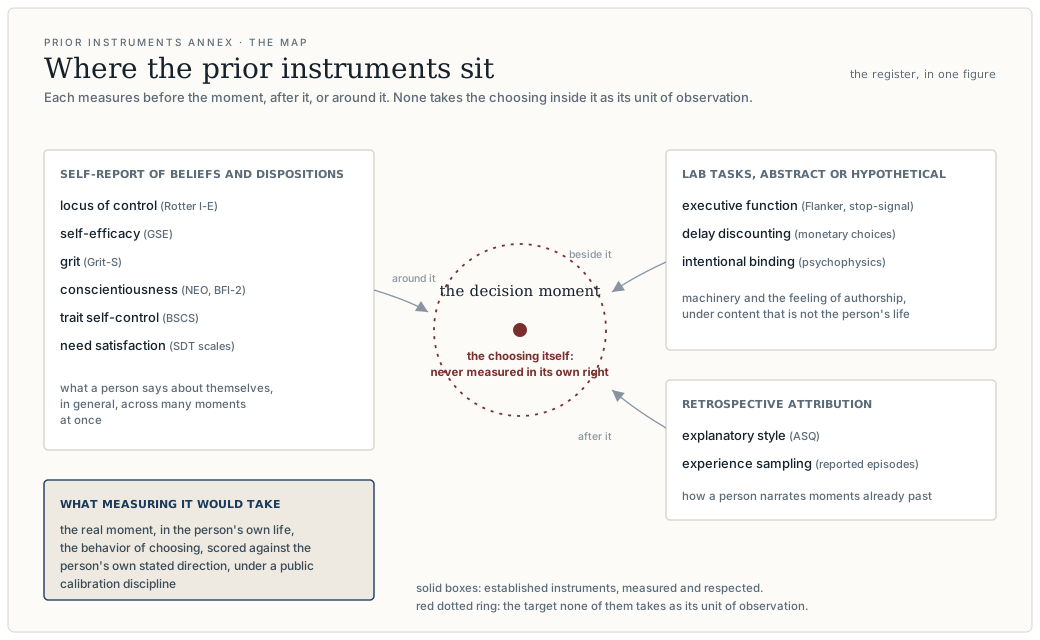
Set side by side, the register resolves into three recurring proxies:
| Method family | Reaches the person's real life | Observes the choosing itself | Governed as a measure of it |
|---|---|---|---|
| Self-report of beliefs and dispositions | Only as a summary | No; scores self-description | No |
| Laboratory behavior on borrowed content | No | Behavior yes; the person's own moment, no | No |
| Retrospective and sampled reports | Yes, after the fact | No; scores the report of it | No |
Every instrument above is legitimate on its own terms, and several are foundational. But none meets all three conditions at once: the real moment, in the person's own life, as the unit of observation; the behavior of choosing, judged against the person's own stated direction, as the thing scored; and a published, governed methodology whose claims are calibrated in public.
That is the precise sense of "never measured in its own right": not that nobody has measured anything nearby, but that no published instrument has taken the choosing itself, at the moment it happens, in the life it happens in, as its unit of observation and its object of calibration.
Continue: The AQ Standard
What the Institute owes these literatures
This annex is an acknowledgment as much as a distinction. The Institute's own program is built on the shoulders of the register above, in four explicit ways.
The comparator constructs define the bar. A new measure of agency earns the name only if it shows incremental, criterion-relevant validity beyond grit, locus of control, self-efficacy, conscientiousness, self-regulation, and executive function, and against general cognitive ability. The prior instruments are not rivals to be dismissed; they are the standard of evidence any newcomer must exceed, and the Institute fixed them as its comparators in public, in advance.
The sense-of-agency tradition supplies a convergent-validation path: if an instrument for choosing measures something real, its readings should relate, at the predicted level and no higher, to the established instruments of authorship and perceived control.
The helplessness tradition's own revision supplies the founding motivation in its strongest scientific form: if control is what is learned, then the learned thing deserves a direct measure.
And experience sampling proved the terrain is reachable: daily life can be instrumented respectfully. The remaining step, from sampled reports to a governed behavioral measure, is the step the Institute was established to take.
One note on the name. The initials "AQ" have prior use: Stoltz's Adversity Quotient (1997) names a different construct, resilience in the face of adversity, with its own instrument and literature. The Institute's instrument is the Agency Quotient, spelled out on first use for that reason, and this annex records the distinction rather than contesting the initials.
The bar this annex holds the Institute to
A page like this one would be easy to write dishonestly, as a tour of other people's limitations. Its honest form requires the Institute to state its own position with the same precision it applies to the neighbors.
The Agency Quotient (AQ) stands at [ Evidence tier: [hypothesis-grade] ]. The construct and the methods are published; no outcome evidence has been earned yet; reliability and predictive validity are not yet established. It is an instrument, not a predictor. If, under the planned independent and pre-registered validation, AQ fails to add explanatory value beyond the comparators named above, then it is a new name, not a new science, and the Institute will publish that result with the same standing as a favorable one. The claim this annex documents is a claim about what has not yet been measured. It is not a claim that the Institute has already measured it well. That has to be earned, in the open, on the ladder this site describes.
Continue: Where validation stands · Read the working papers
An open challenge
This annex is maintained as a falsifiable document. If a published, governed instrument exists that takes the real decision moment, in a person's own life, as its unit of observation, and scores the behavior of choosing in its own right, the Institute asks to be told. The correction will be made on this page, dated, with the instrument cited and the claim revised to whatever narrower form remains true. An institution that fixes its validation bar in public before the results come in should expect, and welcome, the same treatment of its history claims.
Continue: Read the working papers
References
- Ainslie, G. (1975). Specious reward: A behavioral theory of impulsiveness and impulse control. Psychological Bulletin, 82(4), 463-496.
- Bandura, A. (1977). Self-efficacy: Toward a unifying theory of behavioral change. Psychological Review, 84(2), 191-215.
- Brown, J. M., Miller, W. R., and Lawendowski, L. A. (1999). The Self-Regulation Questionnaire. In L. VandeCreek and T. L. Jackson (Eds.), Innovations in Clinical Practice: A Source Book (Vol. 17). Professional Resource Press.
- Chen, B., Vansteenkiste, M., Beyers, W., et al. (2015). Basic psychological need satisfaction, need frustration, and need strength across four cultures. Motivation and Emotion, 39(2), 216-236.
- Costa, P. T., and McCrae, R. R. (1992). Revised NEO Personality Inventory (NEO PI-R) and NEO Five-Factor Inventory (NEO-FFI) Professional Manual. Psychological Assessment Resources.
- Credé, M., Tynan, M. C., and Harms, P. D. (2017). Much ado about grit: A meta-analytic synthesis of the grit literature. Journal of Personality and Social Psychology, 113(3), 492-511.
- Deci, E. L., and Ryan, R. M. (1985). Intrinsic Motivation and Self-Determination in Human Behavior. Plenum.
- Duckworth, A. L., Peterson, C., Matthews, M. D., and Kelly, D. R. (2007). Grit: Perseverance and passion for long-term goals. Journal of Personality and Social Psychology, 92(6), 1087-1101.
- Duckworth, A. L., and Quinn, P. D. (2009). Development and validation of the Short Grit Scale (Grit-S). Journal of Personality Assessment, 91(2), 166-174.
- Haggard, P., Clark, S., and Kalogeras, J. (2002). Voluntary action and conscious awareness. Nature Neuroscience, 5(4), 382-385.
- Hofmann, W., Baumeister, R. F., Förster, G., and Vohs, K. D. (2012). Everyday temptations: An experience sampling study of desire, conflict, and self-control. Journal of Personality and Social Psychology, 102(6), 1318-1335.
- Kirby, K. N., Petry, N. M., and Bickel, W. K. (1999). Heroin addicts have higher discount rates for delayed rewards than non-drug-using controls. Journal of Experimental Psychology: General, 128(1), 78-87.
- Logan, G. D., and Cowan, W. B. (1984). On the ability to inhibit thought and action: A theory of an act of control. Psychological Review, 91(3), 295-327.
- Maier, S. F., and Seligman, M. E. P. (2016). Learned helplessness at fifty: Insights from neuroscience. Psychological Review, 123(4), 349-367.
- Mazur, J. E. (1987). An adjusting procedure for studying delayed reinforcement. In M. L. Commons et al. (Eds.), Quantitative Analyses of Behavior (Vol. 5). Erlbaum.
- Miyake, A., Friedman, N. P., Emerson, M. J., Witzki, A. H., Howerter, A., and Wager, T. D. (2000). The unity and diversity of executive functions and their contributions to complex "frontal lobe" tasks. Cognitive Psychology, 41(1), 49-100.
- Moore, J. W., and Obhi, S. S. (2012). Intentional binding and the sense of agency: A review. Consciousness and Cognition, 21(1), 546-561.
- Pearlin, L. I., and Schooler, C. (1978). The structure of coping. Journal of Health and Social Behavior, 19(1), 2-21.
- Peterson, C., Semmel, A., von Baeyer, C., Abramson, L. Y., Metalsky, G. I., and Seligman, M. E. P. (1982). The Attributional Style Questionnaire. Cognitive Therapy and Research, 6(3), 287-300.
- Rotter, J. B. (1966). Generalized expectancies for internal versus external control of reinforcement. Psychological Monographs: General and Applied, 80(1), 1-28.
- Ryan, R. M., and Deci, E. L. (2000). Self-determination theory and the facilitation of intrinsic motivation, social development, and well-being. American Psychologist, 55(1), 68-78.
- Schwarzer, R., and Jerusalem, M. (1995). Generalized Self-Efficacy Scale. In J. Weinman, S. Wright, and M. Johnston (Eds.), Measures in Health Psychology: A User's Portfolio. NFER-Nelson.
- Seligman, M. E. P., and Maier, S. F. (1967). Failure to escape traumatic shock. Journal of Experimental Psychology, 74(1), 1-9.
- Soto, C. J., and John, O. P. (2017). The next Big Five Inventory (BFI-2). Journal of Personality and Social Psychology, 113(1), 117-143.
- Stoltz, P. G. (1997). Adversity Quotient: Turning Obstacles into Opportunities. Wiley.
- Stroop, J. R. (1935). Studies of interference in serial verbal reactions. Journal of Experimental Psychology, 18(6), 643-662.
- Tangney, J. P., Baumeister, R. F., and Boone, A. L. (2004). High self-control predicts good adjustment, less pathology, better grades, and interpersonal success. Journal of Personality, 72(2), 271-324.
- Tapal, A., Oren, E., Dar, R., and Eitam, B. (2017). The Sense of Agency Scale: A measure of consciously perceived control over one's mind, body, and the immediate environment. Frontiers in Psychology, 8, 1552.
- Whiteside, S. P., and Lynam, D. R. (2001). The Five Factor Model and impulsivity: Using a structural model of personality to understand impulsivity. Personality and Individual Differences, 30(4), 669-689.