
Lexicon · mechanism Validation status: field-test
Behavioral Law of Agency
In Brief
The Behavioral Law of Agency is a decision-node model: at a moment of choice, what a person does is read through three channels they can actually reach, not through who they are.
Those channels are State (how the body feels), Story (the meaning the mind assigns), and Friction (how hard the option is to act on). In its compact public form, Behavior is approximately (State times Story) divided by Friction: change any one of the three and you change the behavior.† It sits in the mechanism layer of the doctrine, beneath the protocols and the scoreboard. It answers the most basic question: why did the behavior happen, and what would move it? Its point is to retire the character verdict. Instead of "I'm lazy" or "they're a bad lead," you read the three channels and tune them. The working claim, still under test, is that tuning those channels at the moment of choice puts the choice back under deliberate control.†
Glossary Definition
The Behavioral Law of Agency is a functional decision-node model that treats what a person or organization does at a moment of choice as the output of three engineerable channels, State, Story, and Friction, rather than as evidence of fixed character.
Formal Definition
The Behavioral Law of Agency is a functional decision-node model that predicts behavior at a choice point as a function of three engineerable channels: State, Story, and Friction. State is the body's arousal, safety, and trust. Story is the appraisal or predictive narrative running about the event. Friction is the kinetic cost of executing an option in the real world. For the public register, the model holds that changing the State, the Story, or the Friction at a decision node shifts the behavior.† No appeal to character is required. The decision node itself is the Pause Point, the brief window between the automatic tag and the full story. At that window volition is a measurable construct (SR:R-08); the interruptibility of the reflex is defined and evidenced in the Pause Point tile.
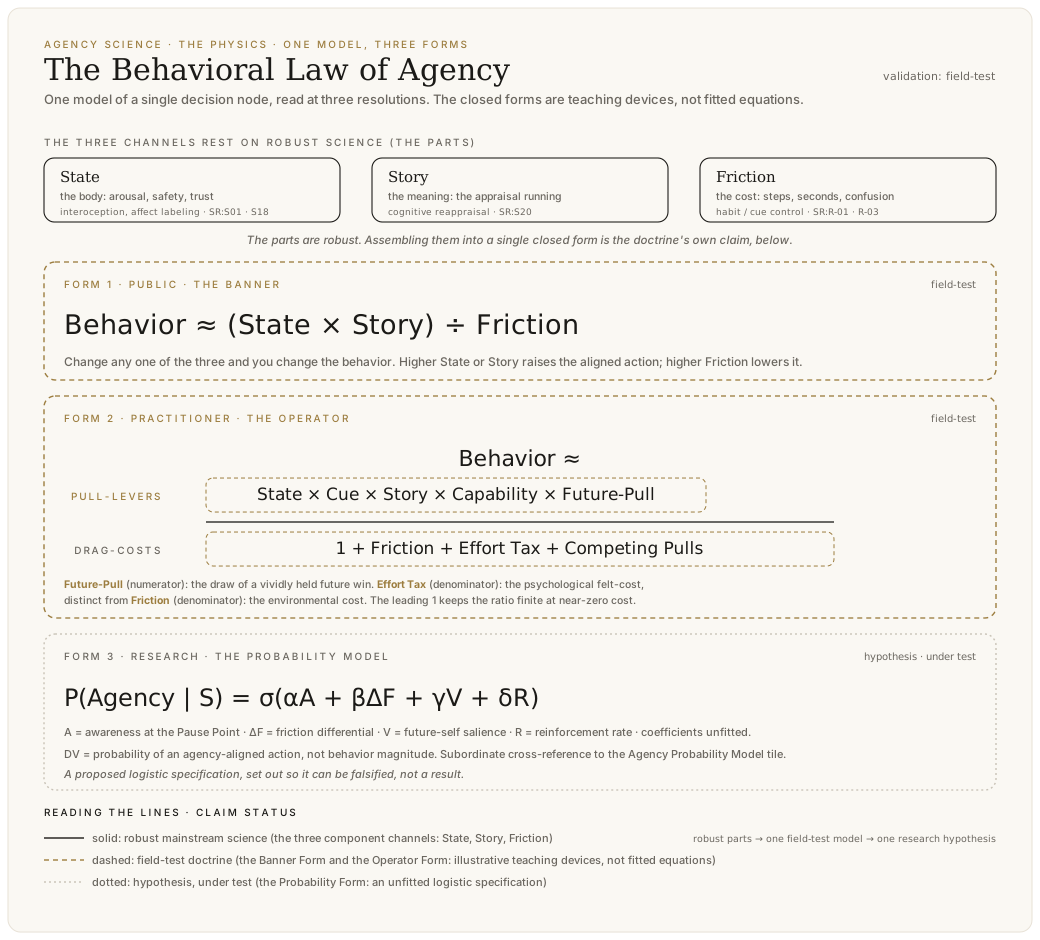
A compact teaching form captures the directions: behavior is roughly (State times Story) divided by Friction.† The model treats a higher State and a stronger Story as raising the odds of the aligned action, and higher Friction as lowering them. This arithmetic is an illustrative teaching device, not a fitted or validated functional form: the directions are load-bearing, the closed-form expression is not.
Model type: functional.
Scope note. In scope: the channels that move a single behavior at a single decision node, and the routing question of which channel to tune. Out of scope: a complete account of why any behavior happens, clinical conditions, and real external constraint (poverty, danger, caregiving load), which are circumstance, not channel. Friction here is environmental, the steps and seconds and confusion of acting, and is distinct from Resistance, the developmental challenge that builds capacity.
Validation status: field-test.
One model, three forms
The same model is read at three resolutions, not split into three different rules. The form above is the Banner Form, the public lead. In compact notation it reads B ≈ (State × Story) ÷ Friction.† For practitioners there is an Operator Form that names the levers at higher resolution; for researchers there is a Probability Form that states the model as a falsifiable specification. All three describe one model of one decision node.
The Operator Form decomposes and extends the three Banner levers to eight: behavior is roughly (State times Cue times Story times Capability times Future-Pull) divided by (1 plus Friction plus Effort Tax plus Competing Pulls). The compact notation is B ≈ (State × Cue × Story × Capability × Future-Pull) ÷ (1 + Friction + Effort Tax + Competing Pulls).† The numerator runs in body-trigger-narrative-skill-outcome order. State is the body, Cue is the trigger that starts the move, Story is the narrative, Capability is the skill to execute, and Future-Pull is the motivational salience of a future outcome. The denominator holds the costs that lower the action's probability, with the leading 1 keeping the ratio finite when cost is near zero: Friction, Effort Tax, and Competing Pulls (the rival options active at the same decision node). This is the same model viewed at higher resolution, not a different rule. The eight-term form is the same kind of illustrative device as the Banner, never a fitted equation.†
Two of the Operator levers carry a sharp boundary. Effort Tax is the psychological felt cost of acting, and it sits in the denominator. It is categorically distinct from environmental Friction: Friction is the external steps, seconds, and confusion of executing an option, while Effort Tax is the internal felt cost of acting. The two move independently and must not be merged.†
Future-Pull is the motivational salience of a future outcome, and it sits in the numerator. Greater future-outcome salience is hypothesized to increase the probability of the aligned action.† The name carries a lineage acknowledgment to Land and Jarman's Breakpoint and Beyond, 1992 (name-ancestry only; not an evidence citation; see Provenance).
The Probability Form is the subordinate research formalization, stated for falsifiability and developed in its own tile, Agency Probability Model. It writes the probability of an aligned action at a node as a logistic function, P(Agency|S) = σ(αA + βΔF + γV + δR).† Read aloud, that is the probability of agency given State equals sigma of a weighted sum of four terms. Those terms are A, awareness at the Pause Point; ΔF, the friction differential (the cost gap between the aligned and default moves); V, future-self salience; and R, reinforcement rate. Its dependent variable is the probability of an aligned action, not the magnitude of behavior, and its coefficients are unfitted. It is a proposed specification, offered so it can be tested, not a result.†
Overview
Maya (composite, illustrative) promises herself she will ship the deck tonight. Two hours later she has reorganized her desktop and answered email she could have ignored. Danny (composite, illustrative) tells a prospect the contract is as good as signed, then goes quiet for a week. From the outside both look like flaws of will. The model says something narrower and more useful: at the moment each one tipped, three dials were set against the aligned move, and none of them was "who they are."
Part of why the default wins is timing. At a decision node the automatic system tends to render the immediate cost faster and louder than the delayed payoff (SR:S33, SR:S57). The cost is the effort, the discomfort, the small social risk. The payoff is the meaning, the pride, the regret avoided. Making the near-term value visible follows the cited discounting and incentive-salience premise (SR:S33, SR:S57). Pre-deciding the next concrete move follows implementation-intention evidence (SR:S04). The doctrine's added claim is that routing those moves through State, Story, and Friction lets the deliberate choice win before the old story hardens.† The reframe is deliberate, not a willpower story. This is why the doctrine frames apparent laziness or weak willpower as explainable through the three channels.† It rests on habit and discounting research, not on a depleting-resource tank. The dignity rule runs underneath all of it: the villain is the default, never the person.
Lived Experience
Run Maya forward with the channels in view. Her State is low, so the desk feels like a wall. Her Story is catastrophic, "if it's not perfect it's worthless," which makes starting feel like risking failure. Her Friction is high in the wrong direction: the file is buried four folders deep while the distractions are one tap away. The move is not to summon more willpower. It is to tune. Stabilize State with a breath, swap the Story for a smaller true one ("a rough draft is still a draft"), and cut Friction by pinning the file open. Each lever maps to a well-studied mechanism, and the move that gets her started, pre-deciding the next concrete action, is the strongest-evidenced of them (SR:S04, strongest for initiation). The combined routing is the doctrine's own claim, under test: tuning the three channels at the decision node lowers the activation energy for the target behavior and raises it for the default.† That is what puts the choice back under deliberate control.
As a field-test analogy beyond this tile's single-decision-node scope, the doctrine extends the same model to a market.†
A customer who will not buy has a State (trust), a Story (does this solve my problem?), and a Friction (clicks to checkout). The claim that one model governs both a person's behavior and a market's, Human OS and Growth OS alike, is the doctrine's signature structural bet. It is held at field-test: the human-side mechanisms are well-supported, the market transfer is an analogy still being tested.†
Science Anchor
The model is a functional decomposition, and its strength is that each channel rests on a literature, not on a coinage.
State rests on interoception, the brain's reading of the body's own signals (SR:S01). Bringing those signals into awareness changes how the moment is processed; the matching move, naming the feeling, draws on affect labeling, where putting a sensation into words dampens limbic reactivity (SR:S18, replicated). Story rests on cognitive reappraisal, where rewriting the appraisal of an event changes the emotional and behavioral response that follows (SR:S20). There is a deeper claim under Story that the field both shares and contests. That the response is generated by pre-existing programming running automatically until the person intervenes is shared ground. Whether that programming is pre-wired by genetics or installed by experience is the contested part. The entry stays origin-neutral about it (SR:S11, contested, paired with SR:S01).
Friction rests on habit science: behavior is heavily cue- and context-driven, so changing the cost of an option changes how often it is chosen (SR:R-01). The reason the model treats the default as engineerable rather than as a character flaw is prevalence: a large share of daily behavior, roughly 43 to 45 percent of daily actions, is habitual rather than deliberate (SR:R-03). The reason repeated practice can make a behavior easier is plasticity: experience-dependent change is the same family of learning that underlies motor practice and reward learning (SR:S24, SR:S42, SR:S37, SR:S41, SR:R-01). And the reason visible progress accelerates it is feedback: behavior at the node runs as a cybernetic loop, where a visible scoreboard feeds reinforcement back into the next iteration (SR:R-09, SR:R-12, SR:S42).
The doctrine's field-test claim sits on top of these mechanisms: repeated State/Story/Friction tuning at live decision nodes leaves the aligned behavior measurably easier over time.†
FAQ
Is this really a "law"? On the public and scholarly surfaces the entry presents it as a model, not a law of physics. "Law" is a teaching label for how reliably the three channels move behavior, not a claim of physical inevitability. The precise statement is the functional one: behavior at a decision node is a function of State, Story, and Friction.
Why three channels and not more? Because three is what a person can actually tune in the moment. State, Story, and Friction map cleanly onto the body, the mind, and the environment, and each has a matching move. More dimensions would be more complete and less usable. The model trades completeness for a routing rule a person can run at the Pause Point, and whether three channels capture enough variance to be useful is itself testable (see Falsification & Boundary Conditions).
Does the equation mean behavior is calculable? No. The (State times Story) divided by Friction form is a teaching device that captures the directions: raise State or Story and the aligned action gets likelier, raise Friction and it gets less likely. It is not a measured or fitted formula, and the entry says so plainly. The Falsification & Boundary Conditions section states what would disconfirm it even as a teaching model.
Claim Status
What rests on robust-or-settled source-backed science, and what is the doctrine's own contribution, stated plainly so a reader never has to guess.
| Claim | Status |
|---|---|
| The component mechanisms behind each channel (interoception, affect labeling, reappraisal, habit automaticity, plasticity, the feedback loop) | Robust to settled mainstream science, at each cited source's SR grade (see Science Anchor) |
| Volition at the decision node is a measurable construct | Robust (Haggard / Moore / Schurger) |
| The State/Story/Friction model itself: field-test doctrine | Field-test |
| The (State x Story) / Friction equation: field-test doctrine, an illustrative teaching form not a fitted model | Field-test |
| The Operator Form (8-lever expansion of the model): field-test doctrine, an illustrative practitioner decomposition not a fitted model | Field-test |
| Effort Tax as a distinct psychological felt-cost denominator variable (vs environmental Friction): field-test doctrine | Field-test |
| Future-Pull as a distinct outcome-salience numerator variable: field-test doctrine (Land & Jarman 1992 ancestry: name-ancestry only; not an evidence citation) | Field-test |
| Immediate costs are typically rendered more saliently than delayed payoffs at decision nodes | Robust source-backed premise (SR:S33, SR:S57); no dagger |
| Tuning State/Story/Friction at the decision node to flip the default: field-test doctrine | Field-test |
| Repeated State/Story/Friction tuning at live decision nodes leaves the aligned behavior measurably easier over time (compounding): field-test doctrine (the plasticity mechanism it rests on is robust) | Field-test |
| Reframing 'laziness' as a three-channel result rather than a character or willpower failure: field-test doctrine (the doctrine does not rest on ego-depletion) | Field-test |
| One model across person and market (Human OS and Growth OS obey the same three channels): field-test doctrine | Field-test |
| That the emotional response runs automatically from pre-existing programming: shared ground; its ORIGIN (genetic vs learned) is contested science | Contested governing source (origin-neutral framing required) |
| The predictive-processing / model-based-control systems narrative: contested framework, offered as hypothesis-level narrative only | Contested; optional deeper narrative, not load-bearing |
Probability Form status. The Probability Form P(Agency|S)=sigma(alpha A + beta dF + gamma V + delta R): hypothesis, a proposed unfitted logistic specification (subordinate to Agency_Probability_Model). It is graded hypothesis, under test: a proposed logistic specification whose coefficients are not yet fitted, set out here so it can be falsified. The pipe in the expression is read aloud as "given" (probability of agency given State).
† marker. Throughout this entry, a dagger (†) marks a claim graded field-test or hypothesis in the table above and in the Formal Definition's three forms. It is flagged once, here, so the prose never has to repeat the label inline. Anything unmarked is either plain description or rests on the robust science cited in the Science Anchor.
Falsification & Boundary Conditions
The model is doctrine at field-test, and it is presented as falsifiable at that grade. A minimal test would hold the target behavior fixed and vary one channel at a time at real decision nodes, then check three things. First, dependency: does raising State, strengthening Story, or lowering Friction reliably shift the rate of the aligned action in the predicted direction? Second, routing: does tuning the channel that is actually set against the move outperform tuning a channel that is already favorable, or a non-channel-matched motivational prompt? Third, compounding: do repeated iterations at live nodes leave the aligned behavior measurably easier over time?
The core claims would be disconfirmed if changing a channel produced no reliable directional shift in behavior, or if targeted routing did no better than generic effort, or if repeated iterations left no durable change. The teaching equation specifically would be disconfirmed as a literal model, though not as a teaching device, if behavior failed to track the multiplicative pattern it implies. Two example disconfirmations. State and Story add rather than multiply. A near-zero Story still produces the action whenever State is high.
Claim-Status traceability matrix
This matrix is a bidirectional, exact-quote ledger. Every field-test or hypothesis row of the Claim Status box appears below, AND every daggered body sentence is traced here. Each "body location" cell names the section and quotes the exact daggered clause (an abbreviated quote is marked with an ellipsis); when a claim is daggered in more than one place, all locations are listed. Each row carries a falsification mini-design: measure, window, comparison, and disconfirming result. The disconfirming-result column states a test outcome, not a graded doctrine claim, so it carries no dagger. One markdown-table convention applies: a pipe character inside a quoted clause is escaped as \| in its cell, and the quote matches the body verbatim once that escape is read as a plain pipe. No daggered body sentence and no field-test/hypothesis row is left untraced.
| Daggered claim (Claim Status row) | Body location (exact daggered quote) | Measure | Window | Comparison | Disconfirming result |
|---|---|---|---|---|---|
| The State/Story/Friction model itself (dependency) | Formal Definition: "changing the State, the Story, or the Friction at a decision node shifts the behavior.†" · In Brief: "change any one of the three and you change the behavior.†" | Rate of the aligned action under a one-channel manipulation | Per decision node, across a manipulation block | Channel-up vs channel-held, same target behavior | No reliable directional shift in the aligned-action rate when a channel is moved |
| The (State × Story) ÷ Friction teaching equation (as a literal model) | Formal Definition: "behavior is roughly (State times Story) divided by Friction.†" · One model, three forms: "B ≈ (State × Story) ÷ Friction.†" | Functional form of the aligned-action rate across crossed State, Story, Friction levels | A factorial manipulation block | Multiplicative vs additive (or other) fit | Behavior fails to track the multiplicative pattern (e.g. State and Story add, or near-zero Story still yields the action when State is high) |
| The Operator Form (8-lever expansion) | One model, three forms: "The compact notation is B ≈ (State × Cue × Story × Capability × Future-Pull) ÷ (1 + Friction + Effort Tax + Competing Pulls).†" and "The eight-term form is the same kind of illustrative device as the Banner, never a fitted equation.†" | Incremental directional effect of each added lever (Cue, Capability, Future-Pull, Effort Tax, Competing Pulls) | Per-lever manipulation block | Lever-up vs lever-held | An added lever shows no reliable directional effect in the predicted direction |
| Effort Tax distinct from environmental Friction | One model, three forms: "The two move independently and must not be merged.†" | Aligned-action rate under an Effort-Tax-only manipulation (perceived felt cost held apart from environmental steps) | Per decision node | Effort-Tax varied with Friction fixed, and the reverse | The two cannot be moved independently (manipulating one always moves the other), collapsing the distinction |
| Future-Pull distinct outcome-salience numerator variable | One model, three forms: "Greater future-outcome salience is hypothesized to increase the probability of the aligned action.†" | Aligned-action rate as future-outcome salience is raised, other levers fixed | Per decision node | Future-Pull-up vs future-Pull-held | Raising future-outcome salience yields no increase in the aligned-action probability |
| Tuning State/Story/Friction at the node to flip the default (routing) | Lived Experience: "tuning the three channels at the decision node lowers the activation energy for the target behavior and raises it for the default.†" · Overview: "routing those moves through State, Story, and Friction lets the deliberate choice win before the old story hardens.†" · In Brief: "tuning those channels at the moment of choice puts the choice back under deliberate control.†" | Aligned-action rate under channel-matched routing | Per decision node | Tuning the off-set channel vs tuning a favorable channel vs a non-channel-matched motivational prompt | Matched routing does no better than tuning a favorable channel or a non-channel-matched prompt |
| Repeated tuning leaves the behavior measurably easier over time (compounding) | Science Anchor: "repeated State/Story/Friction tuning at live decision nodes leaves the aligned behavior measurably easier over time.†" | Effort Tax / latency-to-initiate for the target behavior | Repeated nodes across days or weeks | Early iterations vs later iterations | No durable reduction in felt cost or latency after repeated iterations |
| Reframing 'laziness' as a three-channel result (not character/willpower) | Overview: "This is why the doctrine frames apparent laziness or weak willpower as explainable through the three channels.†" | Variance in the aligned-action rate explained by State/Story/Friction settings vs a trait/character measure | Across persons and nodes | Three-channel model vs a dispositional-trait predictor | A stable trait predicts behavior at the node and the three channels add no explanatory value |
| One model across person and market (cross-domain transfer) | Lived Experience: "the doctrine extends the same model to a market.†" and "the market transfer is an analogy still being tested.†" | Aligned-decision rate (e.g. checkout completion) under a market-side State / appraisal / execution-cost manipulation | Per market decision | Channel-matched market intervention vs unmatched | Channel manipulations move human behavior but not the matched market decision |
| Probability Form P(Agency|S) = σ(αA + βΔF + γV + δR) | One model, three forms: "P(Agency|S) = σ(αA + βΔF + γV + δR).†" and "offered so it can be tested, not a result.†" | Fit of the logistic specification to observed aligned-action probability | A fitting study (subordinate to Agency Probability Model) | Fitted coefficients vs null (no term carries signal) | No term carries reliable signal, or the logistic form fits worse than a simpler baseline |
Non-empirical exemptions: none. Every field-test/hypothesis row above carries a falsification mini-design, and every daggered body sentence maps to exactly one row above. The Land & Jarman and Lewin references are name/conceptual-lineage only (not evidence citations) and therefore carry no dagger and no matrix row.
The boundary is where the model stops applying. It describes a person's or a market's automaticity working against a declared aim, not circumstances working against options. Real external constraint is circumstance, not channel; tuning channels will not move it. Clinical severity (depression, addiction, anxiety disorders) exits the model and belongs to treatment. The teaching equation is illustrative only: it must never be presented as a fitted or measured relationship, and no vivid point estimate belongs inside the formal claim. The cross-domain transfer to markets is an analogy under test, strongest where a market decision genuinely has a state, an appraisal, and an execution cost, and weakest where the buying decision is dominated by factors the three channels do not name (price floors, regulation, lock-in).
Quick Reference
- What it does: turns a character verdict into a tunable problem. Which channel is set against the aligned move, and which one do you change?
- The shape: three channels at one decision node, the Pause Point. Tune State (the body), Story (the meaning), or Friction (the cost). Changing one channel can shift which option is easier to take.
- Object type / Layer: mechanism / Class 5.
- The equation: behavior is roughly (State times Story) divided by Friction. A teaching form for the directions, not a fitted model.
- Cast (composite, illustrative): Maya (the stalled deck), Danny (the ghosted contract). Registry-sourced figures, not real people.
- Depends on: The Pause Point (the decision node it operates at). Also State, Story, Friction (the three channels). And AOS Autopilot Operating System (the default-behavior system it interrupts).
- Produces: POWER Protocol (the in-the-moment routine that tunes State and Story). And AQ Agency Quotient (the scoreboard that tracks the dials).
- Often confused with: Law of Agency Conversion: this is the channel model; conversion is the compounding mechanism over time. Resistance: Friction is environmental cost, Resistance is the developmental challenge that builds capacity (see Rust vs Weight).
Relations
- part_of:: The Engine of Agency (TBD). The mechanism layer the Engine's capacities operate on.
- depends_on:: The Pause Point (TBD). The decision node where the channels can be re-tuned.
- depends_on:: State (TBD). The body channel.
- depends_on:: Story (TBD). The appraisal channel.
- depends_on:: Friction (TBD). The environmental channel.
- depends_on:: AOS Autopilot Operating System (TBD). The default-behavior system the model interrupts at the node.
- produces:: POWER Protocol (TBD). The intervention that shifts State and Story in real time.
- produces:: AQ Agency Quotient (TBD). The measure that tracks the channels as dials.
- contrast_with:: Law of Agency Conversion (TBD). This is the channel equation; conversion is the compounding mechanism over time.
- contrast_with:: Resistance (TBD). Friction is environmental cost; Resistance is the capacity-building challenge.
- contrast_with:: Fogg Behavior Model (TBD). B=MAP models a prompted moment's threshold, whether motivation clears the line at the instant of a prompt; this model is direction-neutral State, Story, and cost at any decision node. Analogy, not equivalence (SR:S23, mixed).
- related:: Agency Probability Model (TBD). The subordinate Probability-Form formalization the Formal Definition points to; its dependent variable is the probability of an agency-aligned action.
- related:: Decision Node Propensity Model (TBD). The choice-level model for which option wins among competitors at a node.
- related:: Rust vs Weight (TBD). The Friction-versus-Resistance distinction in full.
Related concepts (Core): The Pause Point, State, Story, Friction, AQ Agency Quotient, The Engine of Agency, POWER Protocol, Agency Probability Model, Decision Node Propensity Model, Fogg Behavior Model, Law of Agency Conversion, Resistance, Rust vs Weight, AOS Autopilot Operating System
Aliases & Registers
| alias | register | status |
|---|---|---|
| Behavioral Law of Agency | scholarly | approved and locked (D-BL-1, DB-03) |
| Behavioral Law | internal | locked |
| the model: Behavior = (State × Story) ÷ Friction | public | locked (D05: public register = "the model", never "law"/"physics") |
In the scholarly register the concept is named Behavioral Law of Agency everywhere; the name is approved and locked, not pending. First-use scope line: it is a coined practitioner-register name; formally it is a functional model, "law" in the lay sense (cf. Fitts's Law); its validation is field-test and its equation structure is hypothesis.
Provenance & Ancestry
The State/Story/Friction channel model and its teaching equation are author-coined (Master Canon lineage). Its closest academic genealogy is the behavior-equation family, behavior written as a function of the person and the environment, B = f(P, E), the classic Lewin formulation (conceptual lineage only; not an evidence citation), together with cybernetic self-regulation, behavior as a feedback loop closing on a reference value (SR:R-09, Carver and Scheier). The doctrine's own contribution is the three-channel routing layer and the decision-node framing, not those underlying mechanisms.
The Operator Form's Future-Pull lever carries a separate lineage acknowledgment: the idea that a vividly held future outcome pulls present behavior echoes Land and Jarman's Breakpoint and Beyond (1992), and the name credits that ancestry wherever Future-Pull appears (name-ancestry only; not an evidence citation and not in the Science Register).
Other academic neighbors: dual-process accounts of fast and slow processing (SR:S02, cite the framework, not the popularized priming studies); the habit/goal interface (SR:R-01); and behavioral-economic present bias (SR:S33). A deeper systems-level narrative is sometimes offered for why the model works: a model-based account in which choice shifts from cached, energy-minimizing defaults toward value-aligned control (SR:S21, contested, paired with interoception SR:S01). That framing is optional and is offered only as narrative, never as settled mechanism; the model does not depend on it.
Sources
- SR:S01 Interoception (Craig / Barrett / Critchley); robust; anchor the construct, not single heartbeat-task statistics.
- SR:S02 Dual-process / System 1 and System 2 (Kahneman); robust framework; cite the fast/slow distinction, never the popularized priming studies.
- SR:S04 Implementation intentions (Gollwitzer); robust; strongest for initiation.
- SR:S11 Theory of constructed emotion (Barrett); contested vs basic-emotion theory; used origin-neutral and paired with interoception (caveat travels).
- SR:S18 Affect labeling (Lieberman); robust; replicated (Burklund 2015).
- SR:S20 Cognitive reappraisal / emotion-regulation process model (Gross); robust.
- SR:S21 Predictive processing / active inference (Friston / Clark); contested; partial direct validation, used as optional narrative only (caveat travels).
- SR:S23 Fogg Behavior Model, B=MAP (Fogg); mixed; behavior-design popularization with a real research base, cited here only for the typed contrast, not for an empirical claim.
- SR:S24 Mental practice / motor-cortex plasticity (Pascual-Leone 1995); robust.
- SR:S33 Hyperbolic discounting (Ainslie); robust.
- SR:S37 Operant conditioning / negative reinforcement (Skinner); settled; cited as lineage.
- SR:S41 Schedules of reinforcement (Ferster & Skinner 1957); settled.
- SR:S42 Dopamine reward-prediction error (Schultz); settled.
- SR:S57 Incentive salience, wanting vs liking (Berridge 2007); robust.
- SR:R-01 Habit mechanism (Wood & Neal 2007; Wood & Rünger 2016); robust; cue-triggered behavior.
- SR:R-03 Habit prevalence (Wood, Quinn & Kashy 2002); robust; ~43-45% of daily actions are habitual.
- SR:R-08 Volition and sense of agency (Haggard 2017; Moore 2016; Schurger 2012); robust; Schurger defuses the Libet attack.
- SR:R-09 Cybernetic self-regulation / control theory (Carver & Scheier 1981/1998); robust; feedback-loop model.
- SR:R-12 Progress-monitoring meta-analysis (Harkin et al. 2016); robust.
Version History
| version | date | change | by |
|---|---|---|---|
| 5.8 | 2026-07-01 | Convergence close-out on the round-5 dual audit. Quick Reference efficacy wording neutralized ("Changing one channel can shift which option is easier to take"). Falsification boundary sentence recast in affirmation form ("Real external constraint is circumstance, not channel"). The Land and Jarman mention in "One model, three forms" now carries the name-ancestry marking inline. Publication state set to final. Change-log entries rewritten in publishable form. Build Spec updated in lockstep to v1.4 (concept_id publication rule, matrix scope note, body-mention marking rule, affirmation-form rule for the Falsification layer). | claude-code claude-code-golden-tile-fixer-20260701-sub-mechanism |
| 5.7 | 2026-07-01 | Register-fork finalization + punch-list verification pass. ADDED the locked register fork to frontmatter per Universal Law §1.2 ("one canonical tile, two rendered registers", Steve): registers.institute.in_brief_opener = the tile's exact construct-first In Brief opening sentence (unchanged; the canonical body In Brief stays the Institute register), and registers.radical_agency.in_brief_opener = the metaphor-first popular alternate ("Three dials sit under the moment you cave or come through..."), authored to the same Hook Law certainty discipline: no number, no causal-direction or coverage or efficacy claim, so it needs no dagger and upgrades nothing. VERIFIED each r3 punch-list item is resolved in the shipped file, programmatically where possible: (1) figure resolves: _diagrams/behavioral-law/behavioral-law-three-forms.lexicon.svg exists relative to the tile, solid/dashed/dotted legend in the SVG matches figure_alt + figure_caption ("line treatment", never "line weight"); (2) the Formal Definition public-register application is daggered and exact-quoted by the matrix dependency row; (3) the Overview effectiveness sentence is split into SR-cited premises (SR:S33, SR:S57; SR:S04) + a separate daggered doctrine application; (4) Falsification wording is neutral ("non-channel-matched motivational prompt", "Two example disconfirmations"); (5) matrix bidirectionality re-proven by script: all matrix quotes resolve verbatim in the body and all 17 body doctrine daggers map to rows (legend exempt). HARDENED the matrix intro with the markdown escaped-pipe convention (a | inside a quoted cell reads as a plain pipe when matching the body), so a verbatim-substring audit of the Probability Form row cannot false-fail. Build Spec updated in lockstep to v1.3 (register-fork frontmatter requirement, neutral-comparator-label rule, escaped-pipe convention). Strict gate re-run: lexicon_style_check.py --strict PRINTS PASS, zero warnings, no waivers. | claude-code claude-code-golden-tile-consolidation-20260701-sub-mechanism |
| 5.6 | 2026-06-26 | Round-3 convergence FINAL (GLM r3 SHIP 9/9 + Codex r3 FIX 8.4/8.5), union of real remaining findings against Universal Law §11 + §12. CENTERPIECE (§12.1): rebuilt the Claim-Status traceability matrix as a BIDIRECTIONAL, EXACT-QUOTE ledger. Every body-location cell now names the section PLUS the exact quoted daggered clause (abbreviated quotes marked with an ellipsis); claims daggered in more than one place list all locations (dependency: Formal Def + In Brief; routing: Lived Experience + Overview + In Brief; cross-domain: both Lived-Experience daggers; Operator Form: notation + "never a fitted equation"; Probability Form: the logistic + "not a result"); verified all 17 matrix quotes resolve verbatim in body and every doctrine dagger maps to one row (legend † marker. correctly exempt). §12.2: disconfirming-result column carries no dagger (it is a test outcome, not a graded claim); intro states this. Codex r3 fixes: (a) Formal Definition public-register application now daggered ("changing the State, the Story, or the Friction at a decision node shifts the behavior.†"), split from "No appeal to character is required" so the genus+differentia opener stays clean and the matrix dependency row exact-quotes it; (b) Overview unsourced effectiveness claim split per Nuance 9 into cited premises ("Making the near-term value visible follows ... (SR:S33, SR:S57). Pre-deciding the next concrete move follows ... (SR:S04).") + a SEPARATE daggered doctrine application ("routing those moves through State, Story, and Friction lets the deliberate choice win before the old story hardens.†"); (c) Falsification formal-layer diction neutralized: "generic pep talk" -> "non-channel-matched motivational prompt" (prose + routing-row comparison/disconfirmation), "Two example breaks" -> "Two example disconfirmations". Figure (§12.6): figure_asset set to the relative _diagrams/behavioral-law/behavioral-law-three-forms.lexicon.svg, figure path de-parenthesized, figure_section "Formal Definition" kept; SVG verified present with solid/dashed/dotted legend mapping robust/field-test/hypothesis (matches caption). Strict gate (§11.2, no waiver): split the dagger-adjacent merges the parser chains at .† (Formal Def + the Overview tail restructured so no two daggered sentences are adjacent) until lexicon_style_check.py --strict PRINTS PASS. | claude-code lexrb-behavioral-law-CONVERGENCE-R3-20260626 |
| 5.5 | 2026-06-26 | Codex GPT-5.5 FINAL redline applied (last gate), against Universal Law v1.1 §11 + the mechanism Build Spec. CENTERPIECE (§11.1): built the mandatory Claim-Status -> body-dagger -> Falsification traceability matrix into ## Falsification & Boundary Conditions, covering every field-test/hypothesis row (dependency, teaching equation, Operator Form, Effort Tax vs Friction, Future-Pull, routing, compounding, laziness-reframe, cross-domain transfer, Probability Form) with measure/window/comparison/disconfirmation; non-empirical exemptions = none. Codex fixes: (a) split the plasticity fusion in Science Anchor into an undaggered SR-cited premise (SR:S24/S42/S37/S41/R-01) + a SEPARATE daggered compounding-doctrine sentence (§11.6/Nuance 9), and added its Claim-Status row; (b) regraded the "cost-renders-before-payoff" row to a robust SR-backed premise (SR:S33/S57), NO dagger (was misgraded field-test); (c) neutralized Formal-Definition vivid diction ("future win"->"motivational salience of a future outcome", "bidding for the same moment"->"active at the same decision node", "earn a sharp boundary"->"carry a sharp boundary", "internal toll"/"how heavy the act feels"->"internal felt cost", "harder it pulls"->"greater future-outcome salience...increases the probability of the aligned action"); (d) Lewin note (§11.7): removed "queued for S6", marked "conceptual lineage only; not an evidence citation", dropped the bare 1936 date (no SR row). Strict gate: split 6 over-length sentences (In Brief, Formal Def, Lived Experience, Science Anchor, Falsification, two Quick-Reference bullet merges) until lexicon_style_check.py --strict PRINTS PASS (§11.2; no waivers). | claude-code lexrb-behavioral-law-CODEX-FINAL-20260626 |
| 5.4 | 2026-06-26 | GLM 5.2 second-pass redline applied (FIX, 9/10). (a) Overview ¶2: removed the doctrine † from the robust premise sentence "At a decision node the automatic system tends to render the immediate cost faster and louder than the delayed payoff (SR:S33, SR:S57)" because a robust, SR-cited premise carries NO dagger (Universal Law §2.1); the following doctrine-framing sentence ("...explainable through the three channels.†") already carries the doctrine's dagger. Kills the reverse-fusion GLM flagged MEDIUM. (b) Formal Definition ¶2: added † to the FIRST prose mention of the teaching equation ("...divided by Friction.†") to match the compact-notation form below it (Universal Law §3.2; Build Spec Nuance 6 first-mention rule; GLM LOW). Build Spec updated in lockstep with Nuance 9 (do NOT dagger the robust premise) + Nuance 6 first-mention clarification. Gate at the time: non-strict PASS (the strict claim recorded here was later found to be incorrect: the v5.4 file still FAILED --strict on 6 over-length sentences, corrected in v5.5). | claude-code lexrb-behavioral-law-GLM2-FIX-20260626 |
| 5.3 | 2026-06-25 | Gold-exemplar A+++ conformance pass against the Universal Golden Tile Build Law + the GLM 5.2 full-tile audit. Applied: In Brief reopened construct-first ("a decision-node model: at a moment of choice, what a person does is read through three channels they can actually reach, not through who they are"), notation moved out of the front of the opener into Banner form, controlling hedge retained at close (Build Law §1.1/§1.2). Formal Definition rewritten to lead with genus + differentia, the term as grammatical subject, removing "The model states... it predicts" (GLM HIGH, ISO-704). Removed the orphan Claim-Status row "AQ lift from compounding reps (TTP/RFR/AC/TTR)" whose abbreviations appeared nowhere in the body (GLM HIGH, orphan; D01-AQROUTE keeps AQ algorithm internals out of scope). Ego-depletion characterization softened to "the doctrine does not rest on ego-depletion" (uncited "failed replication" claim removed; GLM HIGH; SR:S13 not in Sources). Land & Jarman 1992 marked "(name-ancestry only; not an evidence citation)" at both the Claim-Status row and Provenance (GLM MEDIUM). Register bleed neutralized in Science Anchor ("leans on"→"rests on", "fights over"→"contests", "reps"→"repetition/iterations", "speeds it up"→"accelerates") and in Falsification ("stated so it can lose"→"presented as falsifiable at that grade") (GLM MEDIUM, register purity). Maya and Danny labeled "(composite, illustrative)" at first mention in the Overview (GLM LOW; Build Law §2.3). FAQ "Why three?" answer extended to acknowledge the completeness/usability trade and point to Falsification (GLM LOW). D05 honored throughout: public register = "the model", proper noun retained but reframed in the same breath. Gates: lexicon_style_check.py PASS. | claude-code lexrb-behavioral-law-GOLDEN-20260625 |
| 5.2 | 2026-06-14 | S3 rebuild to the v5.2 spine from the S2.5-passed claim ledger (REBUILD per DB-01 D05: 3-form presentation, public register = "the model", never "law"/"physics"). In Brief first; ISO-704 Glossary + Formal Definition (genus + differentia, no circularity); State/Story/Friction channels anchored to the Science Register; teaching equation labeled an illustrative form, not a fitted model (D01); Claim Status box with the single † legend (field-test/hypothesis); Falsification + Boundary Conditions added; dash-free relations with concept-ID parentheticals; em-dashes eliminated. Contested sources (TCE S11, predictive processing S21) paired with interoception and used origin-neutral / narrative-only with caveats traveling; ego depletion (S13) explicitly NOT cited for the anti-willpower reframe. | claude-code lexrb-behavioral-law-P4f1-20260614 |
| 5.2 | 2026-06-15 | S4.5 dual-redline reconcile. Applied (surgical, voice-preserving): C-04 Claim Status header "settled science"→"robust-or-settled source-backed science"; C-02 + C-03 causal verbs→model-prediction framing (Formal Definition); C-19 "predictable result"→"explainable through"; C-15 market opener flagged as field-test analogy beyond single-node scope; C-12b inline SR:S33/SR:S57 on the discounting sentence; C-16 inline SR:R-08 on the volition construct + interruptibility deferred to the Pause Point tile; C-02b In Brief "physics layer"→"mechanism layer" (D05 public surface); C-07 dagger removed from the contested-source caveat (outside the field-test/hypothesis † legend). Adjudicated REJECT (evidence + independent Codex GPT-5.5 concurrence): C-01 (Glossary already carries genus+differentia, gate-verified; Formal Definition legitimately opens with the public-register model statement under the v5.2 3-form spine); C-12a/C-11a/C-11b/C-11c dagger-hygiene (contradict the single-† convention legend + rubric M2.7, which flag a claim once, not per sentence). RD-01..RD-06 (Redline 2) N/A: audited the legacy canon file (SCRIPT/CHEMY/AOS/P.O.W.E.R./S-F-E/BTSR/"In plain terms"), none of which exists in this v5.2 draft. Gates: rubric non-strict 0 FAIL; style/SR/claim-ledger PASS. | claude-code lexrb-behavioral-law-S4.5-20260615 |
| 5.2 | 2026-06-15 | P4f1 gold-exemplar conformance FIX (independent-audit blockers). Reordered to the reconciled v5.2 spine: FAQ now precedes Claim Status; merged the split Falsification + Boundary Conditions into ONE ## Falsification & Boundary Conditions after Claim Status (test design kept, boundary paragraph folded under it). Aliases: dropped the two non-registry forms, restated the public alias to the registry's locked form "the model: Behavior = (State × Story) ÷ Friction". Fixed the broken registry: anchor (book-physics to behavioral-variables--interventions). Inline-cited orphan SR:S04 (implementation intentions) on the Lived-Experience initiation/routing claim. Relations: "physics layer" to "mechanism layer" (D05 consistency w/ In Brief). Removed the 2 redundant daggers from the Formal Definition. Gates: style/SR/claim-ledger PASS. | claude-code lexrb-behavioral-law-P4f1-FIX-20260615 |
| 5.2 | 2026-06-15 | S3 AUTHORITY-FIX patch (decision-coverage sweep). Added the ONE LAW, THREE FORMS (D05): Banner kept as public lead; Operator Form added (D09: Future-Pull in numerator, Effort Tax in denominator and distinct from environmental Friction, the leading 1 keeps the ratio finite); Probability Form added as a subordinate cross-ref to Agency Probability Model with the DV note and unfitted-coefficient glossary (daggered field-test/hypothesis). Future-Pull name LOCKED; Land & Jarman 1992 ancestry carried at Provenance. D-BL-1: scholarly alias row corrected to "approved and locked (D-BL-1, DB-03)". D-BL-2: Provenance now names the Lewin B=f(P,E) (1936) lineage + Carver & Scheier (SR:R-09); added contrast_with:: Fogg Behavior Model with the mandatory B=MAP boundary line. Em-dash ban honored; single-† convention preserved. Gates: rubric non-strict 0 FAIL; style/SR/claim-ledger/decision-coverage/link-integrity PASS. | claude-code lexrb-behavioral-law-S3-AUTHFIX-20260615 |
| 5.2 | 2026-06-15 | S4.5 RECONCILE pass. Applied 3 Codex (GPT-5.5) FIX findings, surgical and voice-preserving: (1) rendered the exact approved symbolic notation for all three forms inside the "One model, three forms" body; (2) D-BL-2 Fogg contrast made a live SR-backed claim by adding SR:S23 (mixed) and citing it inline with the B=MAP boundary line; (3) the residual "pending DB-02" string annotated as a historical mislabel. Gates re-run clean. | claude-code lexrb-behavioral-law-S4.5-RECONCILE-20260615 |