
Lexicon · protocol Validation status: field-test
P.O.W.E.R. Protocol
In Brief
The P.O.W.E.R. Protocol is a trainable, in-the-moment routine that runs a fixed five-move sequence in the brief window after a trigger and before an automatic reaction stabilizes, to turn a single hijack moment into a response a person can stand behind.
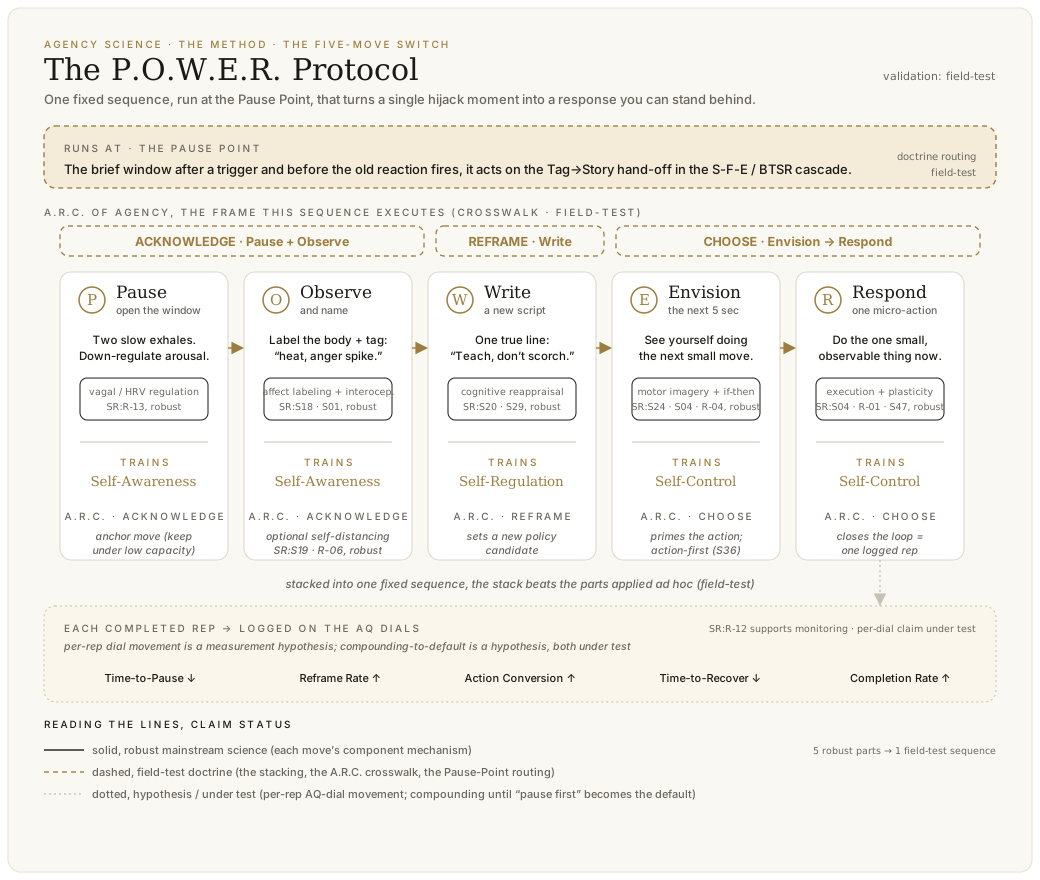
The five moves are Pause, Observe and Name, Write a New Line, Envision the next five seconds, and Respond with one micro-action. It runs at the Pause Point, the brief window after a trigger and before the old reaction fires, which is where it sits inside the method layer of Agency Science (the part of the doctrine that catalogs trainable procedures). Its job is to give a person something concrete to do in the first moments of heightened arousal, when the automatic story is reaching for the wheel. The working wager, still under test, is simple. Stacking these five moves into one memorable sequence beats applying the same techniques piecemeal.† A second claim, also under test, is the measurement one. Each rep is meant to log the AQ-relevant observations (Time-to-Pause, Reframe Rate, Action Conversion, Time-to-Recover, Repair Latency), with hypothesized compounding improvement across reps.†
Glossary Definition
The P.O.W.E.R. Protocol is a trainable self-regulation procedure that runs a fixed five-move sequence (Pause, Observe and Name, Write a New Line, Envision the next five seconds, Respond with one micro-action) at the moment of a reactive impulse to convert that impulse into a value-aligned response.
Formal Definition
The P.O.W.E.R. Protocol is a stacked self-regulation routine that runs a fixed five-move sequence. It is executed at the Pause Point and described in Agency Science as acting on the Tag-to-Story hand-off inside the Sensation-Feeling-Emotion cascade (S-F-E, also written Body-to-Tag-to-Story-to-Response, BTSR). The doctrine claim under test is narrower: the routine can be initiated before the automatic Story and the prior behavioral policy have stabilized.† Each move recruits an independently supported mechanism. A paced exhale is the opening regulation cue, affect labeling makes the appraisal editable, a one-sentence reappraisal sets a new policy candidate, and a single observable micro-action closes the loop with behavioral evidence. The Envision move is the pivot. The person simulates themselves executing the next micro-action and sees the specific outcome they intend, which is hypothesized to prime the action.† The one boundary is that the picture stays coupled to a real next move; action-less outcome fantasy de-energizes pursuit.
Scope note. In scope: the in-the-moment conversion of one reactive impulse into a value-aligned response, and the training of that conversion as a repeatable unit. Out of scope: it is a pocket routine, not therapy or a substitute for clinical treatment. Clinical severity (trauma, panic, addiction) exits the routine and is referred to a clinician. Validation status: field-test
Overview
Picture the moment you usually lose (composite, illustrative). A child knocks a glass of orange juice across the table, your chest spikes, and your voice is already going sharp before any deliberate choice was available. On autopilot, the next ten seconds are written for you. The routine is what you run instead, and it is built to be remembered when your biology is loud.
It sounds like this, in five short moves. You Pause: a paced exhale. You Observe and Name: "heat in the chest, anger spike." You Write a New Line: "Teach, don't scorch." You Envision the next five seconds: you simulate yourself executing the next micro-action and see the exact outcome you want. You picture kneeling, handing over a towel, the spike settling as you do it. You Respond: you do exactly that one small thing. Same kid, same mess, a different next chapter.
One clean rep does not make a person new. It puts one notch in a different direction. The wager of the method is that hundreds of logged reps move "pause first" from an idea you believe into the default your nervous system reaches for on its own.†
Science Anchor
The routine is a stack of separately validated parts, assembled for use under pressure. Each move maps onto a literature that stands on its own.
Pause. A paced exhale engages vagal pathways and is used to down-regulate sympathetic arousal (SR:R-13). In this protocol, Pause is the opening move that precedes Observe and Name in the sequence. The mechanism here rests on mainstream heart-rate-variability and neurovisceral-integration work, not on any fringe account.
Observe and Name. Brief, precise affect labeling reduces amygdala activity and recruits prefrontal control, raising interoceptive clarity and making the appraisal editable (SR:S18, SR:S01). The affect-labeling effect is robust and replicated; the interoception strand anchors the construct rather than any single heartbeat-detection statistic.
Write a New Line. A one-sentence cognitive reappraisal shifts the appraisal from catastrophic or self-excusing toward value-aligned, setting a new policy candidate (SR:S20, SR:S29). Reappraisal sits inside Gross's emotion-regulation process model, and the broader cognitive-therapy tradition corroborates the same family of moves.
Envision the next five seconds. The move operates by having the person simulate themselves executing the next micro-action and see the specific outcome they intend. Rehearsing the specific result the person wants is hypothesized to prime the action.† Short-horizon motor imagery of a specific action engages premotor planning, and paired with an if-then implementation intention it raises the odds the action is executed (SR:S24, SR:S04, SR:R-04). The implementation-intention meta-analysis is strongest for getting an action started and attenuates for complex, willpower-heavy goals, a caveat that travels with the claim. The one boundary on the picture: outcome visualization has to stay coupled to a real next action. Action-coupled visualization is hypothesized to prime the move.† The boundary on that claim is robust: action-less outcome fantasy de-energizes pursuit (SR:S36, SR:R-05).
Respond. A smallest-possible, observable micro-action under sixty seconds closes the loop and supplies behavioral evidence, which consolidates the new policy through experience-dependent plasticity over repeated reps (SR:S24, SR:R-01, SR:S47). A single rep is not claimed to consolidate anything; consolidation is the over-time claim, and habit formation is presented as a range (a median near 66 days, spanning roughly 18 to 254), never a fixed number.
An optional self-distancing move inside the Observe step, watching the loop from a step back, helps regulate without taxing deliberate control (SR:S19, SR:R-06). It is reliable but small-to-moderate, best validated for past negative events and anger, and is not generalized as an in-the-moment regulation mechanism for all cases.
Evidence Status
Field-test grade. The evidence today is practitioner observation plus the independently validated component mechanisms above. Two doctrine claims are the routine's own and are held lower than the parts they assemble.
The first is structural: that stacking the five moves into one fixed, memorable sequence run under pressure outperforms applying the component techniques ad hoc, and that this stack is the standard unit rep of agency conversion.† Each component is independently robust. That the specific stack beats piecemeal use is falsifiable and under test, not a restatement of mainstream science. A companion structural claim is the crosswalk: that the five moves map onto the three A.R.C. beats (Acknowledge, Reframe, Choose) as a structural mapping, with Acknowledge covering Pause plus Observe, Reframe covering Write, and Choose covering Envision through Respond.† That mapping is the doctrine's own and is held at field-test, with its disconfirmation criterion stated in the Evaluation section.
The second is measurement: that each rep logs the AQ-relevant observations (Time-to-Pause, Reframe Rate, Action Conversion, Time-to-Recover, Repair Latency), with hypothesized compounding improvement across reps, plus a completion-rate process metric.† Progress monitoring improving goal attainment is itself robust (SR:R-12). But that these named dials improve across logged reps is the doctrine's own claim, not yet validated. A single rep records a dial reading; it does not shift it. A controlled study coding live reps against dial movement over time would raise the label.
Held as hypothesis: that logged reps compound across time until "pause first" shifts from a deliberate idea into the default policy.† The general principle that cue-triggered routines automate with repetition is robust (SR:R-01, SR:S47, with formation time presented as the 18-to-254-day range). The specific compounding-to-trait claim for this routine is the forward wager, not yet extended beyond what the habit literature supports.
Accessibility Variants
The routine is a pocket move, not a therapy session, and it is built to fit a clenched jaw and a busy day. Several variants exist for lower-capacity states.
- Low-capacity / depleted states: drop to the two anchor moves, Pause and Respond, and let the middle three return when there is more bandwidth. A leaner ignition variant (the 7-2-1 Ignition) carries this load.
- Aphantasia (no mental imagery): run the Envision move as a verbal if-then sentence ("when I kneel, I hand over the towel") rather than a picture; the implementation-intention payload carries the load without requiring visualization (SR:S04).
- Alexithymia / low interoception: run the Observe step graded, naming body-location words ("heat in the chest") before reaching for an emotion label, so the move starts where the signal is clearest.
- ADHD / executive-function and attention differences: externalize the Pause. Do not make the trigger-to-pause window depend on internal vigilance; let a physical, visual, or auditory cue carry the P-step (a hand on the chest, a sticky note at the desk, a phone chime tied to the usual trigger), so the routine stays runnable when sustained internal monitoring is hard.† The affect-labeling and implementation-intention payloads it rests on are themselves robust (see Science Anchor); the externalized cue is the accessibility move, not a clinical claim.
- Freeze / dissociation (shutdown rather than spike): this is not the state the pocket routine is built for, and it is not a crisis tool. When the response is shutdown, numbness, or dissociation rather than a hot spike, downshift first and seek co-regulation: grounding and another regulated nervous system come before any pocket script.† A person in freeze or dissociation is steered to that, not handed five moves to run alone.
- After-action review: when the live moment is already gone, run the sequence in retrospect (Retro-P.O.W.E.R.) to rehearse the rep for next time.
- Kid register: the same five moves, named for a child ("stop, name it, flip it, picture it, do one small thing").
- Clinical referral (contraindication): clinical severity such as trauma, panic, or addiction exits the routine. It is not a treatment, and a person in that range is referred to a clinician rather than handed a pocket script.
Integrity & Gameability
The routine fails when it is performed as a ritual rather than run as a real switch. The common failure modes:
- Naming without editing. A person labels the feeling, feels briefly virtuous, and then runs the old reaction anyway. Affect labeling is a setup move, not the point; if the Write and Respond moves never land, no policy actually changed.
- A "micro-action" that is not observable. "I'll calm down" is not a Respond move. The countermeasure is the under-sixty-second, observable test: if a camera could not see it happen, it does not count as a rep.
- Logging theater. Counting reps to grow a streak rather than to change behavior turns the scoreboard into the goal. The countermeasure is to grade reps by whether the chosen response actually differed from the autopilot one, not by volume alone.
- Reappraisal as self-excuse. "Write a New Line" can be misused to rationalize the easy path. The Line has to move the appraisal toward a declared value, not away from the discomfort. Every Line is a rep against the old SCRIPT (the automatic story the cascade defaults to).
The integrity floor is the observable R-step: three of the five moves (Observe, Write, Envision) are private cognition and can only be self-reported, so the public, camera-visible micro-action plus the completion-rate process metric are what keep a logged rep honest. How reps feed the AQ scoring is owned by the AQ rebuild, not this tile.
FAQ
What is a "rep" here? A rep is one complete run of the five moves on one real hijack moment, ending in an observable micro-action that gets logged. It is the standard unit of practice for this routine: a single instance where the chosen response differed from the autopilot one. It is not a streak count.
Is this the same as just taking a breath and calming down? No. The Pause is only the first move and it opens the window; it is not counted as a completed protocol rep unless followed by a changed action. The routine's point is the Write and Respond moves: composing a value-aligned line and executing one observable micro-action.
Why "Envision" if visualization is unreliable for some people? The Envision move is a simulation of yourself executing the next micro-action and seeing the exact outcome you are reaching for, not a vivid mental movie for its own sake. Rehearsing the specific result you want is hypothesized to prime the move.† For people with aphantasia, the same move runs as a verbal if-then sentence (see Accessibility Variants). The one boundary is that the picture stays tied to a real next action; an outcome you only fantasize about, with no action coupled to it, drains the drive to pursue it.
Is the P.O.W.E.R. Protocol established science? The component mechanisms rest on robust, well-replicated literatures: vagal regulation, affect labeling, reappraisal, motor imagery, implementation intentions, habit consolidation (see Science Anchor). The assembly of those parts into one fixed sequence, and the claim that the sequence's reps move the AQ dials over time, are the doctrine's own contributions, held at field-test and hypothesis. The Claim Status box states exactly which is which.
Claim Status
What rests on settled science, and what is the doctrine's own contribution, stated plainly so a reader never has to guess.
| Claim | Status |
|---|---|
| The component mechanisms (paced-exhale vagal regulation, affect labeling, cognitive reappraisal, motor imagery, implementation intentions, habit consolidation) | Robust mainstream science, at each cited source's stated SR grade (see Science Anchor) |
| Self-distancing in the Observe step aids regulation without taxing control | Robust, with the stated boundary (small-to-moderate; best for past negative events) |
| Action-coupled simulation of the next micro-action, paired with the intended outcome, primes initiation | Field-test doctrine (the E-step's working claim; falsifiable via the D26 roadmap) |
| The routine can be initiated before the automatic Story and the prior behavioral policy have stabilized | Field-test doctrine (doctrine routing claim) |
| Stacking the five moves into one fixed sequence beats applying the parts ad hoc | Field-test doctrine (falsifiable; see Evaluation) |
| The A.R.C. of Agency maps onto the five moves as a crosswalk | Field-test doctrine (structural mapping; disconfirmation in Evaluation) |
| ADHD variant: externalized P-step cues so the pause does not depend on internal vigilance | Field-test doctrine (accessibility design) |
| Freeze/dissociation variant: downshift + co-regulation first, not a crisis tool | Field-test doctrine (accessibility and safety design) |
| Each rep logs the AQ-relevant observations (TTP, RFR, AC, TTR, Repair Latency), with compounding improvement across reps | Measurement hypothesis, under test |
| Logged reps compound until "pause first" becomes the nervous system's default | Hypothesis |
† marker. Throughout this entry, a dagger (†) marks a claim graded field-test or hypothesis in the table above. Anything unmarked is either plain description or rests on the robust science cited in the Science Anchor.
Evaluation / Failure Conditions
The routine is doctrine at field-test, and it is presented as falsifiable. For a given person, it would be judged not working on observable markers rather than on faith in the method.
- Non-response: reps are logged but the named response keeps matching the autopilot response. The routine is being completed procedurally without producing a changed response.
- Partial response: the early moves run (Pause, Observe) but Respond rarely closes, so behavior does not change downstream.
- Regression / contraindication: distress rises rather than settles when the routine is attempted, which signals that the situation has exited pocket-routine range and belongs to a clinician.
The structural doctrine claim is falsifiable directly. The disconfirmation design (the D26 research roadmap (TBD), the doctrine's planned falsification trials) is a controlled comparison against active comparators: STOPP, RAIN, and plain single-technique reappraisal. On matched incidents, raters code each run for whether the chosen response differed from the autopilot one, and the named AQ dials are tracked across reps.
- Disconfirmation of the structural claim: if the fixed five-move stack does no better than STOPP, RAIN, or plain reappraisal on matched incidents, the central contribution fails.
- Disconfirmation of the measurement claim: if the named AQ dials show no improvement across logged reps relative to those comparators, the per-dial claim fails.
- Disconfirmation of the A.R.C. crosswalk claim: if independent coders cannot reliably map the five moves onto the three A.R.C. beats (Acknowledge, Reframe, Choose), or if one or more moves fail to map to any A.R.C. component under blind coding, the structural-mapping claim fails.
Claim-Status traceability matrix. Each field-test or hypothesis row of the Claim-Status box carries a disconfirmation criterion here. The matrix is bidirectional: every daggered body sentence appears in a row, and every row lists each of its daggered body locations by exact quote. Each row names its measure, its window, its comparator, and the result that disconfirms it.
| Claim (Claim-Status row) | Daggered body location (exact quote) | Measure | Window | Comparator | Disconfirming result |
|---|---|---|---|---|---|
| E-step priming (action-coupled simulation + intended outcome primes initiation) | Formal Definition: "The person simulates themselves executing the next micro-action and sees the specific outcome they intend, which is hypothesized to prime the action.†" · Science Anchor (Envision): "Rehearsing the specific result the person wants is hypothesized to prime the action.†" · Science Anchor (Envision boundary): "Action-coupled visualization is hypothesized to prime the move.†" · FAQ: "Rehearsing the specific result you want is hypothesized to prime the move.†" | Initiation latency, completion rate, blind-coded response difference over matched incidents | Per incident, across a preregistered block of matched reps | Implementation-intention-only and action-description-only conditions | No incremental improvement over either comparator condition |
| Pause-Point / Tag-to-Story routing (the routine can be initiated before the automatic Story and the prior behavioral policy have stabilized) | Formal Definition: "The doctrine claim under test is narrower: the routine can be initiated before the automatic Story and the prior behavioral policy have stabilized.†" | Blind-coded onset of trigger, affect label / story formation, and response onset per incident | Per incident, across a preregistered block | Self-report of timing vs. blind-coded incident timeline | Coders cannot reliably locate a pre-response window, or the routine is usually initiated after the policy has already executed |
| Structural stack (the fixed five-move sequence beats the parts applied ad hoc) | In Brief: "Stacking these five moves into one memorable sequence beats applying the same techniques piecemeal.†" · Evidence Status: "that stacking the five moves into one fixed, memorable sequence run under pressure outperforms applying the component techniques ad hoc, and that this stack is the standard unit rep of agency conversion.†" | Rater-coded share of reps where the chosen response differed from the autopilot response; AQ dials tracked across reps | Across matched incidents over the preregistered trial | STOPP, RAIN, plain single-technique reappraisal | The fixed stack does no better than the active comparators on matched incidents |
| A.R.C. crosswalk (five moves map onto the three beats) | Evidence Status: "that the five moves map onto the three A.R.C. beats (Acknowledge, Reframe, Choose) as a structural mapping, with Acknowledge covering Pause plus Observe, Reframe covering Write, and Choose covering Envision through Respond.†" | Inter-coder reliability of the five-to-three mapping under blind coding | Per blind-coding pass | Independent coders working from the move definitions | Coders cannot reliably map the five moves onto the three beats, or one or more moves map to no beat |
| ADHD externalized-cue variant (external P-step cueing keeps the pause runnable) | Accessibility Variants (ADHD bullet): "so the routine stays runnable when sustained internal monitoring is hard.†" | Time-to-pause and completion rate for ADHD / high-attention-difficulty users | Per incident, across a preregistered block | Internal self-monitoring (no external cue) for the same users | External cueing does not improve, or worsens, either time-to-pause or completion rate |
| Freeze / dissociation safety variant (downshift + co-regulation, not the pocket routine) | Accessibility Variants (freeze/dissociation bullet): "grounding and another regulated nervous system come before any pocket script.†" | Correct triage away from the pocket routine, distress escalation, referral / co-regulation follow-through | Per shutdown-state incident, across the trial | Hot-spike incidents handled by the pocket routine | Shutdown states are not reliably distinguished from hot-spike states, or the protocol delays care |
| Measurement (each rep logs the AQ dials, with compounding improvement across reps) | In Brief: "Each rep is meant to log the AQ-relevant observations (Time-to-Pause, Reframe Rate, Action Conversion, Time-to-Recover, Repair Latency), with hypothesized compounding improvement across reps.†" · Evidence Status: "that each rep logs the AQ-relevant observations (Time-to-Pause, Reframe Rate, Action Conversion, Time-to-Recover, Repair Latency), with hypothesized compounding improvement across reps, plus a completion-rate process metric.†" | Time-to-Pause, Reframe Rate, Action Conversion, Time-to-Recover, Repair Latency, plus completion rate, coded across logged reps | Longitudinal, across the preregistered rep window | STOPP, RAIN, plain reappraisal | The named dials show no improvement across logged reps relative to the comparators |
| Compounding-to-default ("pause first" becomes the default policy) | Overview: "hundreds of logged reps move 'pause first' from an idea you believe into the default your nervous system reaches for on its own.†" · Evidence Status: "that logged reps compound across time until 'pause first' shifts from a deliberate idea into the default policy.†" | Independent time-to-pause, autopilot-response frequency, and first-response default | Longitudinal, across the preregistered window | Active comparators (logged comparator reps) | No relative improvement on the default-policy markers over the preregistered window |
Until that trial runs, the protocol is held at field-test on the strength of its component literatures plus practitioner observation.
Quick Reference
- Object type / Layer: protocol / Class 5. It is the in-the-moment method layer of the doctrine.
- Depends on: The Pause Point is where it runs. SFE Cascade is the Tag-to-Story hand-off it acts on. The Engine of Agency supplies the capacities its moves train.
- Produces: A completed rep plus the behavioral evidence that updates the policy. The rep is tracked on the AQ dials.
- Often confused with: ARC of Agency. The A.R.C. is the three-beat conceptual frame (Acknowledge, Reframe, Choose). This routine is the concrete five-move procedure that executes it.
- The five moves: P is Pause, a paced exhale. O is Observe and Name, labeling the affect. W is Write a New Line, a one-sentence reappraisal. E is Envision the next five seconds, simulating yourself executing the next micro-action and seeing the specific outcome you intend. R is Respond, one observable micro-action under sixty seconds.
Relations
- broader:: ARC of Agency (TBD). The A.R.C. is the parent method frame; this routine is its concrete five-move procedure.
- has_part:: Outcome Lock (TBD). The E-step modifier that locks attention on the chosen result during the seconds around action initiation.
- intervenes_on:: SFE Cascade (TBD). The Tag-to-Story hand-off inside the cascade is where the routine is described as acting.
- depends_on:: The Pause Point (TBD). The window the routine runs inside.
- depends_on:: The Engine of Agency (TBD). Supplies the capacities each move trains.
- produces:: POWER Rep (TBD). The logged unit rep of agency conversion.
- measured_by:: AQ Agency Quotient (TBD). The dials the reps are hypothesized to move across time.
- crosswalks_to:: ARC of Agency (TBD). Acknowledge maps to Pause plus Observe, Reframe to Write, Choose to Envision through Respond.
- related:: Cognitive Reappraisal (TBD). The mechanism behind the Write move.
- related:: Affect Labeling (TBD). The mechanism behind the Observe move.
- related:: RFR Reframe Rate (TBD). One of the AQ dials a rep is hypothesized to move.
- related:: AC Action Conversion (TBD). One of the AQ dials a rep is hypothesized to move.
- related:: The 7 2 1 Ignition (TBD). The leaner ignition variant for low-capacity states.
- related:: Retro POWER (TBD). The after-action variant.
- related:: Pause First (TBD). The movement-level ritual the routine consolidates.
Related concepts (Core): The Pause Point, SFE Cascade, BTSR, ARC of Agency, The Engine of Agency, AQ Agency Quotient, Outcome Lock, Cognitive Reappraisal, Affect Labeling, Visualization, Self Awareness, Self Control, Self Regulation, Friction Design, RFR Reframe Rate, AC Action Conversion, The 7 2 1 Ignition, POWER Rep, POWER Completion Rate, Retro POWER, Pause First, SCRIPT, D26 Research Roadmap
Aliases & Registers
| alias | register | status |
|---|---|---|
| P.O.W.E.R. Protocol | public | locked |
| P.O.W.E.R. | internal | locked |
Provenance & Ancestry
The five-move sequence is author-coined as a stacked routine and a named unit rep. Its parts are credited to their own literatures: affect labeling (Lieberman lineage), cognitive reappraisal (Gross; the cognitive-therapy tradition), implementation intentions (Gollwitzer), motor imagery and mental practice (Pascual-Leone), vagal down-regulation through paced breathing (neurovisceral-integration work), and habit consolidation (Wood and Neal; Lally). The contribution is the assembly: a fixed, memorable order built to run under pressure and to be logged as the standard rep of agency conversion. It executes the A.R.C. of Agency at the Pause Point and feeds the measurement layer.
Sources
- SR:R-13 Thayer & Lane, neurovisceral integration / vagal HRV; robust. Anchors the paced-exhale Pause move (the mainstream replacement for polyvagal citations).
- SR:S18 Lieberman, affect labeling; robust (replicated, Burklund 2015).
- SR:S01 Interoception (Craig / Critchley / Barrett); robust; anchors the construct, not single heartbeat-task statistics.
- SR:S20 Gross, reappraisal / emotion-regulation process model; robust.
- SR:S29 Cognitive Behavioral Therapy (Beck); settled; corroborates the reappraisal family.
- SR:S24 Pascual-Leone (1995), mental practice / motor-cortex plasticity; robust.
- SR:S36 Taylor et al. (1998), process versus outcome simulation; robust; carries the one E-step boundary (action-coupled visualization, not action-less fantasy), not the E-step's leading frame.
- SR:R-05 Oettingen MCII / WOOP (Wang, Wang & Gollwitzer 2021 meta, g~.34); robust; modest effects, and action-less outcome fantasizing de-energizes low-expectancy goals by design. Cited only on the one E-step boundary line.
- SR:S04 Implementation intentions (Gollwitzer); robust.
- SR:R-04 Gollwitzer & Sheeran 2006 meta (d~.65, 94 studies); robust; strongest for initiation, attenuates for complex/willpower-heavy goals (caveat travels).
- SR:R-01 Wood & Neal 2007 / Wood & Rünger 2016, habit mechanism; robust.
- SR:S47 Habit formation (Lally / Wood); robust; present formation time as a range (median 66 days, 18 to 254), never a fixed number.
- SR:S19 Self-distancing (Kross); robust; small-to-moderate, best-validated for past negative events / anger, does not establish a universal in-the-moment regulation effect (caveat travels).
- SR:R-06 Kross & Ayduk 2017; Moser 2017, distanced self-talk; robust; works without taxing cognitive control.
- SR:R-12 Harkin et al. 2016, progress-monitoring meta; robust; monitoring goal progress improves attainment (supports the value of monitoring, not the specific per-dial claim).
Version History
| version | date | change | by |
|---|---|---|---|
| 5.8 | 2026-07-02 | Register fork completed (Law 13.1, Fable 5 re-audit): added the registers: frontmatter block with the Institute opener (verbatim from the body In Brief) and the metaphor-first Radical Agency alternate. The stacked-sequence efficacy claim carries its dagger and restates the body-daggered claim already rowed in the matrix. Body copy untouched. Re-linted PASS (--strict, zero warnings). | claude-code claude-code-golden-standard-fable-reaudit-20260702 |
| 5.7 | 2026-07-01 | Convergence pass. Formal Definition now leads with the term as its grammatical subject; the Pause-Point routing claim is narrowed and stated as its own daggered sentence, with the Claim-Status row and the traceability-matrix quote updated to the exact wording; the Science Anchor Pause sub-block rephrased as structural description of the sequence; neutral wording in the Evaluation non-response marker and the FAQ Pause answer; figure asset and manifest re-verified on disk; Version History rewritten in publishable form; publication status set to final. | claude-code lexrb-golden-protocol-r4-20260701 |
| 5.6 | 2026-06-26 | Round-3 dual-audit convergence. Rebuilt the Claim-Status traceability matrix as a bidirectional, exact-quote ledger: every daggered body sentence is listed by exact quote, and claims stated in multiple places list all locations. Split the Pause premise from its protocol application in the Science Anchor; neutralized residual formal-layer diction (self-distancing note, Sources caveat, matrix wording); rewrote the Science Anchor Envision sub-block in third person; removed daggers from the disconfirmation-criteria bullets; set the figure to the resolving relative path with the SVG and manifest verified on disk. Build Spec updated in lockstep (v1.3). | claude-code lexrb-golden-protocol-r3-20260626 |
| 5.5 | 2026-06-26 | Codex redline. Built the Claim-Status traceability matrix into Evaluation, giving every field-test and hypothesis row a daggered body location, measure, window, comparator, and disconfirming result. Replaced the pseudo-precise "half-second" in the In Brief with the brief-window and first-moments wording; neutralized the E-step Claim-Status row. Build Spec updated in lockstep. | claude-code lexrb-golden-protocol-codex-final-20260626 |
| 5.4 | 2026-06-26 | GLM second-pass redline. Split the Envision claim into a daggered hypothesis plus its robust boundary; reconciled the SCRIPT and D26_Research_Roadmap forward-links across frontmatter, the Relations mirror, and the body; stated and daggered the A.R.C. crosswalk claim in Evidence Status; standardized the E-step operational wording across sections; "operates by" in the Science Anchor. Build Spec updated in lockstep. | claude-code lexrb-golden-protocol-glm2-20260626 |
| 5.3 | 2026-06-25 | Golden Tile pass. Institute construct-first opener applied; efficacy phrasing removed from the Science Anchor and FAQ; the orange-juice scene labeled composite at first mention; "hijack" removed from the Glossary; negative parallelism removed from the FAQ; S-F-E expanded and SCRIPT glossed and linked; relation surfaces reconciled; the A.R.C. crosswalk disconfirmation criterion added. The lived register is carried inside the Overview per the protocol spine; the tile does not add a separate Lived Experience section. | claude-code lexrb-golden-protocol-power-20260625 |
| 5.2 | 2026-06-15 | Reconcile pass. The four binding decisions (D-PW-1, D-PW-2, D-PW-ACCESS, D-PW-TWIN) confirmed landed; residual punctuation scrub completed on the primary draft and the Codex twin. | claude-code lexrb-power-p4f1-fix-20260615 |
| 5.2 | 2026-06-15 | Authority-fix pass. W-step canonical name set to "Write a New Line"; the E-step leads with the practitioner doctrine and demotes the boundary citations to one line; ADHD and freeze/dissociation accessibility variants added; Codex twin rebuilt to identical step definitions. | claude-code lexrb-power-p4f1-fix-20260615 |
| 5.2 | 2026-06-15 | Fix pass. Reordered to the v5.2 protocol spine; FAQ added; AQ wording corrected to per-rep logging with compounding across reps; aliases trimmed to the registry-lawful set; the Outcome_Lock relation added; aphantasia and alexithymia variants and the integrity floor added. | claude-code lexrb-power-p4f1-fix-20260615 |
| 5.2 | 2026-06-14 | S3 draft to the v5.2 spine from the passed claim ledger (13 rows). Pause move anchored to R-13; Pause-Point placement, five-move stack, and A.R.C. crosswalk held at field-test; AQ-dial shifts and compounding-to-default held at hypothesis. | claude-code lexrb-power-p4f1-20260614 |
| 1.x | (pre-rebuild) | Legacy v1 tile (Seeker/Scrutinizer description format). Superseded by this draft. | (prior) |