
Lexicon · measure Validation status: field-test
AC Action Conversion
In Brief
Action Conversion (AC) is a follow-through dial that reports the share of caught reframes a person actually turns into an aligned move in the real world.
In Agency Science it sits on the Agency Quotient (AQ) scoreboard, the dashboard of agency metrics, as the dial that asks one question: when you saw the cleaner line, how often did you take the step? It matters because a reframe that stays in the head has not yet changed the behavior AC measures. The gap between an intention and the matching behavior is real and well-studied, and AC is the meter on how often that gap closes. The working claims, still under test, are that AC is trainable (field-test) and that a rising AC shows up as movement in AQ (hypothesis).†
Glossary Definition
Action Conversion (AC) is a behavioral follow-through metric that reports the percentage of caught reframes a person turns into an aligned micro-step in the real world.
Formal Definition
Action Conversion is the proportion of caught reframes (a caught reframe being a reappraisal a person actually noticed themselves making, and logged) that are followed by an aligned micro-step within the same episode. Aligned means consistent with the practitioner's stated working aim for that episode, not with any judgment of whether the move was wise. A micro-step is an observable action logged as the response to that episode, small enough to be completed within the episode's bounds. An episode is one logged reframe-and-respond instance, bounded by the practitioner's session or incident record (a single sitting, not an open-ended day). AC is the R-step (Respond) of the P.O.W.E.R. Protocol, the doctrine's named regulate-and-respond sequence, expressed as a rate from 0 to 100 percent over a defined window of logged reframe episodes. The intended population is any practitioner running a reframe-and-respond practice and keeping incident records.
The computation is explicit. Over a named window (for example the past 30 days of logged episodes), the dial equals the count of caught reframes that were followed by an aligned micro-step, divided by the total count of caught reframes in that window, times 100. The numerator is the converted episodes; the denominator is every episode where a reframe was caught, converted or not. When the denominator is zero (no caught reframes in the window) the result is reported as "insufficient volume / no score," never as zero percent and never as a hit rate, because a rate has no meaning without a base. Every reported score travels with two labels that are part of the number, not metadata about it: the window it covers and the provenance tier it was captured at (self-reported, observed, or instrumented; see Provenance Tiers). A score stated without its window and tier is not a valid score.
Scope note: The dial counts the move-into-behavior rate, not the quality, size, or durability of the move, and not whether the underlying reframe was wise. It is silent on outcome. A score is only as trustworthy as the data tier beneath it (self-reported, observed, or instrumented), and the metric is gameable at the self-reported tier.† AC does not by itself diagnose why a person fell short on a given episode.
Validation status: field-test.
Overview
Three composite figures (composite, illustrative), not real people, keep the same scoreboard for a month. Maya catches herself mid-spiral and writes "two ugly slides beat zero," then opens the deck and adds the two slides. That episode converts. Danny writes "protect the bond tonight," means it, and still ends the evening scrolling past bedtime. That one does not. Marcus writes "teach, don't scorch" before a hard reply, breathes, and sends the kinder version. That one converts.
Run the month and the pattern is a number. Maya converts much of what she catches. Danny catches plenty and converts little. The dial does not shame Danny. It locates the bottleneck: his catching is fine, his follow-through is the leak. That is the whole point of putting a meter on the step rather than on the insight. A reframe that never moves a muscle is a "nice idea in my head, same behavior in my life," and AC is what makes that leak visible instead of invisible.
Science Anchor
AC measures the closing of a documented gap. People routinely form an intention and then fail to act on it. This is the intention-behavior gap, and follow-through is improvable: implementation intentions raise the odds an intention gets enacted. Gollwitzer and Sheeran's meta-analysis reports d≈.65 across 94 studies, strongest for initiation and weaker for complex or willpower-heavy goals (SR:S04, SR:R-04). The reframe AC counts is a cognitive reappraisal, a real and trainable emotion-regulation move in Gross's process model (SR:S20).
The step itself draws on two well-supported capacities. Starting the aligned move engages task initiation, which is shaped by delay discounting and procrastination dynamics (SR:S33, SR:S40). The doctrine's field-test application is Self-Discipline: lowering the cost of the aligned micro-step is expected to increase initiation.† Holding back a competing urge engages response inhibition, the stop-signal capacity associated with the right inferior frontal gyrus (SR:S34). This entry does not treat that holding-back as a depletable willpower reserve.
Two more literatures explain why a dial like this can move behavior at all. Much daily action is context-cued and runs without a decision (roughly 43 to 45 percent of daily behavior is habitual), and behavior shifts when the cued context shifts (SR:R-01, SR:R-03). The doctrine's field-test application is Friction Design. Tuning the surroundings so the aligned move is the path of least resistance is taken to change which behavior runs.† Separately, monitoring progress toward a goal raises the rate of attainment, the cybernetic feedback mechanism Harkin and colleagues' meta-analysis documents (SR:R-12, SR:R-09). The doctrine's field-test claim is that tracking AC applies the progress-monitoring mechanism and is expected to increase AC.† Specific goals produce better performance than vague goals (SR:R-11), which is why AC scores against a concrete working aim rather than a general wish. The doctrine's field-test claim is that AC is trainable via the matched levers: Self-Discipline, Self-Control, Rituals, and Friction Design.†
What the doctrine adds, and holds at field-test, is the routing claim. AC is taken to reflect the interaction of State, Story, and Friction under the Behavioral Law of Agency.† That model holds that behavior follows from regulated arousal, a permitting self-story, and favorable friction. Under that model, the same held reframe is expected to convert more often when state, story, and friction are favorable.†
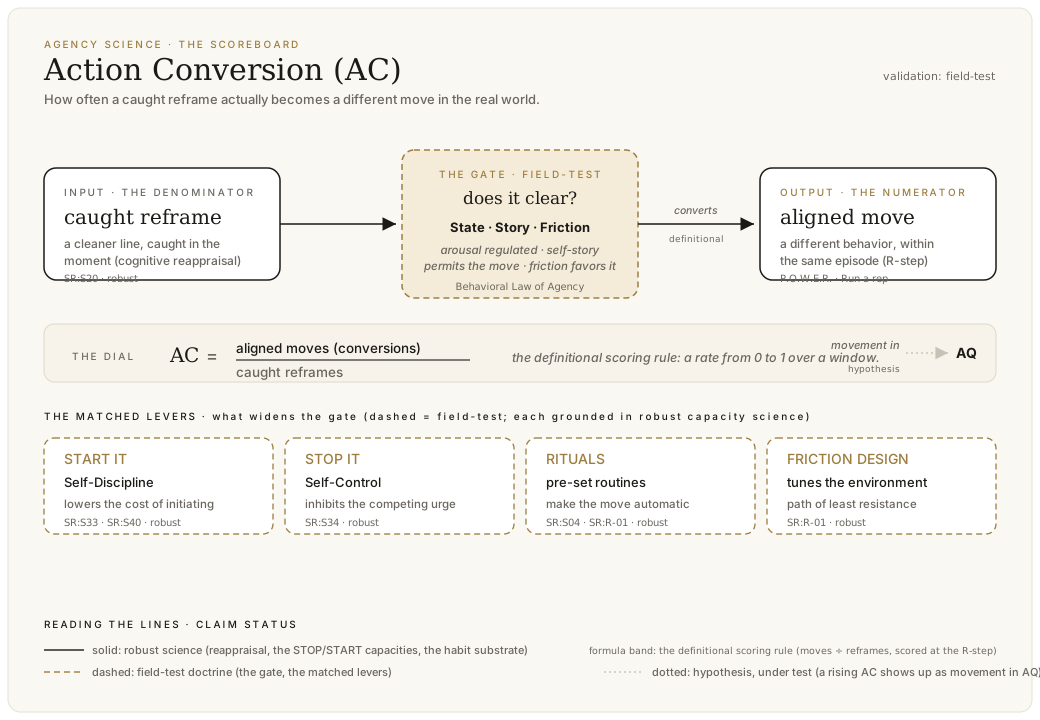
Psychometrics
Status: pilot-pending. No reliability, validity, or norming coefficients exist yet; none are claimed. AC is defined operationally (caught reframes that yield an aligned micro-step over a window) and is in field use, not psychometric validation.
The planned work names what would have to be shown before AC could carry anything stronger than a field-test label. Inter-rater reliability: two independent raters coding the same incident records should agree on whether an episode converted. Test-retest stability over a short window where no real change is expected. Convergent evidence: AC should track other follow-through signals (for example P.O.W.E.R. Completion Rate, the share of full sequences a person runs) and move with the matched-lever interventions. Until those studies run, AC is a practitioner dial, not a validated instrument.
Provenance Tiers
AC reports three provenance tiers for logged events, each defined by how the underlying events were captured. The doctrine's measurement-integrity claim, held at field-test, is that the claim a score can support scales with its tier.†
- Self-reported. The person logs their own caught reframes and whether each one converted. The known failure mode is inflation: a person can log reframes that never really had to convert, or quietly score a near-miss as a hit. A self-reported AC is a private signal, not an external one.
- Observed. A second party (coach, partner, rater) confirms the reframe and the move; the move is witnessed rather than asserted. The known failure mode is selective presentation: the rater sees only the episodes brought to them.
- Instrumented. The move leaves an independent trace (a sent message, a calendar event created, a logged workout) tied to the reframe; the behavior is recorded, not recalled. The known failure mode sits on the other half of the pair: the trace records the move, while the caught reframe behind it is still asserted.
Because the dial is gameable at the self-reported tier,† AC is read as a within-person trend on a stated tier, never as a cross-person ranking and never as a tier-blind absolute. Mixing tiers without saying so corrupts the number.
FAQ
Is a higher AC always better? Higher Action Conversion is the direction of travel, but only when there is real volume beneath it. AC on two caught reframes a month is noise. Read it next to Reframe Rate so a high percentage on a thin base does not flatter the score.
Does a low AC mean I have no willpower? No. A low Action Conversion locates the follow-through bottleneck; it does not measure a willpower reserve. The next question is operational: initiation cost, competing urges, routines, and environmental friction.
Can I game my own AC? Yes, especially on the self-reported tier,† which is exactly why the tier travels with the score. Logging only the reframes that were going to convert anyway inflates the number. Read AC as a within-person trend on one stated tier over time.
Claim Status
What rests on settled science, and what is the doctrine's own contribution, stated plainly so a reader never has to guess.
| Claim | Status |
|---|---|
| The intention-behavior gap exists and follow-through is improvable (implementation intentions) | Robust (SR:S04, SR:R-04; strongest for initiation, attenuates for complex goals) |
| Reappraisal is a real, trainable emotion-regulation move | Robust (SR:S20) |
| Task initiation (delay discounting, procrastination) and response inhibition are real capacities the step draws on | Robust (SR:S33, SR:S40, SR:S34) |
| Specific goals produce better performance than vague goals; progress-monitoring raises attainment | Settled / robust (SR:R-11, SR:R-12, SR:R-09) |
| Context-cued behavior shifts when the cued context shifts | Robust (SR:R-01, SR:R-03) |
| Friction Design (tuning surroundings so the aligned move is the path of least resistance) changes which behavior runs | Field-test doctrine |
| Tracking AC applies the progress-monitoring mechanism and is expected to increase AC | Field-test doctrine |
| AC is the within-episode follow-through step (the R-step of P.O.W.E.R.), scored as a rate | Definition (doctrinal mapping; no validation claim) |
| AC reflects the interaction of State, Story, and Friction under the Behavioral Law of Agency | Field-test doctrine |
| AC is trainable via the matched levers (Self-Discipline, Self-Control, Rituals, Friction Design) | Field-test doctrine |
| The dial's meaning depends on its provenance tiers and gameability (a low-friction self-report tier carries the weakest claim) | Field-test (measurement-integrity claim) |
| A rising AC shows up as movement in AQ | Hypothesis, under test |
† marker. Throughout this entry, a dagger (†) marks a claim graded field-test or hypothesis in the table above. It is flagged once, here, so the prose never repeats the label inline. Anything unmarked is plain description or rests on the robust science cited in the Science Anchor.
Falsification & Boundary Conditions
The dial's doctrine claims are presented as falsifiable. The matrix below is the controlling artifact, and it runs both ways: every field-test or hypothesis row of the Claim Status box appears here, and every daggered claim in the body is accounted for here. Each body-location cell carries the exact quoted daggered sentence (abbreviated quotes are marked with an ellipsis), so the map points to the precise sentence under test, not to a section. A body-location cell lists only body and frontmatter surfaces; the Claim Status row itself is never listed as a location, because the row is the ledger entry the matrix indexes. Where one row covers more than one daggered body sentence, each phrase is quoted; where a daggered claim restates across surfaces, every location is listed. Each row then carries a test design (measure, window, comparison, and the result that counts as disconfirmation); a disconfirmation criterion is a test design and carries no dagger. A row that is a pure definitional mapping carries no empirical test and is marked as such. These are validation designs, not the reader-facing caveats in Interpretation Limits.
| Claim Status row (field-test / hypothesis) | Body dagger location | Measure | Window | Comparison / comparator | Disconfirming result |
|---|---|---|---|---|---|
| AC is trainable via matched levers | In Brief "The working claims, still under test, are that AC is trainable (field-test)...†"; Science Anchor "The doctrine's field-test claim is that AC is trainable via the matched levers: Self-Discipline, Self-Control, Rituals, and Friction Design.†" and "The doctrine's field-test application is Self-Discipline: lowering the cost of the aligned micro-step is expected to increase initiation.†" | AC at the instrumented tier on two matched groups of practitioners | Eight weeks of logged episodes | Intervention group running the matched levers (lower the cost of starting, Friction Design, ritualize the move) vs a passive-tracking control with no lever coaching; pre-registered margin | The intervention group's AC does not exceed the control group's by the pre-registered margin. A single positive arm is not enough; the matched control is the test. |
| AC reflects the State / Story / Friction interaction | Science Anchor "AC is taken to reflect the interaction of State, Story, and Friction under the Behavioral Law of Agency.†" and "Under that model, the same held reframe is expected to convert more often when state, story, and friction are favorable.†" | Per-episode state (calm vs activated), story (permitting vs blocking), friction (favorable vs adverse), each logged alongside whether the episode converted | Within-person, any stretch with enough episodes to model the three-way interaction (a pre-set minimum, for example 60 episodes per person) | Episodes scored high on all three conditions vs episodes scored low; the interaction term against the single main effects | Conversion does not rise as state, story, and friction jointly improve, or a single factor accounts for the variance and the interaction term adds nothing. |
| Friction Design changes which behavior runs | Science Anchor "Tuning the surroundings so the aligned move is the path of least resistance is taken to change which behavior runs.†" | AC, with the friction of the aligned move manipulated and held otherwise constant | Within-person ABAB reversal, each phase long enough to log a stable AC | Favorable-friction phases vs adverse-friction phases for the same practitioner; the aligned move's friction is the manipulated variable | AC does not track the friction manipulation: conversion does not rise when the aligned move is made the path of least resistance and fall when it is not. |
| Tracking AC applies the progress-monitoring mechanism and is expected to increase AC | Science Anchor "The doctrine's field-test claim is that tracking AC applies the progress-monitoring mechanism and is expected to increase AC.†" | AC at the instrumented tier under a visible-dashboard feedback condition vs a hidden-logging condition | Eight weeks per arm | Practitioners who see their AC dashboard vs matched practitioners whose AC is logged but not shown back; assignment pre-registered | Visible tracking does not raise AC over hidden logging by the pre-registered margin. |
| The dial's meaning depends on its provenance tiers and gameability | Formal Definition scope note "...the metric is gameable at the self-reported tier.†"; Provenance Tiers "The doctrine's measurement-integrity claim, held at field-test, is that the claim a score can support scales with its tier.†" and "Because the dial is gameable at the self-reported tier,†"; FAQ "Yes, especially on the self-reported tier,†..." | Concordance between self-reported AC and the same episodes captured at the observed/instrumented tier, plus inflation and noise tests across tiers | Within-person, a window with paired self-report and observed/instrumented records | Self-report tier vs observed/instrumented tier for the same episodes; tier-mixed scores vs single-tier scores | Self-report shows no inflation relative to the instrumented trace and tier does not change the claim a score can support, that is, the integrity claim fails because tier is not load-bearing. |
| A rising AC shows up as movement in AQ | In Brief "...a rising AC shows up as movement in AQ (hypothesis).†"; Quick Reference Produces "A rising AC shows up as movement in AQ (hypothesis, under test).†"; Relations produces:: "A rising AC shows up as movement in AQ (hypothesis, under test).†" | Within-person AC gains and AQ gains across repeated measurement waves | Wave-to-wave in a longitudinal sample | Cross-lagged panel: do within-person AC gains predict AQ gains at the next wave, controlling prior AQ | Within-person AC increases do not predict AQ increases at the following wave once prior AQ is controlled. A reverse-only path (AQ predicting AC but not the converse) also disconfirms the stated direction. |
| AC is the within-episode follow-through step (the R-step of P.O.W.E.R.), scored as a rate | Formal Definition "AC is the R-step (Respond) of the P.O.W.E.R. Protocol" | Non-empirical doctrinal mapping (definition; no validation claim) | n/a | n/a | None. This row is a definitional placement of AC inside the P.O.W.E.R. sequence and scoring form, not a causal, predictive, measurement, or outcome claim, so it carries no falsification design and no dagger. |
Boundary conditions (out of scope, not failures). AC is silent on whether the converted move was the right one; converting a poorly chosen reframe is still a conversion. AC has no meaning below its volume floor (a denominator near zero), and a low base is reported as "insufficient volume / no score," not as a failed test. The dial has not been validated on any clinical population and is not a clinical measure; any clinical reading is outside its boundary, not a disconfirmation of it. Cross-person comparison is out of scope by construction (the tier-relative, within-person read), so a cross-person ranking that looks wrong is a misuse, not a falsifying result.
Interpretation Limits
A high AC does not mean a person is doing well, only that they followed through on what they caught. Someone who rarely catches a reframe in the first place can post a high AC on a tiny base. AC is therefore read alongside Reframe Rate (RFR), the dial for how often reframes are caught at all: AC is meaningless without volume beneath it. A low AC is a localizer, not a verdict: it locates the follow-through bottleneck, but it does not by itself identify which condition explains the shortfall or why. AC also says nothing about whether the move was the right one; a person can convert a poorly chosen reframe into a poorly chosen act. The dial has not been validated on any clinical population and is not a clinical measure. And a score is read with its provenance tier attached (see Provenance Tiers).
Quick Reference
- Object type / Layer: measure / Class 8. It is the AQ scoreboard dial for follow-through.
- Measures: the follow-through rate of caught reframes (the R-step of P.O.W.E.R.). Read it next to volume.
- Depends on:
- RFR Reframe Rate (the reframe volume AC scores against).
- POWER Protocol (the regulate-and-respond sequence whose R-step AC meters).
- Behavioral Law of Agency (the doctrine's State/Story/Friction routing model).
- Related: Self Discipline; Self Control; Rituals; Friction Design; Regrets Avoided.
- Produces: a sub-signal feeding AQ Agency Quotient. A rising AC shows up as movement in AQ (hypothesis, under test).†
- Often confused with: RFR Reframe Rate. RFR counts how often a reframe is caught; AC counts how often a caught reframe becomes a move.
- Often confused with: POWER Completion Rate. That dial scores whole sequences run; AC scores only the move-into-behavior step.
Relations
- measures:: POWER Protocol (TBD). AC meters the R-step (Respond) of the P.O.W.E.R. regulate-and-respond sequence: the move-into-behavior step within an episode.
- part_of:: AQ Agency Quotient (TBD). AC is one dial ON the Agency Quotient scoreboard, not a parent construct of it.
- depends_on:: RFR Reframe Rate (TBD). AC scores against the volume of reframes RFR counts; without caught reframes there is nothing to convert.
- depends_on:: Behavioral Law of Agency (TBD). Supplies the doctrine's State/Story/Friction routing frame.
- produces:: AQ Agency Quotient (TBD). A rising AC shows up as movement in AQ (hypothesis, under test).†
- contrast_with:: POWER Completion Rate (TBD). Completion Rate scores whole P.O.W.E.R. sequences run; AC scores only the move-into-behavior step within an episode.
- related:: Self Discipline (TBD). The lever for beginning the aligned move (the START-IT lever, the doctrine's name for the start-the-move capacity).
- related:: Self Control (TBD). The lever for holding back a competing urge (the STOP-IT lever, the doctrine's name for the hold-back capacity).
- related:: Rituals (TBD). Builds the aligned move into a cued routine.
- related:: Friction Design (TBD). Tunes the surroundings so the aligned move is the path of least resistance.
- related:: Regrets Avoided (TBD). Downstream outcome the dial feeds toward.
Related concepts (Core): RFR Reframe Rate, POWER Completion Rate, Regrets Avoided, AQ Agency Quotient, Self Discipline, Self Control, Rituals, Friction Design, Behavioral Law of Agency, POWER Protocol
Aliases & Registers
| alias | register | status |
|---|---|---|
| Action Conversion (AC) | internal | proposed |
| Action Conversion | public | proposed |
| AC (scoreboard dial) | internal | proposed |
Aliases are proposed, not locked: a new alias enters as proposed, then passes the collision sweep and the naming gate before it flips to locked. The collision sweep for this tile is complete (checked against the Name Registry, 2026-07-01): "Action Conversion" and "AC" each name one referent, and the "AC" initialism is local to the scoreboard, denoting no external instrument (see Provenance & Ancestry). The proposed status in the table is the live record; the flip to locked happens at the registry gate.
Provenance & Ancestry
Author-coined as a named NPE scoreboard dial (AQ Measurement Pack, Volume 0; the Behavioral Law of Agency chapters). The dial operationalizes a robust academic substrate rather than competing with it: the intention-behavior gap and implementation-intention literature (Gollwitzer; Gollwitzer and Sheeran 2006), Gross's reappraisal model, Ainslie's delay discounting, Steel's procrastination meta-analysis, Aron's response inhibition, the Wood habit program, and Harkin's progress-monitoring meta-analysis. The contribution is the within-episode follow-through dial and its routing to the matched capacities, not the underlying findings. The "AC" initialism is local to the scoreboard and does not denote any external instrument.
Sources
- SR:S04 Implementation intentions (Gollwitzer); robust; strongest for initiation, attenuates for complex/willpower-heavy goals (pair with MCII for commitment claims).
- SR:R-04 Gollwitzer & Sheeran 2006 meta-analysis (implementation intentions, d≈.65, 94 studies); robust.
- SR:S20 Gross, reappraisal / emotion-regulation process model; robust.
- SR:S33 Ainslie, hyperbolic (delay) discounting; robust.
- SR:S40 Steel, procrastination meta-analysis; robust.
- SR:S34 Aron (2007), right-IFG response inhibition (stop-signal); robust.
- SR:R-01 Wood & Neal 2007 / Wood & Rünger 2016, habit mechanism; robust.
- SR:R-03 Wood, Quinn & Kashy 2002 (~43-45% of daily actions habitual); robust.
- SR:R-11 Locke & Latham 2002, goal-setting theory; settled.
- SR:R-12 Harkin et al. 2016, progress-monitoring meta-analysis (Psych Bulletin); robust.
- SR:R-09 Carver & Scheier 1981/1998, cybernetic self-regulation / control theory; robust.
Version History
| version | date | change | by |
|---|---|---|---|
| 1.0 | 2026-06-14 | Initial build on the measure spine: answer-box In Brief; ISO-704 Glossary and Formal Definition; Science Anchor keyed to Science Register sources at their honest grade; Claim Status box with a single dagger legend; Psychometrics, Provenance Tiers, Interpretation Limits; typed relations. | Institute editorial |
| 1.0 | 2026-06-14 | Reconcile pass: dagger coverage extended to the R-step and provenance prose; the implementation-intentions effect size stated exactly (d≈.65); Quick Reference gains the Related mirror line. | Institute editorial |
| 1.0 | 2026-06-15 | Repair pass: R-step references repointed to the P.O.W.E.R. Protocol; aliases set to proposed; the explicit computation and denominator rule added to the Formal Definition; relation types corrected. | Institute editorial |
| 1.1 | 2026-06-25 | Falsification & Boundary Conditions added with a test design per doctrine claim; Science Anchor applications split from their citations and daggered; the In Brief two-grade claim differentiated (trainable = field-test; AQ movement = hypothesis); operational terms defined inline; anatomical and effect-size wording matched to the cited sources. | Institute editorial |
| 1.1 | 2026-06-26 | The Claim-Status traceability matrix made the controlling artifact of the Falsification section and upgraded to the bidirectional exact-quote form; the AQ-movement claim graded and daggered on every surface; formal-register wording neutralized; the figure wired with claim-status line treatment. | Institute editorial |
| 1.2 | 2026-07-01 | Register fork added (institute and radical_agency openers); figure alt and caption discipline (the necessity claim rewritten to the modeled form); the trainability claim stated and daggered in the body and quoted in the matrix; Provenance Tiers rebuilt as neutral taxonomy under a single daggered measurement-integrity sentence; FAQ register corrections; alias collision sweep recorded. | Institute editorial |
| 1.3 | 2026-07-01 | Convergence pass: the AQ-movement claim normalized to the locked hypothesis wording on every surface, including the Claim Status box and the figure; figure citation keys resolved to Sources; the figure frontmatter reduced to the bare asset path; FAQ, Overview, and Science Anchor register fixes; Version History normalized for publication. | Institute editorial |
| 1.4 | 2026-07-01 | Figure made claim-status self-consistent: the definitional scoring rule (formula band and converting flow) drawn solid as a definition, with dashed gold reserved for the graded field-test claims (the gate, the matched levers), and the alt and caption matched; the task-initiation premise split from the doctrine's Self-Discipline application, the application daggered and quoted in the trainability matrix row; lever restatements outside the vivid layers neutralized (Overview, FAQ, Interpretation Limits); the AQ-movement claim normalized to the two locked wordings on the In Brief, Quick Reference, Relations, and matrix surfaces. | Institute editorial |
| 1.6 | 2026-07-03 | Law 13.1a conformance fix caught by the RA-face preview renderer: registers.institute.in_brief_opener was missing the bold markers the body In Brief sentence carries, so the recorded opener was not verbatim. Frontmatter-only; body untouched. Re-linted PASS (--strict, zero warnings). | claude-code claude-code-golden-standard-fable-reaudit-20260702-c |
| 1.5 | 2026-07-01 | Final polish: the Formal Definition scope note narrowed to the gameability claim alone (tier-strength ordering stated once, in Provenance Tiers) and the matrix quote for the provenance row matched; the Overview scene's coverage quantifier dropped. | Institute editorial |