
Lexicon · practice Validation status: field-test
Name the Trap
In Brief
The Name the Trap practice is a daily recognition drill for identifying which of the Four Traps ran a lost moment: the Drift, the Stall, the Spiral, or the Snap.
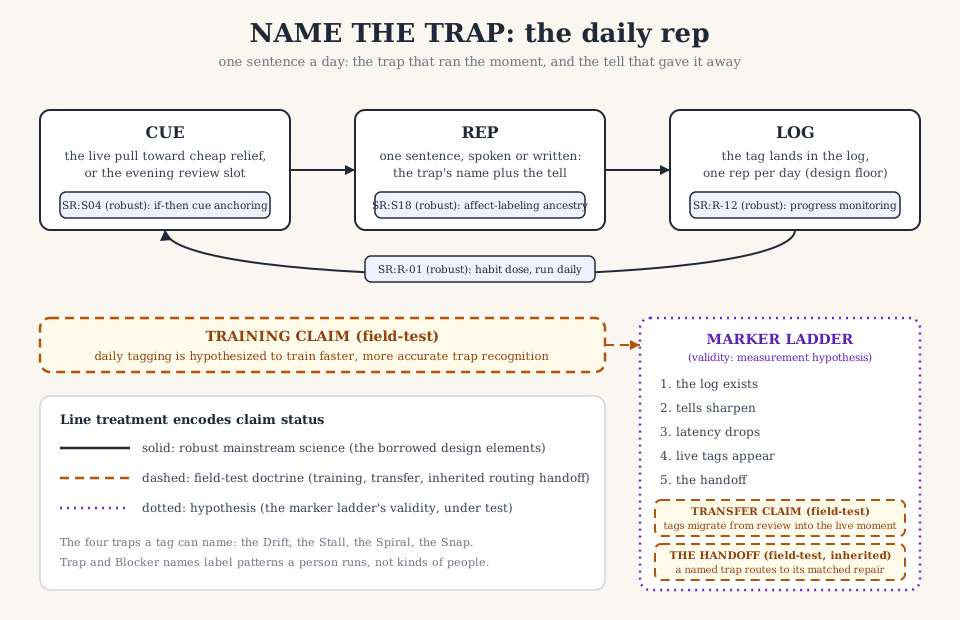
The rep is one sentence, spoken or written, naming the trap and the tell that identified it, once a day. It runs on two cues: the live pull toward cheap relief, and a fixed end-of-day review. The tag starts in the evening review and is trained toward the live moment. It sits in the method layer of Agency Science (the part of the doctrine that catalogs trainable procedures) as the entry drill for trap recognition. It is the smallest rep in the doctrine's routing work: the Four Traps map matches repairs to patterns, and matching starts from a named pattern. The working wager, still under test, is that the daily rep trains the recognition itself: faster, more accurate naming of the running trap with repetition.† A second claim, also under test, is transfer: tags are hypothesized to migrate from review into the live moment.†
Glossary Definition
The Name the Trap practice is a daily recognition drill in which a person tags one real lost moment per day with the trap that ran it and the tell that identified it, to train identification of the running pattern.
Formal Definition
The practice is a single-rep training loop specified by three elements and a progression. The cue is either the felt onset of an impulse toward immediate relief in a live moment, or a fixed end-of-day review slot, anchored as an if-then plan. The rep is one sentence, spoken or written, naming the trap and the tell that identified it. The trap is one of four (the Drift, the Stall, the Spiral, the Snap); the tell is drawn from the trap's signature Blockers (the recurring surface patterns each trap produces). The central claim is that repeated tagging improves the speed and accuracy of trap recognition.† The companion claim is that recognition gained in review transfers to live incidents.† The dose is one rep per day; a design floor, not a finding. Progression moves the tag's placement: after-action first, then live.
Scope note. In scope: training recognition of the four-trap typology on a person's own incidents, and the migration of that recognition from review into the live moment. Out of scope: diagnosing other people, clinical assessment, and behavior change by itself. The practice trains recognition only, and clinical severity (trauma, panic, addiction) exits the practice and is referred to a clinician. Validation status: field-test
The Practice
The cue. Two doors in. The live door is the felt pull toward cheap relief: the hand drifting to the phone, the third snooze, the sharp reply already forming. The backstop door is a fixed end-of-day review slot, two minutes with the day, anchored as an if-then plan ("when I close my laptop, I scan the day for one lost moment").
The rep. One sentence, spoken or written, naming the trap and the tell that identified it. A father clears the dinner dishes, opens his phone to check one thing, and surfaces forty minutes later (composite, illustrative). His rep for that moment: "That was the Drift. The tell: I never decided to scroll." Either form counts, said out loud or written in the log. One sentence is the whole rep, sized so it can run on a full day.
The dose. One rep per day. Week one, use the evening slot only; the job is building the habit of looking at all. From week two, keep the evening slot and start trying to tag live, while the moment is still running. The floor is the practice; a second rep on a loud day is allowed, never owed.
Scaling. On a low-capacity week, tag without classifying: "I lost that moment" is a legal rep, and the trap name returns when there is more bandwidth. For kids, run the rep out loud with a parent, in plain words for the four patterns. For a person prone to rumination, prefer the live door and hold the review rep hard to its one sentence (see When To Run It).
When To Run It
Three triggers, in the order the practice introduces them.
- The evening review (the backstop). A fixed two-minute slot at the end of the day. The practice starts here, because the doctrine sequences after-action tagging before live tagging.
- The live pull (the target). The felt reach for cheap relief, caught while it happens. This is the door the practice trains toward.
- The after-action rep. A moment already lost, tagged once the body has settled. On days the evening slot gets missed, this replaces it.
When not to run it.
- In crisis, safety first; the practice waits.
- In shutdown, numbness, or dissociation, do not run a tagging drill on the moment alone. Go to grounding and co-regulation, and bring a clinician in when these states are frequent.
- Clinical severity (trauma, panic, addiction) is not practice territory; it belongs with a clinician.
- If tagging turns into replaying the moment on a loop, drop the after-action rep, keep only the evening slot bound to its one sentence, and pause the practice and bring in support if distress rises.
Progress Markers
What to watch, in the order the doctrine expects it to appear. The markers are observation prompts; whether they move, and in this order, is part of what the field test measures.
- The log exists. Week one's only marker: a tag a day, even messy, even wrong.
- Tells sharpen. The cited tell gets specific: from "I wasted the evening" to "I never decided to scroll."
- Latency drops. The tag moves from the evening review to minutes after the moment. Tag latency is hypothesized to shorten across weeks of daily reps.†
- Live tags appear. The trap gets named while it is still running. Tags are hypothesized to migrate from after-action review into the live moment.†
- The handoff. A live tag is followed by a reach for the matched repair, the capacity the Four Traps map pairs with that trap. Naming the running trap is hypothesized to improve the odds that the next repetition is trainable, a claim inherited from the Four Traps typology and held there at field-test.†
That the five markers index real recognition gain, rather than growing fluency at writing log entries, is itself a measurement hypothesis, under test.†
Common Failure Modes
- Labeling theater. A tag a day while nothing else moves. The tag is a routing act; the countermeasure is the handoff marker: over the weeks, some live tags should be followed by an attempted matched repair, and a log with none of that is theater.
- Trap talk as identity. "I am a Staller" is not a rep. Trap and Blocker names label patterns a person runs, never kinds of people (the dignity rule; see Agency Blockers). The rep names the pattern in the moment and leaves the person out of it.
- Streak gaming. Logging to keep a chain alive turns the scoreboard into the goal. Grade a week by whether any tags were live and whether the tells got sharper. Volume alone proves nothing here.
- Brooding reps. For a person prone to rumination, the after-action rep can turn into replay. The bound is structural: one sentence, then done. When a tag will not stay one sentence, run only the evening slot; when distress rises, pause the practice and bring in support (see When To Run It).
- Vocabulary sprawl. The typology is fixed at four. Inventing a fifth trap mid-week means the rep has drifted from recognition into theorizing. When a moment fits no trap, tag it unclassified and move on.
Science Anchor
The practice is a training-loop design. Each design element rests on its own literature; the assembly, and the claims it carries, are the doctrine's own and are graded in the Claim Status box.
The naming rep. Putting an affective state into words reduces amygdala reactivity and recruits prefrontal control (SR:S18). That is affect labeling, and it is robust. The practice's application is the doctrine's own extension: from labeling the feeling to labeling the pattern. Repeated pattern-tagging is hypothesized to train faster, more accurate recognition of the running trap.†
The cue. An if-then plan that binds a response to a concrete cue raises the odds the response is executed (SR:S04). The practice borrows the form twice: the evening slot as the fixed cue, and later the live pull itself as the cue for a live tag.
The log. Monitoring progress toward a goal improves attainment, on a large meta-analytic base (SR:R-12). That finding supports keeping a log at all. It does not establish the practice's own marker-validity claim, which is graded separately in the Claim Status box.
The dose. Context-cued routines automate with repetition (SR:R-01), and formation time spans a wide range rather than a fixed number (SR:S47). The dose is based on that mechanism: a small daily rep is the practice's field-test design for making recognition routine. Whether the noticing automates as the habit literature would predict is part of the transfer claim, graded in the Claim Status box.
FAQ
Is this the same as the Observe and Name move in the P.O.W.E.R. Protocol? No. The P.O.W.E.R. Protocol runs five moves inside one hot moment, and its Observe and Name move labels the feeling. Name the Trap runs across days and labels the pattern. They are siblings in the method layer: the protocol converts one moment; the practice trains the naming across many.
What if I name the wrong trap? Wrong tags are expected in the first weeks. The rep is still complete: a tag was made, a tell was cited, and the tell can be checked later against the trap's signature Blockers. The point of the reps is accuracy over weeks, so week-one accuracy is not the bar.
Is one rep a day enough? One rep is the floor the drill is built on, chosen so the practice survives real weeks rather than collapsing after a strong start. Whether that floor is enough to move recognition is exactly what the field test measures (see Falsification & Boundary Conditions). A second rep on a loud day is allowed; the floor, never the ceiling, is the design.
Is Name the Trap established science? The parts it borrows are robust: affect labeling, if-then cue plans, progress monitoring, habit formation (see Science Anchor). The assembly is the doctrine's own. That daily tagging trains recognition is held at field-test.† That the recognition transfers to live moments is also held at field-test.† The marker ladder is a measurement hypothesis. The Claim Status box states which is which.
Claim Status
What rests on settled science, and what is the doctrine's own contribution, stated plainly so a reader never has to guess.
| Claim | Status |
|---|---|
| The component mechanisms the design borrows (affect labeling, if-then cue plans, progress monitoring, habit formation) | Robust mainstream science, at each cited source's stated SR grade (see Science Anchor) |
| Daily tagging trains faster, more accurate recognition of the running trap | Field-test doctrine (the central training claim; falsifiable, see Falsification & Boundary Conditions) |
| Recognition transfers from after-action review into the live moment | Field-test doctrine (the transfer claim; falsifiable, see Falsification & Boundary Conditions) |
| Naming the running trap improves the odds the next repetition is trainable | Field-test doctrine (inherited from the Four Traps diagnostic-naming claim; tested there and here) |
| The five progress markers index real recognition gain, in the stated order | Measurement hypothesis, under test |
† marker. Throughout this entry, a dagger (†) marks a claim graded field-test or hypothesis in the table above. Anything unmarked is either plain description or rests on the robust science cited in the Science Anchor.
Falsification & Boundary Conditions
The practice carries four graded claims: the training claim, the transfer claim, the inherited routing claim, and the marker-validity hypothesis. Here is how each could be disconfirmed.
For a given person, the practice is judged not working on observable markers. The log fills but the tells stay vague. Tags never leave the evening slot. Blind checks against the trap map keep disagreeing with the person's tags. Distress rises with the reps and does not settle.
The controlled design is a preregistered four-to-eight-week comparison. All participants are taught the four-trap typology first. They are then split into three arms: a daily-rep arm running this practice, a vocabulary-only arm taught the typology with no daily rep, and a journaling arm writing daily without the typology. Four things are measured. Tag accuracy is coded against two independent raters on the same described incidents. Tag latency is the time from incident to tag. Live-tag share is the fraction of tags made while the moment ran. Handoff rate is the fraction of live tags followed by an attempted matched repair, rater-coded.
- Disconfirmation of the training claim: if the daily-rep arm does no better than the vocabulary-only arm on tag accuracy and tag latency, teaching the typology did the work, the rep adds nothing, and the central claim fails.
- Disconfirmation of the transfer claim: if accuracy improves on the evening log while live-tag share does not move against either comparator arm, the practice built a journaling skill and the transfer claim fails.
- Disconfirmation of the inherited routing claim: if live tags are not followed by higher matched-repair attempt or success rates than untagged incidents in the same arm, naming adds no routing benefit here, and the inherited claim fails (its parent test lives at The Four Traps).
- Disconfirmation of the marker-validity hypothesis: if the markers move out of order for most participants, or move without corresponding gains in rater-coded accuracy, the ladder does not index recognition and the hypothesis fails.
Traceability matrix. The matrix is a two-way ledger. Every field-test or hypothesis row of the Claim Status box appears here, and every daggered sentence in the body or the frontmatter register fork is listed by exact quote in some row's location cell. Each row names its measure, its window, its comparison, and the result that disconfirms it.
| Claim (status) | Daggered body location(s), exact phrase | Measure | Window | Comparison | Disconfirming result |
|---|---|---|---|---|---|
| Training claim: daily tagging trains faster, more accurate recognition of the running trap (field-test) | In Brief: "The working wager, still under test, is that the daily rep trains the recognition itself: faster, more accurate naming of the running trap with repetition.†" · Formal Definition: "The central claim is that repeated tagging improves the speed and accuracy of trap recognition.†" · Progress Markers: "Tag latency is hypothesized to shorten across weeks of daily reps.†" · Science Anchor (the naming rep): "Repeated pattern-tagging is hypothesized to train faster, more accurate recognition of the running trap.†" · FAQ: "That daily tagging trains recognition is held at field-test.†" · frontmatter registers.radical_agency: "The wager, still under test, is that the naming trains the seeing.†" | Rater-coded tag accuracy and tag latency | The preregistered four-to-eight-week window | The vocabulary-only arm (typology taught, no daily rep) | No improvement in accuracy or latency over the vocabulary-only arm |
| Transfer claim: recognition moves from after-action review into the live moment (field-test) | In Brief: "A second claim, also under test, is transfer: tags are hypothesized to migrate from review into the live moment.†" · Formal Definition: "The companion claim is that recognition gained in review transfers to live incidents.†" · Progress Markers: "Tags are hypothesized to migrate from after-action review into the live moment.†" · FAQ: "That the recognition transfers to live moments is also held at field-test.†" | Live-tag share | The preregistered four-to-eight-week window | Both comparator arms | Log accuracy improves while live-tag share does not move against either arm |
| Inherited routing claim: naming the running trap improves the odds the next repetition is trainable (field-test, inherited) | Progress Markers: "Naming the running trap is hypothesized to improve the odds that the next repetition is trainable, a claim inherited from the Four Traps typology and held there at field-test.†" | Matched-repair attempt and success rates after live tags, rater-coded | Per incident, across the preregistered window | Untagged incidents in the same arm | Live tags are not followed by higher matched-repair attempt or success rates |
| Marker-validity hypothesis: the five markers index real recognition gain, in the stated order (hypothesis) | Progress Markers: "That the five markers index real recognition gain, rather than growing fluency at writing log entries, is itself a measurement hypothesis, under test.†" | Marker order and marker movement against rater-coded accuracy as the criterion | The preregistered four-to-eight-week window | Rater-coded accuracy as the criterion measure | Markers move out of order for most participants, or move without corresponding accuracy gains |
Boundary conditions. The practice inherits the typology it names. If the Four Traps structure claim fails at its own tile, this practice trains a vocabulary without a validated referent map, and its accuracy measure loses its criterion. The practice trains recognition only; the doctrine does not claim that recognition alone changes downstream behavior. For rumination-prone users the after-action rep is bounded or dropped, and shutdown states are routed to co-regulation, never to the drill (see When To Run It).
Quick Reference
- The rep in one line: Name one lost moment's trap and the tell that gave it away, once a day.
- Cue / Rep / Dose: The cue is the live pull or the evening review slot. The rep is one sentence, spoken or written, naming the trap and the tell that identified it. The dose is one rep per day.
- Trains: Self Awareness. The capacity the practice targets: identification of the running pattern, the awareness gate of the Four Traps map.
- Object type / Layer: practice / Class 5. The method layer's entry drill for trap recognition.
- Feeds: The Four Traps. The routing map that pairs each named trap with a candidate repair capacity.
- Often confused with: POWER Protocol. The protocol converts one hot moment with five moves; this practice trains pattern-naming across days.
Relations
- trains:: Self Awareness (TBD). The capacity the practice targets: identification of the running pattern.
- drills:: The Four Traps (TBD). The routing map whose diagnostic naming move the reps rehearse.
- intervenes_on:: Autopilot Capture (TBD). The condition the practice is aimed at: automatic behavior running unobserved.
- related:: POWER Protocol (TBD). The in-the-moment sibling; its Observe and Name move labels the feeling inside one run.
- related:: Agency Blockers (TBD). The tell catalog a tag cites.
- related:: Affect Labeling (TBD). The mechanism ancestry of the naming rep.
Related concepts (Core): The Four Traps, Agency Blockers, Self Awareness, Autopilot Capture, POWER Protocol, Affect Labeling
Aliases & Registers
| alias | register | status |
|---|---|---|
| Name the Trap | public | proposed |
Provenance & Ancestry
The practice is author-coined as a daily recognition drill built on the Four Traps typology. Each borrowed design element is credited to its own literature: the naming rep to affect labeling (Lieberman lineage), the cue anchoring to implementation intentions (Gollwitzer), the log to progress monitoring (Harkin and colleagues), and the daily dose to habit formation (Wood and Neal; Lally). The contribution is the assembly: one bounded rep per day aimed at pattern recognition rather than affect labeling alone, feeding the doctrine's routing layer.
Sources
- SR:S18 Lieberman, affect labeling; robust (replicated, Burklund 2015). Anchors the naming rep's ancestry; the pattern-tagging extension is the doctrine's own and is graded, never cited to this source.
- SR:S04 Implementation intentions (Gollwitzer); robust. Anchors the if-then anchoring of the evening slot and the live-pull cue.
- SR:R-12 Harkin et al. 2016, progress-monitoring meta; robust; monitoring goal progress improves attainment (supports keeping a log at all, never the tile's own marker-validity claim).
- SR:R-01 Wood & Neal 2007 / Wood & Rünger 2016, habit mechanism; robust. Anchors the daily-dose design.
- SR:S47 Habit formation (Lally / Wood); robust; formation time presented as a range (median 66 days, 18 to 254), never a fixed number.
Version History
| version | date | change | by |
|---|---|---|---|
| 1.1 | 2026-07-03 | Law 13.1a conformance fix caught by the RA-face preview renderer: registers.institute.in_brief_opener was not verbatim from the body In Brief (markup dropped). Frontmatter-only; body untouched. Re-linted PASS (--strict, zero warnings). | claude-code claude-code-golden-standard-fable-reaudit-20260702-c |
| 1.0 | 2026-07-01 | First release of the gold exemplar for tile_type=practice, built to the Universal Golden Tile Build Law v1.2 and the practice Build Spec v1.0. Register fork carried in frontmatter (Institute and Radical Agency In Brief openers) per the one-canonical-tile, two-rendered-registers ruling; the canonical body In Brief stays Institute construct-first; the radical_agency opener's graded clause is daggered and listed in the traceability matrix. By type design the practice spine carries no Overview and no Lived Experience; The Practice and When To Run It carry the lived register. Figure package co-located at _diagrams/name-the-trap/ (SVG plus manifest). Dual-audit convergence pass applied. | claude-code claude-code-golden-tile-consolidation-20260701-sub-practice |